














Portable Travel Changing Mats: How to Choose and Use One Safely
Learn how to choose, pack and clean a portable baby changing mat, with safe changing steps and guidance from Australia, the UK, the US and Canada.
On this page
- What a portable changing mat does
- Choose a mat that fits your routine
- Compare common changing options
- Use the mat safely, step by step
- One-hand folding and fasteners
- Built-in head cushions and raised areas
- Wipe pockets and packing supplies
- Cleaning and care
- How needs change as your baby grows
- Standards, recalls, and country guidance
- Common mistakes to avoid
- Frequently asked questions
- Sources
- Sources
Short answer: A portable changing mat gives you a clean surface for a nappy change away from home. Choose one that opens flat, stays in place on a firm surface, and is easy to clean. Keep one hand on your baby whenever they are on a raised surface. A mat is not a restraint, change table, or safe place to leave a baby alone. Use a flat floor when you can.
Names such as “one-hand fold”, “head cushion” and “wipe pocket” describe features. They do not prove that a mat is safer. Check how the mat works, how it washes, and whether it fits your daily needs. Babies can move suddenly, even when they are very young.
What a portable changing mat does
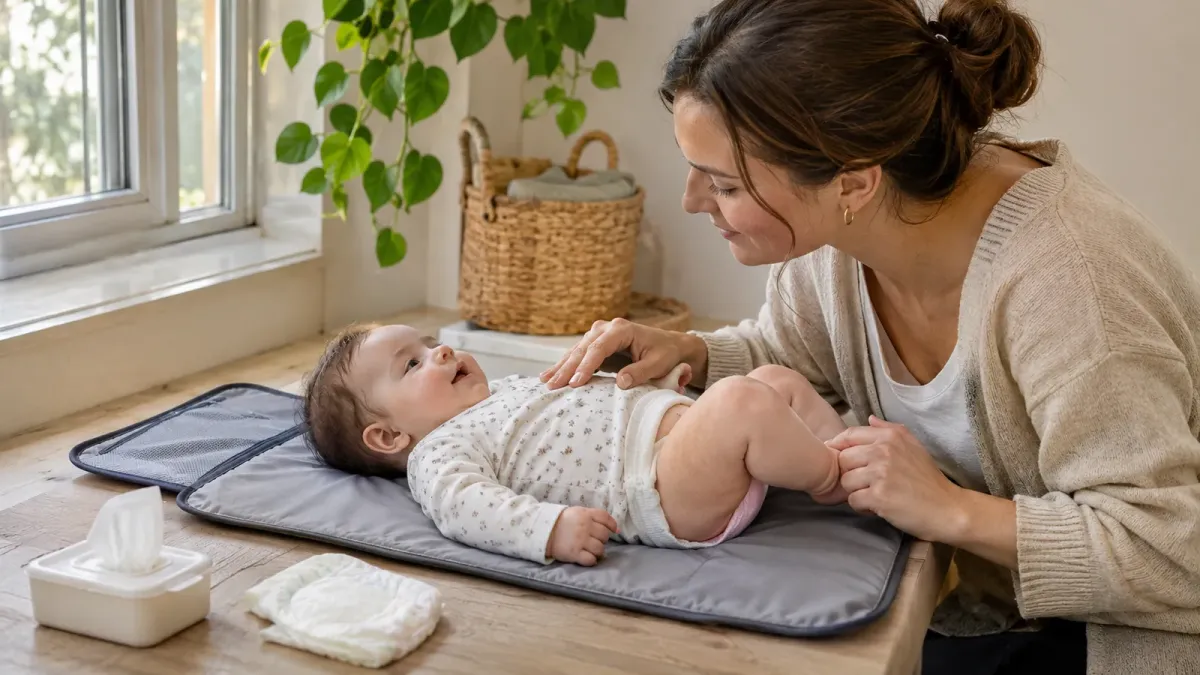
A portable changing mat is a small, foldable or roll-up layer. You place it on a suitable surface before changing your baby's nappy. It helps keep the baby separate from that surface. It can also catch small spills during the change.
Most mats do not have sides, straps, or a firm base. Even if a mat has a raised pad, that does not make it a safe barrier. A baby may roll or wriggle off it. Never leave a baby unattended on a bed, bench, table, or other raised place.
A mat can be useful at home, in a car boot, at a relative's home, or in a public change area. It can make a surface easier to wipe after use. It cannot make a dirty or unsafe surface suitable. Check the place first. If it is unstable, dirty, wet, or near an edge, choose another spot.
Choose a mat that fits your routine
Start with where you expect to change nappies. A small mat may fit a handbag. A larger one may give more room for a growing baby. Check the open size against your changing space. The baby should fit on the mat without their head or feet hanging over its edges.
Look for simple care instructions. Some mats have a wipe-clean surface. Others have fabric that can go in a washing machine. Read the label before buying. A cover that cannot be removed may take longer to clean after a leak or poo.
Check the folds and fasteners. The mat should open without a struggle and stay open while you use it. A Velcro tab can hold a mat closed for storage. It is not a baby restraint. Keep the tab away from the baby's skin, hair, and clothing during a change.
Look at the seams, edges, and surface. Avoid a mat with loose threads, peeling layers, sharp parts, or a strong smell that does not fade after airing. Stop using it if it splits, cracks, or becomes hard to clean. Follow the maker's directions for washing and drying.
Features that may help
- Fold or roll: Choose the style you can pack and open with ease.
- Wipe-clean surface: This can make a quick clean easier between washes.
- Machine-washable fabric: This may help after larger messes. Check the care label.
- Carry handle or fastening: This can keep the mat folded in a bag.
- Wipe pocket: This may keep wipes close. Check that the packet fits and closes.
- Small raised head pad: Treat it as padding only. It does not stop a fall.
Features add bulk and seams. More parts can mean more places for dirt to collect. Choose features you will use. A plain mat that is easy to clean may suit you better than a larger organiser.
Compare common changing options
There is no single best choice for every family. The right option depends on your space, the baby's age, and how you travel. Keep the baby's safety needs in mind with each one.
| Option | Useful for | Things to check | Safety reminder |
|---|---|---|---|
| Portable fold-up mat | Short trips and shared change spaces | Open size, cleaning, folds, and carry size | Use on a stable surface. Stay beside your baby. |
| Portable roll-up mat | Keeping a mat packed in a bag or car | Whether it rolls tightly and opens flat | Unroll it fully before placing your baby down. |
| Wipe-clean changing pad at home | Regular changes in one room | Fit on the furniture and ease of cleaning | Follow the furniture maker's directions. Never leave baby alone. |
| Washable fabric mat | Families who prefer a soft surface | Wash temperature, drying time, and spare cover | Keep it clean and dry. Do not use it as bedding. |
| Disposable changing liner | One-off use or extra spill protection | How it stays in place and how to discard it | Keep loose liners away from baby's face. |
| Public change table | Purpose-built change areas | Cleanliness, stability, and any posted instructions | Keep a hand on baby. A strap does not replace supervision. |
A mat may fit over a public change table, but it does not repair a loose or damaged table. If the table rocks or feels unsafe, do not use it. Ask staff for another option or change the baby on a clean, flat floor area.
Use the mat safely, step by step
- Get what you need first. Put a clean nappy, wipes, and a bag for waste within reach. Keep them away from the baby's mouth.
- Choose a safe place. A flat floor is often the safest option. If you use a raised surface, make sure it is stable and follow its instructions.
- Open the mat fully. Check that it lies flat. Look for dirt, damage, or damp patches.
- Place the baby down gently. Keep the baby's head and body on the mat. Do not leave them near an edge.
- Keep a hand on the baby. Use one hand to steady them when reaching for a nappy or cloth. Do not turn away.
- Change and clean. Clean the baby from front to back where relevant. Use products suitable for your baby.
- Dress the baby before packing. Put the used nappy and wipes out of reach. Wash your hands when you can.
- Clean the mat. Follow its care label. Let it dry fully before folding or rolling it away.
If you forget something, take the baby with you. Do not leave them alone on a raised surface while you fetch it. If another adult is present, ask them to hand it over.
One-hand folding and fasteners
A “one-hand fold” can be handy when you are carrying a bag. It should describe packing the mat, not holding or changing the baby with one hand. A baby still needs close attention during the change.
Practise opening and closing the mat before a trip. Do this while the baby is safely elsewhere. Check that the fastener holds the folded mat without pulling at the fabric. Keep hook-and-loop tabs clean. Lint can stop them closing well.
Do not use a fastener to wrap the mat around a baby. Do not attach the mat to a pram, cot, or car seat unless its maker gives clear instructions for that use. A changing mat is not designed to secure a child during travel or sleep.
Built-in head cushions and raised areas
Some mats include a small cushioned area near the head. This may feel softer than the rest of the mat. It does not keep a baby still or stop them rolling. Do not treat it as a pillow for sleep.
Keep a baby's nose and mouth clear during every change. Watch for signs that the baby is too warm or uncomfortable. If the cushion is damaged, has a loose cover, or cannot be cleaned, stop using the mat.
Never put a baby to sleep on a changing mat. For sleep, use a cot or other sleep space that meets local guidance. Keep soft items and loose bedding out of the sleep space. A padded changing mat is for supervised changes only.
Wipe pockets and packing supplies
A pocket can help keep wipes close. Check the pocket size before relying on it. Some wipe packets are larger than others. A packet that sticks out may fall, open, or get wet.
Keep medicines, creams, nappy sacks, and small items in a closed part of the bag. They should not be within the baby's reach. A baby can grab and mouth objects quickly. Store used nappies in a closed bag, away from children and pets.
Do not leave a wipe packet or plastic bag near the baby's face. Keep packaging out of reach. If the pocket gets wet or dirty, empty it and clean it before packing fresh supplies.
Cleaning and care
Clean the mat after each use when it has visible dirt or bodily fluids. Follow the product label. Different materials need different care. Do not mix cleaning products. Keep them away from the baby.
For a wipe-clean mat, use a cloth and the cleaner allowed by the maker. Wipe both sides if they became soiled. Let the surface dry before folding it. Moisture trapped in a fold can cause odour or damage.
For a washable mat, check whether it can go in a washing machine. Use the stated temperature and drying method. A fabric mat may need a waterproof liner beneath it. Do not use a mat that is still damp.
Check the mat from time to time. Look for cracks, torn seams, flaking coatings, and loose fasteners. Replace it if it no longer lies flat or cannot be cleaned well. Do not repair a damaged mat with tape where the baby may touch it.
How needs change as your baby grows
Age alone does not tell you whether a mat is large enough. Babies grow at different rates. Check the product's stated size and weight guidance. Stop using it when the baby is too large for the surface or can move beyond its edges.
| Stage | What may change | What to do |
|---|---|---|
| Newborn | The baby may need frequent changes and gentle handling. | Use a flat, clean surface. Keep supplies ready and support the baby. |
| Early infancy | The baby may begin to kick, stretch, and turn. | Keep one hand on the baby, especially on raised surfaces. |
| Rolling stage | The baby may roll with little warning. | Prefer the floor. Keep the change quick and stay close. |
| Older baby or toddler | The child may sit up, crawl, or resist lying down. | Use a safe floor space and involve them with a clean nappy or cloth. |
These stages are broad guides, not deadlines. Follow your child's movement and the product's instructions. If your baby has a health need that affects movement or skin, ask a health professional for advice.
Standards, recalls, and country guidance
A portable changing mat is not automatically covered by the same rules as a change table. A safety mark or broad claim on a label does not prove that a mat suits your needs. Look for clear maker details, care directions, and a way to contact the seller.
In Australia, Product Safety Australia provides guidance on change tables and product recalls. In the UK, the Office for Product Safety and Standards handles product safety work. In the US, the Consumer Product Safety Commission provides product safety information. In Canada, Health Canada publishes recalls and safety alerts. Check these official sources if a product is recalled or has a safety concern.
For safe use, Australia's Product Safety Australia, the UK's NHS and RoSPA, the US Consumer Product Safety Commission and American Academy of Pediatrics, and Canada's Health Canada and Canadian Paediatric Society offer child safety information. Their advice supports close supervision and safe changing. A portable mat does not replace that care.
| Country | Official bodies to check | Useful action |
|---|---|---|
| Australia | Product Safety Australia and ACCC | Read change table guidance and search product recalls. |
| United Kingdom | Office for Product Safety and Standards, NHS, and RoSPA | Check product safety notices and local child safety guidance. |
| United States | Consumer Product Safety Commission and American Academy of Pediatrics | Check recalls and follow safe changing advice. |
| Canada | Health Canada and the Canadian Paediatric Society | Search recalls and use child safety guidance. |
Rules and product requirements can change. Check the current advice in the country where you live. If a seller makes a specific safety claim, ask for evidence that applies to that exact product.
Common mistakes to avoid
- Leaving the baby alone: A quick turn can be enough for a baby to move. Keep a hand on them.
- Using a bed as a change table: Beds are soft and raised. Choose the floor when possible.
- Trusting a cushion to prevent rolling: Padding is not a barrier. Stay close and supervise.
- Changing on an unstable surface: Do not use a rocking table or narrow bench.
- Packing a damp mat: Dry it first. Damp folds can smell and may damage the surface.
- Assuming “one hand” means hands-free: It describes a fold feature. It does not keep a baby safe.
- Ignoring damage: Cracks and loose seams can trap dirt or expose inner material.
- Using the mat for sleep: It is for awake, supervised nappy changes only.
- Keeping supplies within reach: Small objects and plastic packaging can be unsafe for babies.
Frequently asked questions
Can I change my baby on a portable mat on the floor?
Yes, if the floor is clean, flat, and clear of hazards. Stay with your baby throughout the change. A floor change avoids the risk of a fall from a raised surface. Keep pets and other children from crowding the space.
Can I leave my baby on the mat while I get a nappy?
No. Take your baby with you or ask another adult to stay beside them. A baby can move suddenly. This applies even when the mat is on the floor, since a baby could reach objects or roll into a hazard.
Is a built-in head cushion safe for sleep?
No. A changing mat is not a sleep surface. Do not let a baby sleep on it, even for a short nap. Move a sleeping baby to a suitable cot or sleep space, following local safe sleep advice.
Does a wipe pocket make changing safer?
It can keep supplies close, but it does not make the change safe by itself. Keep items away from the baby's face and hands. Stay beside the baby and keep one hand on them when they are raised.
How often should I wash a changing mat?
Clean it after each use when it is soiled. Follow the label for routine washing. Let it dry fully before packing. If the surface is cracked or cannot be cleaned, replace it.
Can I use a portable mat on a public change table?
You can place it on a stable, clean table if it lies flat. Check the table first. Do not use it if it rocks or looks damaged. Keep a hand on your baby and follow any posted instructions.
Are roll-up mats better than fold-up mats?
Neither type is always better. A roll-up mat may pack neatly. A fold-up mat may open quickly. Choose the one that fits your bag, opens flat, and is easy to clean. Both need close supervision during use.
Can a changing mat be used in a car?
Use it only when the car is parked in a safe place. Never change a baby in a moving vehicle. Do not place a mat in a car seat or use it to alter the seat.
What should I do if the mat smells strongly?
Follow the maker's airing and cleaning advice. Do not use it if the smell remains strong or causes concern. Contact the seller or maker for product information. Choose another clean surface in the meantime.
Sources
- Product Safety Australia – Change tables guide
- Product Safety Australia – Recalls
- UK Office for Product Safety and Standards
- NHS – Baby and toddler safety
- U.S. Consumer Product Safety Commission – Safe sleep: cribs and infant products
- American Academy of Pediatrics – Choking prevention
- Health Canada – Recalls and safety alerts
- Canadian Paediatric Society – Water safety
Disclaimer: This article offers general information, not medical advice. Follow the product instructions and current guidance where you live. Ask a health professional if you have concerns about your baby's health or care.
Affiliate disclosure: BabyGearFinder may earn a commission if you buy through some links. This does not change the price you pay. We only include products that fit the article's topic.
Sources
- Product Safety Australia – Change tables guide
- Product Safety Australia – Recalls
- UK Office for Product Safety and Standards
- NHS – Baby and toddler safety
- CPSC (US) – Safe sleep: cribs and infant products
- American Academy of Pediatrics (US) – Choking prevention
- Health Canada – Recalls and safety alerts
- Caring for Kids (Canadian Paediatric Society) – Water safety
Related guides
More Car Seats & Travel →
Infant Travel Cribs and Portacots: How to Choose and Use One Safely

How to Choose a Safe Travel Crib or Portable Cot for Your Baby
Travel Cots and Portable Cribs: How to Choose a Safe Folding Cot for Every Trip and Budget
