













Baby Sleeping Bags (Sleep Sacks): 5 Reasons to Use One and How to Choose Safely
Why a baby sleeping bag (sleep sack) helps keep bedding off your baby's face, how to pick the right size and TOG, and what safe-sleep bodies advise.

On this page
- What a baby sleeping bag is (and what it isn't)
- Five reasons parents choose a sleeping bag
- How to choose a safe sleeping bag
- Sleeping bag types compared
- Choosing the right warmth (TOG) and what to wear underneath
- Safe-sleep guidance in Australia, the UK, the US and Canada
- Age stages: newborn to toddler
- Common mistakes to avoid
- Buying second-hand, washing and care
- FAQ
- Sources
Short answer: a baby sleeping bag (also called a sleep sack or wearable blanket) is a safe, practical alternative to loose blankets for most babies. Safe-sleep bodies in Australia, the UK, the US and Canada all agree that the biggest sleep risks come from soft or loose bedding near a baby's face and from overheating. A well-fitted, hoodless, arms-free sleeping bag in the right weight for the room deals with both. It doesn't replace the basics, though: always put your baby on their back, in their own cot with a firm, flat mattress and nothing else in it.
Key points
- Why use one: it can't be kicked up over the face, it keeps a baby at a steady warmth, and it helps keep them on their back.
- Fit: fitted neck and armholes so your baby can't slip down inside; the right size for their weight and length.
- No hood, no weights, no wrap inside. Red Nose specifically warns against hooded and weighted bags and against wrapping a baby inside a sleeping bag.
- Warmth: choose the TOG (thermal rating) for the room, dress your baby lightly underneath, and check their chest or back, not their hands.
- Arms out once your baby shows signs of rolling, and never add a blanket on top.
What a baby sleeping bag is (and what it isn't)
A baby sleeping bag is a garment-shaped bag that zips or snaps closed around your baby's body. It has a fitted neck and either armholes or sleeves, and a roomy bottom so the legs can move freely and the hips can rest bent up and out. It takes the place of a top sheet and blanket: your baby wears their bedding, so there's nothing loose in the cot to cover their face.
It is worth separating sleeping bags from three products that look similar but work differently:
- Wraps and swaddles hold the arms in. They're for young babies who haven't started to roll, and they must stop at the first signs of rolling. Red Nose says wrapping should stop as soon as a baby shows signs of starting to roll, which is often from around 12 weeks.
- Swaddle bags or "transition" bags sit between the two: some have zip-off or snap-off sleeves so you can go from arms-in to arms-out. Once the arms are out they're used like an ordinary sleeping bag.
- Weighted sleep sacks and weighted swaddles have beads or pads sewn in to press down on the baby. Red Nose says to avoid weighted sleeping bags. The American Academy of Pediatrics (AAP) advises against weighted sleep products. A US Consumer Product Safety Commission (CPSC) commissioner has publicly warned that weighted infant swaddles and sleep sacks are unsafe for sleep. These are not the same thing as a standard sleeping bag, whatever the marketing says.
A sleeping bag is also not a sleeping place. It goes inside a safe cot, bassinet or portable cot. It doesn't make a couch, adult bed, pram or car seat safe for sleep.
Five reasons parents choose a sleeping bag
1. It keeps bedding away from your baby's face
All four countries' safe-sleep advice is built on the same idea: keep the cot clear. The Lullaby Trust in the UK calls it "keeping a clear cot". The AAP and the US Safe to Sleep campaign say a bare sleep space has no soft objects or loose bedding. Health Canada says the cot should hold only the mattress and fitted sheet. Red Nose in Australia recommends a safe cot and mattress with no pillows, doonas, bumpers or soft toys. A loose blanket can be kicked up over a baby's head or bunched around their face. A sleeping bag that fits can't, because it's attached to the baby.
2. It keeps temperature steady through the night
Babies who get too hot are at higher risk, and babies wriggle off blankets and then get cold and wake. A bag stays put. The Lullaby Trust suggests a room between 16 and 20°C is comfortable for a sleeping baby. Red Nose doesn't name a room temperature. It says to dress for the conditions and check that your baby's chest or back feels warm, not hot or sweaty. Either way, a bag gives you one predictable layer you can adjust by changing the TOG and what goes underneath.
3. It helps your baby stay on their back with feet near the foot of the cot
The single most important safe-sleep step is putting your baby on their back for every sleep, day and night. A bag doesn't stop a baby who can roll from rolling, and you shouldn't try to stop that. It does keep a young baby's legs in a set space. They can't wriggle down under bedding as easily as they can under a loose blanket. If you use a blanket instead, the advice is "feet to foot": baby's feet at the bottom of the cot, blanket tucked firmly at chest height.
4. It's a simple, consistent sleep cue
Most sleep-settling advice, from child health nurses to parenting services, suggests a short, predictable bedtime routine. Zipping up the same sleeping bag every night becomes part of that routine. It travels with you. The same bag in a portable cot at Grandma's house is a familiar cue in an unfamiliar room. This is a convenience benefit, not a safety claim, but it's one many families value.
5. It's easier for night feeds and nappy changes
Many bags have a two-way zip so you can open the bottom for a nappy change without taking your baby fully out. There's no tucking and re-tucking blankets at 3 am, and less chance of leaving a half-tucked blanket in the cot when you put your baby back down.
How to choose a safe sleeping bag
Red Nose's guidance on choosing a sleeping bag is the most detailed of the four countries' advice, and it lines up with the UK, US and Canadian recommendations. Use this as your checklist when buying new or second-hand:
- Fitted neck and armholes (or sleeves). The neck opening should be snug enough that your baby's head can't slip down inside the bag. Armholes should be fitted too, so an arm can't be pulled in and the bag ride up over the face.
- No hood. Hoods can cover the face and cause overheating, because babies lose heat through the head and face.
- Right size. Bags are sized by age, weight or length. Health Canada points out that a sack that's too large can let a baby slip down inside, and one that's too tight can restrict hip and leg movement. Check the label against your baby's actual weight and length, not just their age.
- Room for the hips. The bottom should be roomy enough for the legs to bend up and out at the hips. Tight legs can strain developing hip joints.
- Secure zips and fastenings. Look for a zip guard at the top so the zip pull can't rub the chin, and check there are no buttons, bows, beads or appliqués that could come loose and become a choking hazard.
- Lightweight, breathable fabric. Red Nose suggests natural fibres such as cotton or bamboo to reduce the risk of overheating.
- Clear labelling. A good label tells you the size range, the TOG or warmth guide, care instructions and flammability information.
- Not weighted. Avoid anything sold as weighted or "gently weighted", and avoid bags that restrict arm movement once your baby is rolling.
Sleeping bag types compared
| Type | Arms | Typical age | Use it when | Watch out for |
|---|---|---|---|---|
| Wrap or swaddle (cotton or muslin) | In (or one/both out) | Newborn to first signs of rolling | Your baby settles better wrapped and isn't rolling yet | Must stop at first signs of rolling; never above the shoulders; loose at the hips |
| Swaddle bag with zip-off sleeves | In, then out | Newborn to a few months | You want a gradual change from arms-in to arms-out | Once rolling, the arms must be out every sleep |
| Sleeveless sleeping bag | Out | From birth (Red Nose) to toddler | Everyday sleep, especially in warm weather | Neck and armholes must fit; no hood |
| Sleeved sleeping bag | Out, in sleeves | Older babies and toddlers | Cooler nights instead of extra layers | Easy to overheat; reduce layers underneath |
| Walking or "feet-out" bag | Out | Toddlers who stand and walk | Your toddler climbs out of a bag or stands in the cot | Still needs a fitted neck; not for young babies |
| Weighted sleep sack | Varies | Not recommended | Don't use | Advised against by Red Nose and the AAP; warned against at the CPSC |
Choosing the right warmth (TOG) and what to wear underneath
TOG stands for thermal overall grade. It's a measure of how well a fabric holds in heat: the higher the number, the warmer. Many brands publish a chart showing which TOG suits which room temperature, but there's no single standard that every brand follows. Red Nose notes that Australia has no specific safety standard for sleeping bag TOG ratings, so treat brand charts as a starting point and check your baby.
As a general guide (always check the maker's chart for your specific bag):
| Room feels | Typical bag | What goes underneath |
|---|---|---|
| Hot (summer, no air conditioning) | Lightest bag available, or no bag and just a light cotton layer | Nappy and singlet, or nappy only |
| Warm | Light bag (about 0.5–1 TOG) | Short-sleeved bodysuit |
| Mild | Medium bag (about 1–2 TOG) | Long-sleeved bodysuit or light sleepsuit |
| Cool | Warmer bag (about 2–2.5 TOG) | Long-sleeved sleepsuit |
| Cold | Warm bag (about 2.5–3.5 TOG) | Long-sleeved sleepsuit, possibly a singlet too |
How to check if your baby is the right temperature:
- Feel the chest, back or tummy. It should feel warm, not hot, sweaty or cold. Hands and feet often feel cool even when a baby is warm enough, so they're not a good guide.
- Signs of overheating include sweating, damp hair, flushed cheeks, a heat rash and fast breathing. Take off a layer or swap to a lighter bag.
- Don't use a hat or beanie for indoor sleep. The NHS and Lullaby Trust both say babies should sleep with their head uncovered.
- If your baby is unwell with a fever, dress them more lightly, not more warmly. Bundling a feverish baby can make them overheat. Get medical advice if you're worried.
Safe-sleep guidance in Australia, the UK, the US and Canada
The core advice is the same across all four countries. The wording and the extra detail differ a little.
| Country | Lead bodies | What they say that's relevant to sleeping bags |
|---|---|---|
| Australia | Red Nose; Raising Children Network; Product Safety Australia (ACCC) | Back to sleep, face and head uncovered, safe cot and mattress, smoke- and vape-free. A safe sleeping bag with fitted neck and armholes and no hood is recommended; weighted bags and wrapping inside a bag are not. Cots must meet the mandatory standard based on AS/NZS 2172. |
| United Kingdom | NHS; The Lullaby Trust | Back to sleep in a clear, flat, separate sleep space; feet to foot if using blankets; room around 16–20°C; well-fitting baby sleeping bags are a suitable option; no hats indoors. |
| United States | AAP; NICHD Safe to Sleep; CPSC | Back to sleep on a firm, flat surface with no soft bedding; wearable blankets are an option; avoid weighted sleep sacks, swaddles and blankets; stop swaddling once a baby shows signs of trying to roll. |
| Canada | Health Canada; Public Health Agency of Canada; Canadian Paediatric Society | Crib, cradle or bassinet meeting Canadian regulations, empty except for a fitted sheet; many parents use sleep sacks instead of blankets; the sack must be the right size; room-share for the first six months. |
There is no single international standard for sleeping bags themselves. In Europe there is a specific standard for children's sleep bags (EN 16781), and some brands sold in Australia, the UK and elsewhere test to it; you'll see it mentioned on some labels. If a brand says its bag meets a standard, it should name the standard. Treat vague claims such as "safety tested" or "hospital approved" with caution unless they come with specifics.
Age stages: newborn to toddler
Newborn to first signs of rolling
Red Nose says sleeping bags can be used from birth, provided the bag is the right size with a fitted neck and armholes. Many parents start with a wrap or swaddle because newborns have a strong startle (Moro) reflex, and move to a bag later. Either is fine as long as it's used safely. Don't put a wrapped baby into a sleeping bag: the extra layer can cause overheating, and Red Nose specifically advises against it.
From rolling (often around 3–6 months)
Once your baby shows signs of rolling, wrapping stops and the arms must be free so your baby can push up and move their head if they roll onto their tummy. This is when a sleeveless or sleeved bag with arms out becomes the main option. Keep putting your baby down on their back. If they roll onto their tummy by themselves and can roll back, Red Nose and the AAP both say you can let them find their own position.
6 to 12 months
Babies grow quickly in this stage. Check the fit every few weeks: the neck shouldn't be loose enough to slip over the chin, and the length should still leave room for the legs to kick. Many families move up a size around now.
Toddlers (12 months and over)
Toddlers can keep using sleeping bags, and many parents find a bag discourages climbing out of the cot. "Walking" bags with foot openings suit toddlers who stand. When your child moves to a bed, a bag can still be used, or you can move to a light blanket. Red Nose's safe-sleep guidance continues to apply in the second year, with less risk of SUDI but plenty of attention to cot safety and falls.
Common mistakes to avoid
- Buying too big "to grow into". A loose neck lets a baby slip down inside the bag with their face covered. Buy the size that fits now.
- Adding a blanket on top. If your baby feels cold, choose a warmer bag or add a layer underneath. A blanket on top defeats the purpose.
- Using a hooded bag. Hoods can cover the face and trap heat.
- Wrapping a baby inside a sleeping bag. Red Nose warns this can cause overheating.
- Using a weighted sleep sack or swaddle. These are not recommended by Red Nose or the AAP, and a CPSC commissioner has warned they are unsafe for sleep.
- Too many layers. A warm bag plus a fleece onesie plus a heater is a common recipe for overheating.
- Thinking the bag makes other places safe. A baby in a sleeping bag still needs their own safe cot. Sleeping bags aren't a substitute for a safe sleep surface, and they don't make bed-sharing or couch sleeping safe.
- Using it in the car seat. Standard sleeping bags shouldn't go under a car seat harness, because bulk between the baby and the harness can stop it holding firmly. Some products are designed with a harness slot; follow the car seat maker's instructions.
Buying second-hand, washing and care
Red Nose says a second-hand sleeping bag is fine in some cases. It must be in good condition and clean. It must come from a smoke- and vape-free home. It should be lightweight natural fabric and the right size, fit and TOG for your baby. Before using any bag, new or used:
- Run the zip up and down and check the stitching around the neck, armholes and zip.
- Look for pilling, holes or stuffing poking through.
- Check there's nothing sewn on that could come loose.
- Wash according to the label before first use. Many bags lose some loft and warmth after repeated washing, so don't rely on an old TOG label for a heavily used bag.
- Have at least two bags so you have one to use while the other is in the wash, especially in the nappy-leak months.
Check product safety recall lists before buying second-hand. Product Safety Australia, the UK Product Safety Database, the US CPSC and Health Canada all publish recalls. Some sleeping bags have been recalled for zip and fastening problems.
FAQ
Is a sleeping bag safer than a blanket?
Safe-sleep bodies treat a well-fitted sleeping bag as a safe option because it can't cover a baby's face the way a loose blanket can. A blanket can also be used safely if it's light, tucked in firmly at chest height with your baby's feet at the foot of the cot. What's not safe is loose, thick or doona-style bedding.
Can a newborn use a sleeping bag?
Yes, Red Nose says sleeping bags can be used from birth if the bag is the right size for your baby with a fitted neck and armholes. Many newborn-sized bags are made for smaller babies; check the weight range.
My baby's hands are cold. Should I add a layer?
Not necessarily. Hands and feet often feel cool. Check the chest or back instead. If that feels warm, your baby is fine.
What TOG should I buy?
It depends on your home and climate. Families in hot climates may only need a light bag (or no bag in the hottest weather), while families in cold homes may need a warmer one in winter. Many parents have two: a lighter one and a warmer one. Use the maker's chart, then check your baby's chest or back.
Are weighted sleep sacks safe?
No. Red Nose advises avoiding weighted sleeping bags, the AAP advises against weighted sleep products, and a US CPSC commissioner has publicly warned that weighted infant swaddles and sleep sacks are unsafe for sleep.
Can my baby sleep on their tummy in a sleeping bag once they can roll?
Always put your baby down on their back. Once they can roll both ways on their own, you don't need to turn them back over if they roll during sleep. Their arms should be out of the bag so they can lift and turn their head.
When should we stop using a sleeping bag?
There's no set age. Many toddlers use bags until they move to a bed, and some keep using them after. Stop when it no longer fits, or when your child is ready for a light blanket in a bed.
Do sleeping bags prevent SIDS?
No product prevents SIDS. Sleeping bags are one way to follow the safe-sleep advice about keeping bedding away from a baby's face and avoiding overheating. Putting your baby on their back, in their own safe cot, in a smoke-free home, and breastfeeding where possible are the steps with the strongest evidence.
Sources
- Red Nose Australia – How to choose a safe sleeping bag
- Red Nose Australia – Six safe sleep recommendations
- Red Nose Australia – When should we stop wrapping?
- The Lullaby Trust (UK) – Keeping a clear cot
- The Lullaby Trust (UK) – Room temperature
- NHS – Reduce the risk of sudden infant death syndrome (SIDS)
- AAP HealthyChildren.org – A parent's guide to safe sleep
- U.S. CPSC – Commissioner statement: weighted infant swaddles and blankets are unsafe for sleep
- NICHD Safe to Sleep campaign (US)
- Health Canada – Safe sleep tips
- Canadian Paediatric Society, Caring for Kids – Safe sleep for babies
Related guides
More Parental Tips →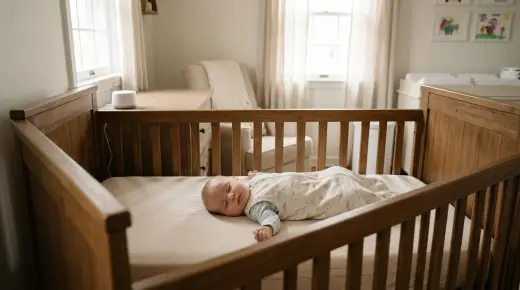
Baby Sound Soothers and White Noise: How to Use Them Safely in Your Baby's Sleep Routine

Portable Baby Sound Spa: How It Helps Sleep and How to Use It Safely

Moving Out of the Swaddle Safely: When to Stop Wrapping and How to Switch Your Rolling Baby to a Sleeping Bag
