














Play Mats Explained: XPE, EVA, TPU and PVC Foam, Chemical Concerns and How to Choose Safely
What play mats are made of (XPE, EVA, TPU, PVC), what testing shows about chemicals like formamide and phthalates, and a simple checklist for choosing a…

On this page
- What is a play mat for?
- The materials, decoded
- What does "off-gassing" mean?
- What testing and rules say
- Is a play mat "toxic"?
- How to choose a safer play mat
- Comparing the main options
- Setting up a new mat
- Using a play mat safely
- Cleaning a play mat
- Age stages
- Rules in Australia, the UK, the US and Canada
- Common mistakes to avoid
- FAQ
- Sources
Short answer: a play mat is a soft mat for floor play, tummy time and crawling. Most are made from foam (EVA or XPE), PVC, or a coated fabric, and some from TPU. Regulators in Australia, the US and Europe set limits for certain chemicals in children's products, such as formamide and phthalates, and testing by Australian regulators in 2011 found typical foam play mats did not expose children to unsafe levels of formamide. No mat is "chemical-free", and a label that says "non-toxic" isn't a guarantee. The most useful steps are to choose a mat from a maker that names its material and the standards it meets, air a new mat out, keep it clean, check it isn't damaged, and watch for small pieces that could be a choking risk.
Key points
- Common materials: EVA foam (puzzle tiles), XPE foam (fold-out mats), PVC (vinyl), TPU-coated foam and fabric mats.
- Regulators: Europe limits formamide in foam toys for under-3s; the US limits certain phthalates in children's toys; Australian testing in 2011 found no safety risk from formamide in typical foam mats.
- "Non-toxic" is a claim, not a standard. Look for the specific tests and rules a mat meets.
- Real hazards are often physical: small pieces that come loose, peeling edges, slipping and trapped fingers.
- Not for sleep. Play mats aren't safe sleep surfaces for babies.
What is a play mat for?
Play mats give babies and toddlers a soft, clean place to play on the floor. They cushion small bumps, define a play space and are easy to wipe down. Parents often use them for:
- Tummy time. Short, supervised time on the tummy while awake helps build neck and shoulder strength.
- Rolling, sitting and crawling practice.
- Play on hard floors, like tiles or timber.
- Quiet play with books and blocks.
A mat is a convenience, not a must. A clean blanket or rug on the floor works for many families.
The materials, decoded
| Material | What it is | Feel | Good points | Things to know |
|---|---|---|---|---|
| EVA foam (ethylene-vinyl acetate) | A soft, flexible foam, often sold as interlocking puzzle tiles | Soft, springy | Light, cushioned, easy to wipe, can be cut to size | Tiles can come apart, and small pieces (like edge borders or letters) can be a choking hazard; some EVA products have been recalled in Australia and Europe for physical hazards or missing warnings |
| XPE foam (cross-linked polyethylene) | A closed-cell foam, usually in thin, fold-out mats | Thin, firm, slightly slippery | Folds flat, waterproof, wipes clean, often has printed patterns | Often has a printed or laminated film layer; thinner than EVA so less cushioning |
| PVC (vinyl) | A flexible plastic, used for mats, covers and inflatable play items | Smooth, slightly sticky | Waterproof, cheap | PVC can contain plasticisers called phthalates, which regulators restrict in children's toys and child care articles |
| TPU (thermoplastic polyurethane) | A flexible, rubbery plastic, often used as a coating or film | Smooth, stretchy | Durable, waterproof, often used as a PVC alternative | Marketed as a "safer" option, but "TPU" covers many formulations; ask for test results |
| Fabric / quilted mats | Cotton or polyester with padding | Soft, cosy | Machine-washable in many cases; no hard foam edges | Padding can make cleaning harder; check for fire-safety and chemical treatments; dries slowly |
| Natural rubber or cork | Plant-based sheets or tiles | Firm | Durable, grippy | Rubber can cause allergy in latex-sensitive people; cork can chip |
| Wool or cotton rugs | Woven floor coverings | Soft | Natural fibres, breathable | Harder to wipe; keep clean |
This table describes typical materials. Each product can differ in thickness, coatings and added ingredients, so always check the maker's information for the mat you're buying.
What does "off-gassing" mean?
"Off-gassing" describes small amounts of chemicals that escape into the air from new products, such as foam, plastics, glues and paints. It's the "new product" smell. Many new items, including furniture, carpets, shower curtains and toys, can do this for a short time.
Concern about play mats comes mainly from a chemical used to make foam softer called formamide, and from plasticisers (phthalates) and other additives in some plastics. Regulators look at them in different ways:
- Smell isn't a safe test. Some chemicals have a smell but are harmless in tiny amounts, and some have none.
- Dose matters. Whether a chemical is a problem depends on how much a child is exposed to, how, and for how long.
- Babies are small. They spend a lot of time on the floor, breathe close to it, and put things in their mouths, so regulators set stricter limits for products for young children.
What testing and rules say
Formamide in foam mats
Formamide is a chemical that can be left over from making foam. In 2010 and 2011, several countries looked at it in foam puzzle mats and toys.
- Australia: in 2011, the ACCC and some state and territory agencies tested 16 EVA foam products, including play mats and toys. Half released no measurable formamide, and where it was found, amounts were very small. The agencies estimated a child would need to mouth a product for 20 minutes, or swallow at least 4.17 square metres of a typical foam play mat every day for life, to approach a level of exposure that might raise health concerns. Product Safety Australia concluded the foam play mats and toys typically available in Australia were safe for their intended purpose.
- Europe: European regulators focused on breathing in formamide. The EU now limits formamide in foam toy materials: no more than 20 micrograms per cubic metre of air after testing, for foam materials above a set content level, in toys for children under 36 months or toys meant to go in the mouth. That rule also applies in the UK as retained law.
The Australian testing is from 2011, so it's older. It looked at EVA foam, not XPE, TPU or other materials. We didn't find regulator testing aimed specifically at XPE mats.
Phthalates in plastics
Phthalates are plasticisers used to make plastics, especially PVC, soft and flexible. In the US, the Consumer Product Safety Improvement Act bans more than 0.1% of certain phthalates in children's toys and child care articles. The CPSC lists PVC as a material that should be tested for phthalates, and says foam rubber or foam plastic may also contain them. The EU has similar limits.
Many makers now advertise "phthalate-free" mats. For products sold in the US, EU or UK, the legal limit applies whether or not the product says so.
Recalls so far
Regulators' recalls of foam puzzle mats have mostly been about physical problems. Examples include small parts that could detach and cause choking, and an EVA mat in Australia recalled because it was missing a safety warning label. So when you choose a mat, the physical safety of the product matters as much as its chemistry.
Is a play mat "toxic"?
It helps to be accurate and calm about this. Here's a fair summary:
- Regulators in Australia, the EU and US have looked at certain chemicals in foam and plastic mats and set limits or concluded typical products were safe for their purpose.
- Testing of one type of mat (EVA) at one time (2011) found very low levels of one chemical (formamide).
- There's less public testing data on newer materials like XPE and TPU.
- "Non-toxic" on a label is a marketing phrase, not a legal standard, and doesn't tell you what tests were done.
- Cheap, unbranded mats from marketplaces may not meet the rules in your country, so it's worth buying from a maker or seller who gives you test details.
So you don't need to panic about a play mat. But you can make careful choices, especially for a young baby who spends lots of time on one.
How to choose a safer play mat
- Know the material. The listing should say whether it's EVA, XPE, PVC, TPU or fabric. If it just says "foam", ask.
- Look for the rules it meets. Examples include the EU toy standard EN 71 (parts 1 to 3), the US ASTM F963 toy standard and CPSC rules, or Australian/New Zealand toy standard AS/NZS ISO 8124. Reputable sellers can share test reports.
- Check for stated limits. Phrases like "meets EU formamide limits" or "phthalate-free" are more useful if backed by a test report.
- Avoid strong chemical smells. A very strong smell that doesn't fade after airing is a sign to contact the seller or return the mat.
- Choose a solid design. A fold-out mat without tiles has no small pieces. If you choose puzzle tiles, pick ones where the edge borders lock firmly and the letters or numbers aren't removable.
- Check the thickness. Very thin mats give little cushioning for babies learning to sit and fall backwards. Thicker mats give more cushion, but too thick and soft can make crawling harder.
- Check grip. A mat that slides on a smooth floor is a trip risk. Look for a non-slip underside.
- Pick easy-clean surfaces. Wipe-clean mats are good for spills and nappy leaks.
- Check size. A mat should fit your space but allow your baby to roll and crawl without reaching the edge too often.
- Check recall lists for the brand and product, including second-hand ones. See Product Safety Australia, the UK Product Safety Database, the US CPSC and Health Canada.
Comparing the main options
| EVA puzzle tiles | XPE fold-out mat | PVC mat | TPU-coated mat | Fabric play mat | |
|---|---|---|---|---|---|
| Cushioning | Good | Thin to medium | Thin | Medium | Soft but can compress |
| Cleaning | Wipe; tiles can trap dirt at joins | Wipe; easy | Wipe; easy | Wipe; easy | Machine wash if allowed |
| Small parts risk | Edges and shapes can detach | Low | Low | Low | Low |
| Chemical questions | Formamide (tested in Australia in 2011) | Printed film; limited public testing | Phthalates and additives | Depends on the formulation | Dyes, flame treatments |
| Best for | Playrooms, crawlers | Small spaces, travel | Messy play | Parents wanting a PVC alternative | Tummy time and floor play |
Setting up a new mat
- Unpack and air it out in a well-ventilated room or outside (out of direct sun) for a day or two before use. This lets any new-product smell fade.
- Wipe it down with a damp cloth and a little mild soap, then dry well.
- Keep the room ventilated, open a window when you can.
- Put it on a flat, clean floor. Don't place it on stairs or near a window with cords.
- Keep the packaging away from babies. Plastic bags and wrapping are suffocation risks.
Using a play mat safely
- Supervise. Always stay close when your baby is on a mat, especially for tummy time.
- Never use it for sleep. Red Nose and other safe sleep groups say babies should sleep on their back in a safe cot or bassinet, not on a mat, beanbag or soft surface.
- Check for chewing. Babies put everything in their mouths. If your baby bites or tears off pieces of foam, take the mat away. Foam can be a choking hazard.
- Check edges and joins each week, and throw out tiles that are cracked or crumbling.
- Keep small toys off the mat for babies under 3 if they're a choking risk, and check toys meet toy safety standards.
- Watch for trips. Curled edges can trip toddlers who are starting to walk. Press them flat or trim them if the maker allows.
- Keep it away from heaters, and don't leave it in a hot car, where heat can damage the material.
Cleaning a play mat
- Everyday: wipe with a damp cloth and a drop of mild dish soap. Rinse with a clean damp cloth and dry.
- After spills or accidents: wash straight away, as milk and nappy leaks can smell and attract germs.
- Avoid harsh chemicals: bleach, strong disinfectants and alcohol can damage some foams and leave residues. Follow the maker's care instructions.
- Puzzle tiles: take apart every so often and clean the edges where dirt collects.
- Fabric mats: machine-wash according to the label, and dry fully.
- Dry fully before folding or storing, to stop mould.
Age stages
Newborn to 3 months
Short bursts of supervised floor time and tummy time on a clean mat or blanket. A thin mat is fine at this age. Stay beside your baby and watch their face.
3 to 6 months
Rolling begins. A mat gives a clear, cushioned space. Keep it clear of toys and cords, and keep your baby in your sight.
6 to 12 months
Sitting, crawling and pulling up. Babies fall backwards when learning to sit, so some cushioning helps. Check for any loose or chewed pieces.
Toddlers
A mat defines a play area and softens falls. Toddlers may jump, run and drag things, so use mats that stay flat and don't slip.
Rules in Australia, the UK, the US and Canada
| Country | Who regulates | What applies to play mats |
|---|---|---|
| Australia | ACCC / Product Safety Australia | No mandatory standard specific to play mats; general safety rules apply. The ACCC tested foam mats in 2011 and found no safety risk from formamide. Check recalls. |
| United Kingdom | Office for Product Safety and Standards (OPSS) | Toy safety rules apply to mats sold as toys, including the formamide limit for foam toy materials |
| United States | CPSC | Limits on certain phthalates in children's toys and child care articles; toy standard ASTM F963 may apply |
| Canada | Health Canada | Toy and children's product rules apply, including limits on some chemicals; check recalls and alerts |
Whether a mat counts as a "toy", a "child care article" or a floor covering can change which rules apply. That's another reason to buy from sellers who can explain what standards the mat meets.
Common mistakes to avoid
- Trusting "non-toxic" alone. Ask for test reports or look for named standards.
- Buying very cheap, unbranded mats with no information on materials or tests.
- Not airing out a new mat.
- Leaving a baby alone on a mat or letting them sleep on it.
- Ignoring chewed or broken pieces.
- Using harsh cleaners that damage the surface.
- Placing mats on slippery floors without a non-slip layer.
- Using the mat as a cushion for dangerous play, like jumping from furniture.
FAQ
Are foam play mats safe?
Testing by Australian regulators in 2011 found typical EVA foam play mats didn't expose children to unsafe levels of formamide. Safety also depends on physical things, like small parts and chewed pieces. Choose a mat from a clear source, air it out and check it often.
What's the difference between EVA and XPE?
EVA is a softer, springier foam, often in interlocking tiles. XPE is a thinner, firmer closed-cell foam used in fold-out mats. Both are common, but we found much less public regulator testing on XPE.
Is TPU better than PVC?
TPU doesn't need the plasticisers that PVC often uses to stay flexible, so it's often marketed as a PVC alternative. But "TPU" covers different formulations, so look for test details rather than assuming.
What does "phthalate-free" mean?
It means the maker says the mat doesn't contain the phthalates regulators restrict. In places like the US and EU, the legal limit applies anyway. A test report is the best proof.
How long should I air out a new mat?
A day or two in a well-ventilated space is a common suggestion. If a strong smell remains after a week, contact the seller.
Can a play mat go in the dishwasher or washing machine?
Foam and plastic mats usually can't. Wipe them clean. Fabric mats may be machine-washable. Follow the label.
Can my baby sleep on a play mat?
No. Babies should sleep on their back in a safe cot or bassinet with a firm, flat mattress. A play mat isn't a safe sleep surface.
Sources
- Product Safety Australia – Testing of foam play mats finds no safety risk to children (2011)
- Product Safety Australia – Recall: EVA foam puzzle mat
- European Chemicals Agency (ECHA) – Toy Safety Directive: substances restricted in toys
- Commission Directive (EU) 2015/2115 (formamide in foam toy materials), as kept in UK law
- U.S. CPSC – Phthalates business guidance
- U.S. CPSC – Statement of policy: testing of component parts
- Product Safety Australia – Recalls
- Health Canada – Recalls and safety alerts
- NHS – Baby and toddler safety
Related guides
More Toys & Play →
Baby and Toddler Play Mats: How to Choose a Safe Mat for Floor Time
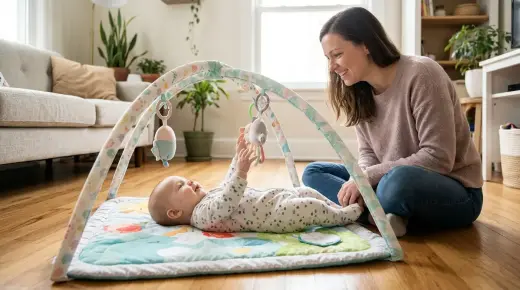
Activity Play Mats for Babies: Choosing and Using One Safely

Baby Car Mirrors and Car Cameras: How to Choose and Use Them Safely
