














Baby Car Cameras and Mirrors: Do They Help, and Are They Safe?
Baby car cameras and mirrors let you see a rear-facing baby, but they can distract you or fly loose in a crash. Plain-English safety advice for AU, UK, US…
On this page
- What are baby car mirrors and cameras?
- Rear-facing is safest. Keep it going as long as you can
- The real risks of mirrors and cameras
- How to choose a mirror or camera
- Mirrors, cameras and other options side by side
- What matters more than a mirror
- Making car trips calmer without a gadget
- Heat and cars: a danger no mirror can show you
- Your pre-trip car seat check
- Age stages
- Common mistakes
- FAQ
- Sources
Short answer: A baby car mirror or camera can help you check on a rear-facing baby, but it does not make the car seat safer. A mirror or camera is an extra object in the car. In a crash, a loose or hard one can fly forward. Looking at a screen can also take your eyes off the road. If you use one, choose a soft, light, shatterproof model, fit it exactly as the maker says, and never fiddle with it while you drive. The most important safety step is still a correctly fitted car seat that meets your country's standard.
This guide explains what these gadgets do, the real risks, how to choose one, and what matters more than any gadget.
What are baby car mirrors and cameras?
Baby car mirrors
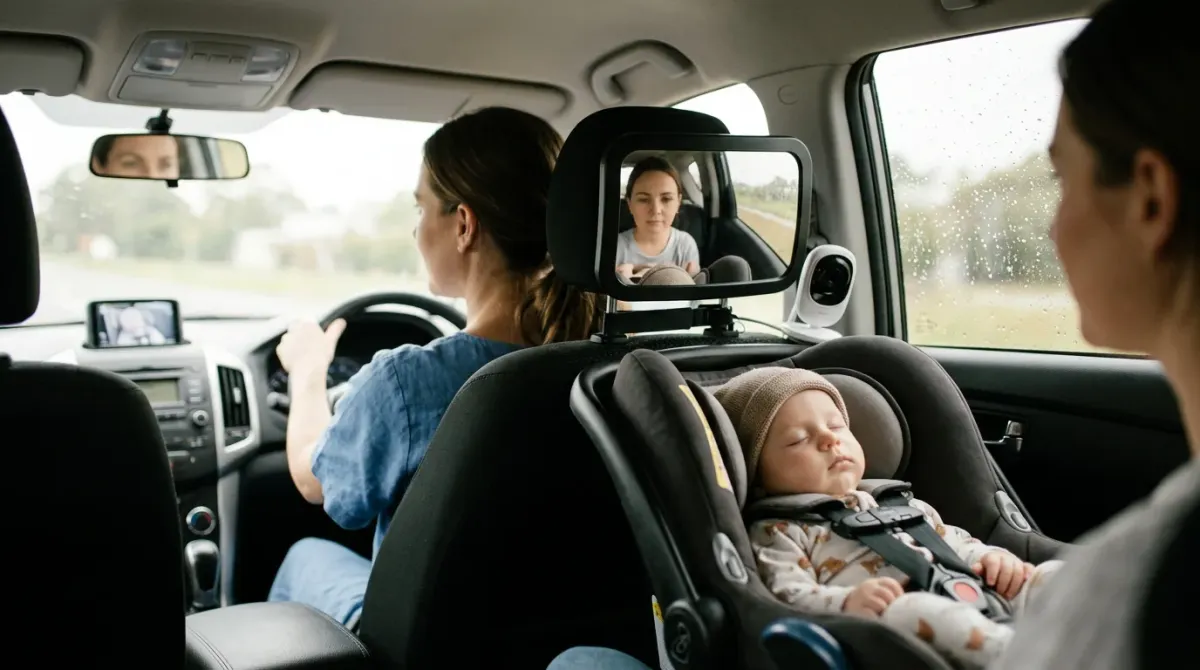
A baby car mirror is a mirror fixed to the back seat headrest. You look at your rear-view mirror, and in it you can see the baby's reflection. Most are plastic with a shatter-resistant surface. Some have a soft padded frame. They are cheap and need no power.
Baby car cameras
A baby car camera is a small camera pointed at the baby. It sends the picture to a small screen on the dash or to a phone. Some give you night vision, a wide view or a sound feed. They need power, from the car's socket, a USB cable or a battery.
Why parents want them
Rear-facing seats are the safest way for babies and toddlers to travel. But you can't see your baby's face from the front seat. A mirror or camera is a way to see if your baby is awake, upset or asleep.
Rear-facing is safest. Keep it going as long as you can
Rear-facing seats spread crash forces across a baby's back, head and neck. Child safety groups in all four countries say to keep children rear-facing for as long as the seat allows. The rules differ by country:
| Country | What the rules say | Where to read more |
|---|---|---|
| Australia | Children under 6 months must be in a rear-facing seat. From 6 months to 4 years they can be rear- or forward-facing, but the rules say rear-facing is safest. Seats must meet AS/NZS 1754. | Product Safety Australia, Transport for NSW and other state road authorities, Kidsafe |
| United Kingdom | Seats must meet UN ECE R44/04 or the newer i-Size (R129) standard. Rear-facing is advised for as long as possible. | GOV.UK child car seat rules, RoSPA |
| United States | Rules vary by state, but the American Academy of Pediatrics says to keep children rear-facing until they reach the top weight or height limit for their seat. | AAP HealthyChildren.org, NHTSA |
| Canada | Rules vary by province. Transport Canada gives advice on rear-facing and seat standards. | Transport Canada, provincial health sites |
Check your local road authority for the exact current rules where you live. They change.
The real risks of mirrors and cameras
1. Loose objects in a crash
In a crash, anything loose in the car keeps moving at the speed the car was going. A hard mirror strapped to a headrest can break away. A heavy camera or phone mount can too. This is why safety experts say to keep the car free of loose hard objects.
There is no international crash-test standard for baby car mirrors. The Fatherly article notes mirrors are not covered by federal safety standards in the US. Claims like "crash tested" on a box may be the maker's own test, and may not use your car seat or your car. Treat them as unproven.
2. Distraction
Every second you look away from the road matters. At 60 km/h, a car travels about 17 metres every second. A glance at a mirror takes less than a second. A long look at a screen takes more. Road safety groups say to keep your eyes on the road.
- A mirror shows your baby in your usual rear-view mirror, so it may add little distraction.
- A screen on the dash is more tempting to watch. Many places have laws about screens in view of the driver.
If your baby is crying, the safest thing is often to stop somewhere safe and settle them. Don't reach back or stare at a screen while driving.
3. Blocking the car seat or the seat belt
Anything attached to the car seat or headrest can get in the way. A mirror strap that goes around the seat could press on the harness. Anything that stops the seat from being installed tightly is a problem. Follow your car seat manual. Always follow your car seat manual, and don't add products the seat maker hasn't approved.
4. False comfort about sleep and breathing
Red Nose warns that babies should not be left to sleep for long periods in a car seat. Research shows risks when babies sleep in car seats for long periods, mainly because the baby's head can fall forward and block their airway. A mirror or camera cannot warn you in time. Take breaks, and take your baby out of the seat when you get home.
The same point about monitors applies here. Red Nose, the Lullaby Trust and the American Academy of Pediatrics say monitors don't prevent SIDS. A camera in the car cannot check that your baby is breathing.
5. Cords and tethers
Camera cables in the back seat can reach your baby. The US Consumer Product Safety Commission has warned for years about strangulation from monitor cords in cots. The same idea applies in a car: keep any cord out of your baby's reach and tidy along the trim. Don't run a cord across the car seat or its harness.
How to choose a mirror or camera
Mirror checklist
- Shatterproof surface (acrylic, not glass).
- Soft or padded frame, light in weight.
- Straps that don't touch the car seat. It should attach to the vehicle's headrest, not the car seat.
- Stable, not wobbly. A mirror that moves can block your rear view.
- Doesn't block the rear windscreen or the view of the baby from other angles.
- Doesn't conflict with a top tether. Some forward-facing and rear-facing seats use a top tether on the back of the seat. Don't add anything near it.
Camera checklist
- Small and light. Avoid heavy phone-style mounts.
- Screen placement. Mount the screen low and to the side, not in your direct line of sight, and never in front of airbags.
- Soft mount. A suction mount that releases in a crash is better than a hard bolt.
- Night vision that doesn't need a bright light.
- Cable management. Enough length to reach the socket but not enough to dangle near the baby.
- Legal. Check your state or country's rules about screens visible to the driver.
- No Wi-Fi needed. A simple wired camera avoids security risks. If a camera connects to your phone or the internet, set a strong password and keep it updated.
Mirrors, cameras and other options side by side
| Option | Good points | Weak points |
|---|---|---|
| No mirror or camera | No loose objects; no screen to watch | You can't see your baby while driving |
| Soft shatterproof mirror on the headrest | Cheap; no power; quick glance | Not crash tested to a common standard; can wobble |
| Wired camera and small screen | Clear view, night vision | More distraction; cable and screen in the cabin |
| Wi-Fi camera to a phone | Flexible | Phone in hand risk; security risks; usually illegal to handle a phone while driving |
| A second adult in the back seat | Can settle and watch the baby | Not always possible |
| Planned stops | Safe way to feed, change and settle | Takes more time |
What matters more than a mirror
- A car seat that meets your country's standard. In Australia and New Zealand, look for AS/NZS 1754. In the UK, look for the ECE R44 or R129 label. In the US, the seat must meet Federal Motor Vehicle Safety Standard 213 (FMVSS 213). In Canada, look for the National Safety Mark and a Canadian Motor Vehicle Safety Standard 213 label.
- The right fit. The seat should be installed tightly. Many places have free or low-cost checks by trained fitters. Use them.
- A snug harness. The harness should be at or just below your baby's shoulders when rear-facing, and snug enough that you can't pinch a fold in the strap at their collarbone.
- No thick coats. A bulky jacket under the harness leaves slack. Dress your baby in thin layers and put a blanket over the top after they're buckled in.
- No aftermarket extras. Strap covers, head wedges, thick liners and other add-ons that didn't come with the seat can change how it works in a crash.
- Expiry date and crash history. Child seats have a use-by date. Never use a seat that has been in a crash unless the maker says it is OK.
- Never leave your baby alone in a car. Cars can heat up quickly, even on mild days.
Making car trips calmer without a gadget
Most babies cry in the car because they are hungry, tired, too hot, bored or uncomfortable. If you fix those, you may not need to look at your baby at all. Try these ideas.
Before you leave
- Time the trip for just after a feed and a nappy change, and near when your baby usually sleeps.
- Dress your baby in thin layers. Cars heat up fast. A baby who is too hot is a grumpy baby. Take off hats and extra layers once you are inside the car.
- Check the harness and seat angle. A seat that is too upright can let a young baby's head slump forward. The seat's manual shows the right angle, and many have a built-in level indicator.
- Pack within reach. Keep a spare dummy (if you use one), a muslin cloth and a drink for yourself in the front, where you can reach them safely when you stop.
On the road
- Plan breaks. On a long trip, stop every hour or two. Take your baby out, feed them, change them and let them stretch. Red Nose recommends not leaving babies in car seats for long stretches, and the same advice appears in other countries.
- Use sound. A soft song, a podcast or your voice can settle many babies. Keep the volume low so you can still hear traffic and your baby.
- Use the sun shade. A cling-on window shade that has no hard parts can keep sun off your baby's face. Choose a flat, soft one. Don't hang toys or heavy objects on the windows.
- Share the load. If another adult is travelling with you, ask them to sit in the back next to your baby on longer trips.
When your baby cries and you can't stop straight away
This happens. Stay calm. Keep your eyes on the road. Talk or sing gently. Find the next safe place to pull over, like a car park or a service station, rather than stopping on a fast road. Then check their nappy, feed, temperature and comfort. If you feel stressed, take a few slow breaths before you drive on. A crying baby is tiring and stressful, but it is not an emergency, and a calm driver is safer than a stressed one.
Heat and cars: a danger no mirror can show you
Cars heat up much faster than most people expect, even on mild days. Babies and young children heat up faster than adults and cannot cool themselves well. That is why health and road safety groups in every country say the same thing: never leave a baby or child alone in a car, not even for a minute.
- Check the back seat every time you leave the car, even if the baby isn't usually with you.
- Put something you need, like your bag, phone or wallet, next to the car seat as a reminder.
- If your child's routine changes, for example a different adult does the drop-off, make a plan to confirm they arrived.
- Lock the car when it's parked at home, and keep keys away from children. Children can climb in and get stuck.
- If you see a child alone in a hot car, call emergency services straight away (000 in Australia, 999 in the UK, 911 in the US and Canada).
Before you buckle your baby in on a hot day, touch the seat and buckle. Metal buckles and dark fabric can burn skin. Use a light cover to shade the seat while the car is parked, and take it off before you put your baby in.
Your pre-trip car seat check
A quick check each time takes less than a minute and helps far more than a mirror. Go through this list.
- Is the seat tight? Hold the seat at the belt path and pull side to side. It should move no more than about 2.5 cm (an inch). Check your manual for the exact test.
- Is the seat angle right? The level line or bubble should be in the correct zone for your baby's age.
- Is the harness in the right slot? For rear-facing, the straps should come from at or just below your baby's shoulders.
- Is the harness snug? After you tighten it, you shouldn't be able to pinch any slack at the collarbone.
- Is the chest clip or buckle in the right place? The clip, if your seat has one, should sit at armpit level.
- Is anything loose in the car? Look at the parcel shelf, the floor and the seat pockets. Put heavy or hard items in the boot.
- Is the baby dressed right? Thin layers, no bulky coat, blanket on top after buckling.
If you aren't sure, book a check with a trained fitter. In Australia, many state road authorities and Kidsafe run or list fitting services. Other countries have similar programs run by health services, fire brigades or road safety groups.
Age stages
Newborn to 6 months
Your baby has little head and neck control. They must be in a rear-facing seat. The most important thing is that the seat is installed correctly and the harness is snug. Avoid long trips without breaks. Take your baby out of the seat every couple of hours if you can, and don't use the car seat as a place for long sleeps at home.
6 to 12 months
Your baby sits up and may grab things. A mirror's strap or a camera cable is now within reach. Re-check anything in the back seat for choking or strangling risks. Keep toys light and soft.
12 months to 4 years
Many toddlers still fit in rear-facing seats, and that is safest. A mirror can help you see them, but toddlers can pull and throw things. Check that nothing is loose in the back. Keep hard toys away.
Older children
Mirrors are not needed once children face forward and can talk to you.
Common mistakes
- Thinking a mirror makes the seat safer. It does not.
- Buying a hard, heavy mirror with a glass or metal frame.
- Looking at a screen for too long. Stop somewhere safe instead.
- Attaching things to the car seat, especially to the harness or frame.
- Letting cords dangle within reach of the baby.
- Blocking the rear window or other mirrors.
- Using a camera to decide a sleeping baby is fine. Take breaks and check in person.
- Using a phone in your hand to view the camera. That is illegal in many places.
- Skipping a professional car seat check. This helps more than any gadget.
FAQ
Is a baby car mirror safe?
It can be reasonably safe if it is light, soft and shatterproof, and fitted to the headrest as the maker says. But there is no common safety standard for them, so choose carefully. The car seat itself matters far more.
Is it legal to have a camera screen in the car?
Rules differ by country and state. Many places ban screens that show video in the driver's view while driving. A small screen mounted to the side may be allowed, but check your local road authority. Never hold a phone while driving.
Will a mirror stop me looking back at my baby?
It helps, but it should not replace safe habits. If your baby is upset, pull over safely. Don't reach back or look around while moving.
Can I use a mirror with a rear-facing seat only?
Mirrors are designed to show a rear-facing baby. They don't help with forward-facing children.
Does a car camera prevent SIDS?
No. No monitor or camera prevents SIDS. Safe sleep habits do, and that includes not letting your baby sleep in a car seat for long periods.
How long can a baby stay in a car seat?
Many safety groups suggest taking breaks on long trips and not leaving a baby in a car seat for more than about two hours at a time. Check your local health or road safety site for their advice.
What should I do if my baby cries in the car?
Pull over somewhere safe and settle them. Never reach into the back seat while driving. For regular long trips, plan stops for feeds and changes.
Sources
- Product Safety Australia – Car seats guide
- Kidsafe – National best practice guidelines: safety of children in motor vehicles
- Red Nose Australia – Keeping baby safe in the car
- Red Nose Australia – Research on risks of infants sleeping in car seats
- Pregnancy, Birth and Baby (Australia) – Car travel with babies and children
- Transport for NSW – Child car seats
- HealthyChildren.org (American Academy of Pediatrics) – Safe sleep: back is best (2022)
- U.S. CPSC – Strangulation deaths prompt recall of video baby monitors with cords (2011)
- Fatherly – Are baby car seat mirrors safe?
Related guides
More Toys & Play →
Baby Car Mirrors and Car Cameras: How to Choose and Use Them Safely

Baby Cameras and Safe Video Storage: SD Cards, Cloud Backups and Privacy

Back-Seat Baby Cameras vs Shatterproof Car Mirrors: Seeing a Rear-Facing Baby Safely
