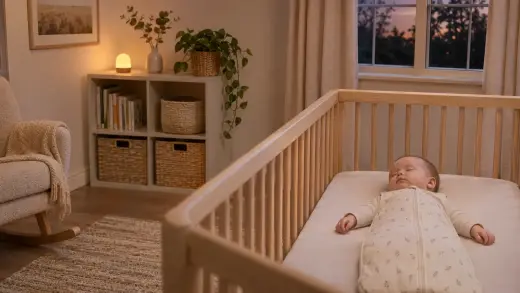
Baby Noise Machines: How to Choose One and Use It Safely
How to choose and use a baby noise machine safely: sound types, safe volume, placement, cord and battery checks, and official advice for AU, UK, US and CA.

On this page
- Key points
- What a baby noise machine is and how it works
- Does your baby really need a noise machine?
- Types of noise machines compared
- Safe volume and where to place the machine
- Other safety checks: cords, batteries, lights and smart apps
- How to choose the right noise machine
- Using a noise machine in shared rooms and when travelling
- Cleaning, care and checking second-hand machines
- Using a noise machine by age stage
- Official guidance in Australia, the UK, the US and Canada
- Common mistakes parents make
- Frequently asked questions
- Sources
Short answer: A baby noise machine plays steady, gentle sounds. It helps cover sudden house noise so your baby can settle. Put the machine across the room, never inside the cot. Keep the volume low and soft. Keep all power cords out of reach, and avoid button batteries.
Health and safety groups agree on the main rule. This includes Australia (Red Nose, Raising Children Network and Product Safety Australia), the UK (The Lullaby Trust and the NHS), the US (the American Academy of Pediatrics and the CPSC) and Canada (Health Canada and the Canadian Paediatric Society). A sound machine is only a comfort tool. It never replaces a safe, clear cot with a firm, flat mattress.
Key points
- Placement: Put the machine across the room, far from your baby's head. Never put it inside the cot or clip it to the rail.
- Volume: Keep it quiet and gentle. If you have to raise your voice over it, it is too loud.
- Cords: Keep power cords well away from the cot so your baby cannot grab them.
- Batteries: Avoid small coin-shaped button batteries. Pick plug-in, USB-charged, or screw-shut AA or AAA models.
- Quiet time: Turn the machine off when your baby is awake. Babies need quiet time to hear voices and learn words.
- No soft toys in cots: Never leave a plush toy with a sound box in a cot with a baby under 12 months.
What a baby noise machine is and how it works
A baby noise machine is a small speaker. It plays steady background sound. Most machines offer white noise, pink noise, rain, ocean waves, fan sounds, or soft shushing. Some also play gentle lullabies or a heartbeat sound.
Babies do not grow up in silence before birth. Inside the womb, they hear blood flowing, breathing, and muffled voices all the time. A silent bedroom can feel strange to a newborn at first. A steady, soft sound can feel familiar and calm.
How sound masking helps sleep
The main job of a noise machine is sound masking. Sound masking means covering sudden sharp noises with a smooth, even sound.
Think about a quiet room at nap time. A dog barks outside or a door slams. That sudden jump in noise can wake a light sleeper. When a soft sound is already playing, the jump feels much smaller. Your baby is less likely to startle awake.
How sleep cues work
Babies learn from simple routines. Turn on the same gentle sound before every nap and at bedtime. Over time, your baby's brain links that sound with sleep. Hearing the sound helps them wind down faster.
Types of sounds explained simply
Boxes and apps use a few common sound names. Here is what each one means in plain words:
- White noise: An even mix of all sound pitches. It sounds like radio static or a loud fan. It can sound sharp or hissy on cheap speakers.
- Pink noise: Softer and deeper than white noise, with less high hiss. It sounds like steady rain or wind in leaves. Many parents and babies find it nicer to hear.
- Brown noise: Even deeper and lower, like distant thunder or a strong waterfall. It has almost no high hiss.
- Nature sounds: Recordings of rain, waves, crickets, or streams. Check that the track loops smoothly without loud bird calls or sudden thunder claps.
- Shushing and heartbeat: Rhythmic sounds that copy a parent shushing or a steady pulse. These often help newborns most in the early months.
Does your baby really need a noise machine?
No. A noise machine is optional, not a must-have item. Many babies sleep well in a normal home without one. Raising Children Network notes that babies can get used to normal household sounds during the day.
Still, a noise machine can help in some homes:
- Noisy streets: Traffic, trains, or neighbours can wake a baby during light sleep.
- Older siblings or pets: Toddlers play loudly, and dogs bark at the door.
- Small homes or shared rooms: When family life happens near the bedroom, soft sound helps buffer dishes, TV, and talking.
- Short daytime naps: Daytime is brighter and louder than night. Gentle sound can help a baby settle.
If your baby already sleeps fine without extra sound, you do not need one. Saving money and keeping the room simple is always a good choice.
Types of noise machines compared
Sound machines come in five main styles. Each style suits a different home and routine.
| Type | How it works | Best for | Watch out for |
|---|---|---|---|
| Plug-in tabletop machine | Sits on a dresser and plugs into the wall. | Everyday use in a nursery or shared bedroom. | Keep the power cord well away from the cot. |
| Portable rechargeable machine | Runs on a built-in battery charged by USB. Clips to a pram or bag. | Travel, car trips, and pram naps while out. | Never clip it inside a cot or close to a baby's face. |
| Smart app-controlled machine | Connects to your phone via Wi-Fi or Bluetooth. Often includes a night light. | Parents who want timers or remote volume control. | Update passwords and avoid bright blue or white light at night. |
| Sound-box plush toy | A soft toy with a small speaker tucked inside. | Comfort for toddlers over 12 months. | Keep soft toys out of cots for babies under 12 months. Check battery covers. |
| Simple fan or spare phone | A bedroom fan or an old phone playing a sound track. | Testing if sound helps before buying a machine. | Do not put a phone in the cot. Check that a fan is safe and not blowing cold air on baby. |
A plain plug-in tabletop machine is often the easiest and safest choice for home. It does not need daily charging. You also do not have to give up your phone at bedtime.
Safe volume and where to place the machine
Hearing safety is the biggest issue with baby noise machines. A baby's ear canals are small, and their hearing is still growing. Sound that feels fine to an adult at the door can be too loud right next to a baby's head.
A 2014 study in the journal Pediatrics by Hugh and colleagues tested infant sleep machines. The researchers found many machines could make sound louder than safe limits when played at top volume or placed right next to the cot. They warned parents to put machines far from the baby, turn the volume down, and limit how long they run.
Where to place the machine
- Across the room: Put the machine on a stable shelf or dresser, far from the cot. Aim for at least two metres away if your room allows.
- Never inside the cot: Do not place any sound machine, speaker, or phone on the mattress or in a cot corner.
- Never clipped to the cot rail: Babies grow fast and learn to reach, pull, and chew on items clipped to the bars.
- Face the speaker away if needed: If the lowest setting feels brisk in a small room, point the speaker toward a wall or curtain to soften it.
How to judge safe volume
You do not need special tools to avoid loud sound. Use these simple checks:
- The talk test: Stand beside the cot. You should be able to speak in a normal, soft voice and be heard clearly over the machine.
- Think of a quiet shower: Aim for the gentle sound of soft rain on a roof or a shower in the next room. Avoid sounds as loud as a vacuum cleaner or hair dryer.
- Lower it once asleep: If you use a slightly firmer sound to help a fussy newborn settle, turn it down a notch once they are deeply asleep.
Give your baby quiet time
Do not run a noise machine all day long. Turn it off when your baby is awake. Babies learn to talk by listening to your voice and everyday sounds around the home. Constant background noise during play can make it harder for them to hear clear speech.
Other safety checks: cords, batteries, lights and smart apps
Volume is not the only safety detail to check before you buy or set up a machine.
Power cords and strangulation risk
Loose cords near a cot are a serious hazard. Both the US Consumer Product Safety Commission (CPSC) and Product Safety Australia warn that babies and toddlers can pull cords into a cot and get tangled. Always keep cords well out of reach, even before your baby can sit or stand. Route the cord behind heavy furniture or use cord covers fixed to the wall.
Button battery safety
Small, flat, coin-shaped button batteries can cause life-threatening internal burns in as little as two hours if swallowed. Product Safety Australia and regulators in the UK, US and Canada warn families to keep button batteries out of homes with young children whenever possible.
Check how a portable noise machine is powered before you buy:
- Pick models with a sealed rechargeable battery charged by USB, or standard AA or AAA batteries behind a screw-down door.
- Avoid remote controls or small travel sound pucks that use coin-shaped button batteries.
- If a remote uses a button battery, keep it locked away out of a child's sight and reach.
Built-in night lights
Many noise machines have a built-in night light. Babies do not need a light on to sleep. Dark rooms help babies learn the difference between day and night.
If you want a dim light for night feeds and nappy changes, pick a warm red, orange, or amber glow on a very low setting. Bright white or blue light can wake your baby's brain up and make it harder to fall back asleep. Turn the light off once the feed or nappy change is done.
Smart features and home privacy
App-connected machines let you change tracks or volume from your phone. That can be handy if you do not want to walk into the nursery. Still, connected devices bring a few extra steps:
- Use a strong, unique password for your home Wi-Fi and for the machine's app account.
- Turn on app updates so security fixes install.
- If the machine has a microphone or listens for crying, check the privacy settings and see what data it saves.
- If you do not need Wi-Fi or Bluetooth, pick a simple offline machine. It is cheaper, easier to use at 2:00 AM, and never drops connection.
Soft toys with sound boxes
Some plush animals hold a sound unit inside their tummy. Red Nose, The Lullaby Trust, the AAP and Health Canada all advise keeping soft toys, pillows, and loose blankets out of a baby's cot for the first 12 months. A soft toy near a baby's face can block breathing. Save plush sound toys for supervised daytime cuddles or for older toddlers.
How to choose the right noise machine
Marketing boxes often promise miracles, like instant sleep or smart cry sensing. Skip the hype and focus on five practical things that matter every night.
1. Smooth sound loops
Cheap sound machines often play a short 10-second clip over and over. If there is a tiny click, pop, or pause at the end of each loop, your brain and your baby's brain will notice it right away. Look for a machine with smooth, non-looping sound or very long tracks with no audible join.
2. Fine volume steps
Some machines jump from silent to quite loud in just one or two clicks. Look for a dial or buttons with many small volume steps. This makes it easy to find a soft, safe level in any size room.
3. Easy buttons in the dark
At 3:00 AM, you do not want to squint at tiny icons or unlock a phone app. Raised buttons you can feel by touch are much easier. A soft dim button light that fades out after a few seconds is also helpful.
4. Power options that match your routine
For the nursery, wall power means the machine will not die halfway through a long night. If your area has power cuts, a model with a backup battery or USB power bank option is useful. For prams and holidays, a lightweight rechargeable unit with long battery life works best.
5. Skip paid subscriptions and bright screens
You do not need a monthly app fee for baby sleep sounds. A basic offline machine with five to ten steady sounds does the same job for years without ongoing costs. Also avoid bright glowing clock faces or moving ceiling projectors near bedtime, as they can distract a tired baby.
Using a noise machine in shared rooms and when travelling
Many families use a noise machine when sharing a bedroom or staying away from home. A few simple habits keep things safe and easy.
Room-sharing with your baby
Health bodies in Australia, the UK, the US and Canada recommend sharing a room with your baby for the first six to 12 months, with the baby in their own safe cot or bassinet. If you snore, cough, or get up early for work, a low sound machine can soften those noises so your baby sleeps through.
Place the machine on a dresser across the room, not between your bed and the cot where someone could trip on the cord in the dark. Choose a gentle pink noise or rain sound that feels calm for adults as well as your baby.
Travel, holidays and prams
A familiar sleep sound can help a baby settle in a noisy hotel or a relative's house. Pack a small USB-rechargeable machine instead of a plug-in unit with a long cord. Check that the machine is placed on a flat table well away from the travel cot.
On pram walks, never tuck a sound machine inside the bassinet or under a closed hood. Sound bounces off the fabric and gets much louder near your baby's ears. Clip it to the outside handle, point the speaker away, and keep the volume low.
Cleaning, care and checking second-hand machines
A tabletop noise machine lasts for years if you look after it. Wipe the outer shell with a dry or slightly damp cloth. Never spray water or cleaner straight into the speaker holes. Keep the machine away from humidifiers or steam vaporisers, as moisture can damage the electronics.
If you buy or borrow a second-hand noise machine, run a quick safety check before using it:
- Inspect the power cord and plug for cracks, bent pins, or loose wires.
- Test the speaker at low and medium volume to make sure there is no crackle or rattle.
- Check the battery door. Make sure it closes tightly and needs a screw or tool if it holds small batteries.
- Check your country's product recall site to make sure the model has not been recalled.
Using a noise machine by age stage
Your baby's needs change fast in the first three years. Here is how sound machines fit each stage.
| Age stage | What is happening | How to use a noise machine safely |
|---|---|---|
| Newborn (0–3 months) | New to the outside world. Strong startle reflex. Short sleep cycles. | Use gentle pink noise, shushing, or rain at low volume across the room. Keep the cot clear and place baby on their back. |
| Older baby (4–12 months) | More alert to household noises. Starting to roll, sit, and stand in the cot. | Keep the machine well away from the cot so baby cannot reach it or its cord. Keep soft sound toys out of the cot. |
| Toddler (1–3 years) | Moving to a toddler bed or big room. May climb or explore at night. | Secure cords to the wall or put the machine on a high shelf out of reach. Avoid button-battery remotes. |
| Preschooler (3+ years) | More independent sleep. Some children prefer quiet or a soft fan sound. | Let your child help pick a calm routine. You can slowly lower the volume or use a timer if you want to stop using it. |
How to stop using a noise machine
There is no strict age when a child must stop using white or pink noise. Many adults sleep better with a quiet fan. Still, if you want to phase it out, do it slowly:
- Turn the volume down one small step every two or three nights.
- After a week or two, switch to a timer so it turns off an hour after bedtime.
- Keep the rest of your bedtime routine, like a bath, story, and cuddle, the same.
Official guidance in Australia, the UK, the US and Canada
No country has a special government safety standard written only for baby noise machines. Instead, national health and product safety bodies cover electrical safety, cords, batteries, and safe sleep spaces.
| Country | Official bodies | Key advice for parents |
|---|---|---|
| Australia | Red Nose Australia, Raising Children Network, Product Safety Australia (ACCC) | Keep the cot clear, firm, and flat on the back. Raising Children Network notes quiet or low background sound is fine, and loud noise should be avoided. Product Safety Australia warns strongly against loose cords near cots and button batteries in children's items. |
| United Kingdom | The Lullaby Trust, NHS, Office for Product Safety and Standards (OPSS) | The Lullaby Trust and NHS advise a clear cot, sleeping on the back, and a comfortable room temperature. OPSS warns parents to buy electrical items from trusted sellers with proper UK plugs and safety marks. |
| United States | American Academy of Pediatrics (AAP), Consumer Product Safety Commission (CPSC) | The AAP advises a clear, firm, flat sleep space on the back, with no loose toys or blankets. The CPSC warns about strangulation from cords near cots and enforces strict rules on button battery doors. |
| Canada | Canadian Paediatric Society (Caring for Kids), Health Canada | Caring for Kids and Health Canada advise a bare cot, back sleeping, and keeping cords and blinds away from sleep spaces. Health Canada also shares tips on securing smart baby gear online. |
In all four countries, safe sleep rules always come first. A noise machine can help mask household sounds, but it never makes an unsafe sleep spot safe. Always lay your baby on their back on a firm, flat mattress in a clear cot, and keep your home smoke-free.
Common mistakes parents make
Most problems with baby noise machines happen because of how they are set up, not the machine itself. Watch out for these common traps:
- Turning it up too loud: Trying to drown out crying with loud white noise can hurt delicate ears. Comfort your baby first with holding, feeding, or gentle rocking, then keep the sound soft.
- Putting it in the cot or pram hood: Sound inside a closed pram hood or cot bounces off the walls and gets much louder near your baby's ears. Clip portable machines to the outside handle, facing away, and keep them quiet.
- Forgetting the cord as baby grows: A cord that seemed safe for a newborn becomes a grab target once your baby starts rolling, sitting, or standing up in the cot.
- Using bright blue night lights: Leaving a bright blue or white light glowing on the machine can trick a baby's body clock into thinking it is daytime.
- Leaving it on all day: Running background noise during awake play cuts down on quiet one-on-one talking time.
- Buying cheap uncertified plugs online: Unknown online sellers sometimes ship unsafe wall chargers that overheat. Buy from trusted local shops with proper local safety marks.
Frequently asked questions
Can a noise machine harm my baby's hearing?
Yes, if it is too loud or too close to your baby's head. Research in Pediatrics showed that some machines can reach unsafe sound levels at top volume. To protect your baby's ears, put the machine across the room and keep the volume low and soft.
Should I leave the noise machine on all night?
You can either leave it on at a low, gentle volume all night or set a timer so it turns off once your baby is settled. If a sudden noise wakes your baby when a timer shuts off, keeping a very soft sound running all night may work better. Either way, turn it off during the day when your baby is awake.
What is the best sound for a baby: white noise, pink noise, or rain?
There is no single best sound for every baby. Pink noise and steady rain sound softer and less hissy than harsh white noise, so most families prefer them. Pick a smooth sound with no sudden loud bangs, chimes, or gaps in the loop.
Can I put a portable sound machine inside the cot or pram?
Never put any sound machine inside a cot. In a pram, do not place it right next to your baby's head or inside a closed hood. If you use a portable machine on a walk, clip it to the outside of the pram handle at a low volume.
Can I use my phone instead of a noise machine?
You can try a phone app for a night or two to see if background sound helps your baby. For daily use, a simple dedicated machine is better. It frees up your phone, avoids bright screen glare, and will not interrupt sleep with a sudden call or message ping.
When should my child stop using a noise machine?
There is no fixed age to stop. Many toddlers and older children still like soft rain or fan noise at bedtime. When you decide to stop, turn the volume down a little bit every few nights until you turn it off.
Is a noise machine safe to use with a baby monitor?
Yes, they work fine together in the same room. Just place the noise machine away from the baby monitor's microphone. If they sit right next to each other, the monitor will pick up constant hiss and may hide your baby's quiet sounds.
Sources
- Raising Children Network – Light, noise and baby sleep: frequently asked questions
- Red Nose Australia – What is a safe sleeping environment
- Product Safety Australia – Button batteries guide
- Hugh et al. – Infant sleep machines and hazardous sound pressure levels, Pediatrics 2014 (PubMed)
- American Academy of Pediatrics (US) – A parent's guide to safe sleep
- The Lullaby Trust – Safer sleep overview
- Caring for Kids (Canadian Paediatric Society) – Safe sleep for babies
- Get Cyber Safe (Government of Canada) – Cyber security tips for your baby gear
Related guides
More Sleep & Nursery →
Mini White Noise Machines for Babies: How to Choose and Use One Safely
Smart Air Purifiers for Your Baby's Room: How to Choose and Use One Safely
Baby Sound Machines and Pink Noise: Safe Volume Limits and Cot Distance