














Taste-Safe Sensory Bins for Babies (6 to 18 Months): Safe Oat, Chia and Water Play
Safe oat, chia and water sensory bins for babies 6 to 18 months. Simple recipes, choking and drowning rules, and official tips for AU, UK, US and Canada.
On this page
- Key points
- What a taste-safe sensory bin is
- Before you start: basic safety rules
- Taste-safe bin ideas compared
- Oat sensory bins: dry oats and cooked porridge
- Chia seed sensory bins: how to soak them safely
- Water play bins: safe setup and drowning prevention
- More simple taste-safe bin ideas
- Sensory play by age: 6 to 18 months
- Safety standards and official guidance across four countries
- Common mistakes to avoid
- How to make clean-up easy
- Frequently asked questions
- Sources
Short answer: A taste-safe sensory bin lets your baby touch, scoop and explore food-based textures without harm if a little goes in their mouth. For babies aged 6 to 18 months, the safest choices are cooked or blended oats, fully soaked chia gel and shallow water. Always sit your baby upright, stay within arm's reach, and keep small parts out of the tub.
This advice follows child safety and choking rules from peak bodies in Australia (Better Health Channel, Royal Life Saving Australia, ASCIA), the UK (NHS, RLSS UK, RoSPA), the US (American Academy of Pediatrics, CPSC) and Canada (Canadian Paediatric Society, Health Canada).
Key points
- Taste-safe is not a meal: It means the mix will not poison your baby if they lick or taste a small bit.
- Sit upright: Only use sensory bins when your baby can sit up well, either on their own or in a supportive highchair.
- Watch at all times: Stay right next to your baby. Never step away, even for a few seconds.
- Soak chia seeds first: Dry chia seeds swell fast in saliva and can block a baby's throat.
- Skip dry rice and beans: Uncooked rice, dried beans and water beads are choking hazards for babies and toddlers.
- Check allergies first: Only put foods in the bin that your baby has already eaten safely.
- Empty water right away: Babies can drown silently in just a few centimetres of water.
What a taste-safe sensory bin is
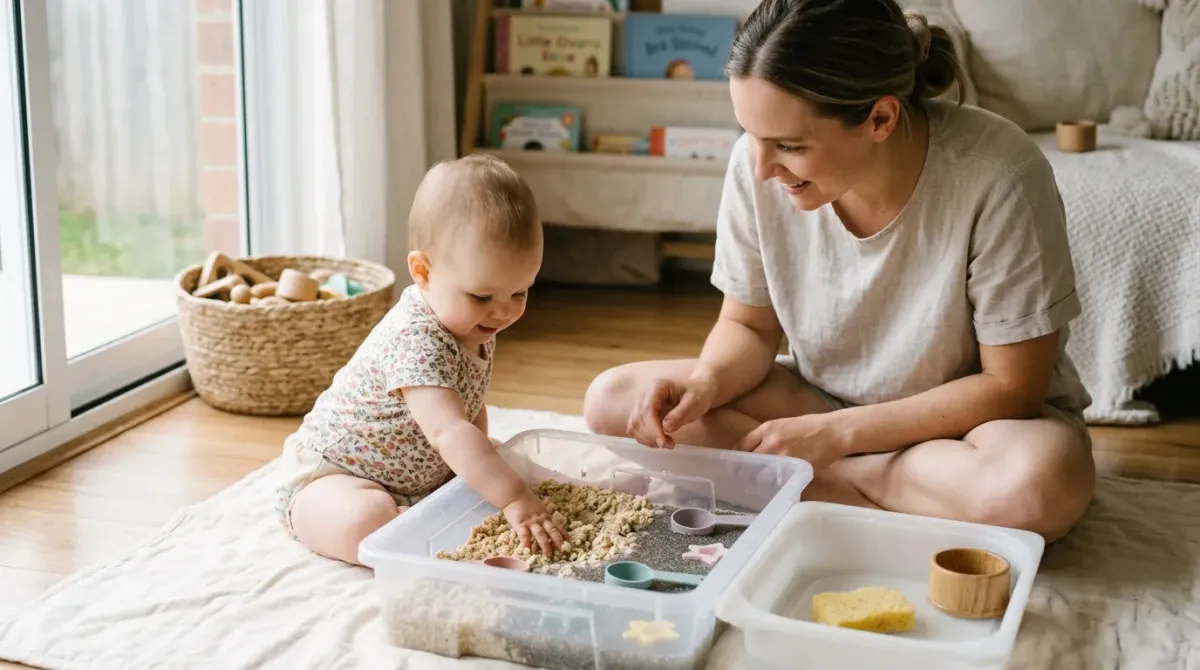
A sensory bin is a shallow tub or tray filled with things for your baby to touch and scoop. Babies learn about the world through their hands and mouths. From 6 to 18 months, almost everything your baby grabs goes straight to their mouth.
A "taste-safe" bin uses everyday food items instead of craft supplies like sand, kinetic sand or plastic beads. If your baby licks their fingers or eats a small spoonful, it is safe. Still, a sensory bin is for play, not for eating a big portion.
Why regular sensory bins are unsafe for babies
Many sensory bins you see online are made for older kids aged 3 and up. They often use dry rice, dried beans, raw pasta, pom-poms or water beads. All of these can choke a baby.
Water beads are a special danger. They look like lollies and are tiny when dry. If a baby swallows one, it swells inside their gut and can cause a life-threatening blockage. Product safety bodies in Australia (ACCC), the UK (OPSS), the US (CPSC) and Canada (Health Canada) all warn against water beads for young children.
Before you start: basic safety rules
A few simple checks make sensory play much safer. Do these before you put the tub on the floor.
1. Wait until your baby sits upright
Your baby should be able to sit upright with good head and neck control. This usually happens around 6 months. Lying on a tummy or leaning back while mouthing food raises the risk of choking.
If your baby still wobbles when sitting, use a highchair with a tray. Strapping them in keeps them upright and stops them tipping into the tub.
2. Stay within arm's reach
Choking and drowning are silent. A baby who is choking or slipping face-down in water cannot cry out for help. Put your phone away and keep your eyes on your baby the whole time.
If you need to answer the door or grab a towel, take your baby with you. Never leave an older child in charge of watching a baby near a bin.
3. Use foods your baby has already tried
Food allergies often show up in the first year. Peak allergy groups like ASCIA in Australia, the NHS in the UK, the AAP in the US and the Canadian Paediatric Society all advise introducing common allergy foods one at a time during meals, not during messy play.
Before you use oats, dairy yoghurt, wheat pasta or berries in a bin, check that your baby has eaten that food before with no reaction. Keep new foods for mealtime when you can watch closely for hives, swelling or vomiting.
4. Check every scoop, cup and toy
Any spoon, cup or toy you add to the bin must be too big to fit inside a baby's mouth. A simple home check is a cardboard toilet roll tube. If an object fits all the way inside the tube, it is too small for a child under 3.
Check that plastic cups and wooden spoons have no cracks, sharp edges or loose parts. If you use baby toys in the bin, look for items that meet toy safety standards such as AS/NZS ISO 8124 (Australia and New Zealand), BS EN 71 (UK) or ASTM F963 (US).
5. Keep it clean and throw away leftovers
Wash your baby's hands and your own hands before play. Use a clean plastic tub or baking tray that has not held harsh cleaners or pet food.
When play ends, throw away any wet or mouthed food. Warm, wet food grows germs fast. Never save half-played oat or chia mix for the next day.
Taste-safe bin ideas compared
Different bin bases suit different ages and mess levels. Here is how the main options compare.
| Bin base | Best age | Texture | Main risk to watch | Clean-up level |
|---|---|---|---|---|
| Blended oat flour | 6 to 12 months | Soft, powdery | Breathing in dry dust if tossed | Medium (wipe and vacuum) |
| Cooked, cooled porridge | 6 to 18 months | Thick, squishy | Hot spots if not cooled well | High (wet and sticky) |
| Dry whole rolled oats | 10 to 18 months | Light, flaky | Dry flakes sticking if eaten in big handfuls | Medium (sweep or vacuum) |
| Pre-soaked chia gel | 8 to 18 months | Slippery, jelly-like | Dry clumps if not soaked long enough | High (slippery on floors) |
| Shallow water | 6 to 18 months | Wet, splashy | Drowning in even shallow water | Low (towel dry) |
| Plain yoghurt paint | 6 to 18 months | Smooth, creamy | Dairy allergy; slippery if spilled | Medium (wipe tray and baby) |
| Cooked soft pasta | 8 to 18 months | Soft, bendy | Undercooked or firm pieces | Low to medium |
Oat sensory bins: dry oats and cooked porridge
Oats are cheap, easy to find and gentle on baby skin. You can use them in three ways depending on your baby's age.
Option 1: Blended oat flour (6 to 12 months)
Dry whole oats can stick to the roof of a young baby's mouth if they grab a big handful. Turning rolled oats into fine oat flour in a blender makes a soft, sand-like dust. It feels silky and melts quickly with saliva.
How to make it:
- Put 2 cups of plain rolled oats into a clean blender or food processor.
- Blend until it looks like coarse flour.
- Pour it into a shallow tray or baking dish.
- Add two big silicone spoons or measuring cups.
Keep the layer thin so your baby cannot scoop up a huge mound. If your baby starts throwing the powder into the air, stop the game so they do not breathe it in.
Option 2: Cooked and cooled porridge (6 to 18 months)
Cooked porridge is one of the safest sensory mixes for young babies. It is soft, moist and easy to swallow if they taste it. It also squishes nicely between little fingers.
How to make it:
- Cook 1 cup of rolled oats with 2.5 cups of water until very soft.
- Stir well and let it cool completely to room temperature.
- Test the centre with a clean finger to make sure there are no hot pockets.
- Spread it in a shallow tray or straight onto a clean highchair tray.
You can stir in a tiny pinch of cinnamon for scent if your baby has had cinnamon before. Skip honey completely. Health bodies in Australia, the UK, the US and Canada warn never to give honey to babies under 12 months because of infant botulism, a rare but serious illness.
Option 3: Dry whole rolled oats (10 to 18 months)
Older babies who are good at chewing and spitting out things they do not want can play with dry rolled oats. Rolled oats are flat and soft when wet, unlike hard raw rice.
How to set it up:
- Pour 2 to 3 cups of plain rolled oats into a wide, shallow tub.
- Add large measuring cups, a wide funnel or big muffin tins.
- Skip small add-ins like raisins, dried cranberries or nuts. Dried fruit and whole nuts are major choking hazards for children under 4.
Chia seed sensory bins: how to soak them safely
Chia seed gel feels like slimy frogs' eggs or jelly. Babies love squishing it, and it washes off skin easily with warm water. However, chia seeds have one strict safety rule.
Never put dry chia seeds in a baby sensory bin. Dry chia seeds soak up many times their weight in liquid. If a baby swallows dry chia seeds, they can swell in the throat or oesophagus (food pipe) and form a thick plug.
How to make safe chia gel
- Measure 1/4 cup of chia seeds into a large bowl.
- Pour in 2 cups of water. This gives lots of liquid so every seed swells fully.
- If you want colour, add 2 drops of food colouring or a splash of beetroot juice to the water first.
- Stir well with a fork for one full minute. Break up any dry clumps.
- Wait 10 minutes, then stir again so no seeds stick together at the bottom.
- Cover the bowl and put it in the fridge for at least 2 hours, or overnight.
- Check the gel before play. Every seed should have a clear jelly coat around it, with no dry crunchy bits.
Serve the gel in a shallow tray on a wipeable mat or outdoors. Chia gel is very slippery if it lands on tiles or floorboards. Keep your baby seated while playing so they do not slip and fall.
Clean-up tip for chia gel
Do not wash big clumps of chia gel straight down a kitchen sink. It can clog the drain pipes. Scoop most of the gel into the bin or compost first, then rinse the tray with warm water.
Water play bins: safe setup and drowning prevention
Water play is simple, free and calming for babies. It needs zero food prep. At the same time, water carries the highest risk of harm if an adult looks away.
Royal Life Saving Australia, RLSS UK, the American Academy of Pediatrics and Lifesaving Society Canada all stress the same point. Young children can drown silently in just a few centimetres of water. A baby who tips forward in a tub may not have the strength to push themselves back up.
Safe water play rules
- Use a tiny amount of water: Put only 1 to 2 centimetres of water in a shallow baking tray or low tub.
- Stay within arm's reach: Sit right beside your baby with both hands free.
- Check the temperature: Use cool or lukewarm water. Never use hot tap water, which can scald a baby's thin skin. Test it with your wrist first.
- Empty it at once: Pour the water out as soon as play finishes. Turn the tub upside down so rain or tap water cannot collect in it later.
- Watch for slips: Put a large bath towel under the tray so wet floors do not cause falls.
Easy water bin ideas for 6 to 18 months
- Floating cups: Float three bright plastic bath cups or measuring spoons in a tray of water.
- Sponge squeeze: Give your baby a clean, large kitchen sponge to dip and squeeze. Make sure it has no scourer pad and no loose foam pieces they could bite off.
- Large frozen blocks: Avoid small ice cubes, which can slip into a baby's throat and block their airway. Instead, freeze water in a big round bowl or a large muffin tin. Run warm water over the big ice block for a few seconds so it is not sticky-cold, then let your baby pat and push it around the tray.
- Citrus slices (12+ months): For older babies who do not bite big chunks off peel, float thick orange or lemon slices in water. Watch closely so they do not chew on seeds or peel.
More simple taste-safe bin ideas
Once you know the rules, you can make safe sensory trays from kitchen staples in minutes.
Cooked soft pasta
Boil large pasta shapes like rigatoni or wide noodles until they are very soft. You should be able to squish a piece easily between your thumb and forefinger. Rinse in cold water so it cools down fast and does not stick together.
Toss with a teaspoon of olive oil so the shapes slide easily. Babies like threading fingers through rigatoni tubes or pulling long noodles apart. Throw away leftovers when play is done.
Plain yoghurt "paint"
Plain full-fat Greek yoghurt makes a great finger paint for babies 6 months and up who already eat dairy. Put a spoonful on a clean highchair tray. Add a tiny drop of food colouring or mashed berry juice to make two or three colours.
Your baby can swirl the yoghurt with their hands, clap in it and lick their fingers. If your baby has a dairy allergy, use plain unsweetened soy or oat yoghurt that they have already eaten safely.
Mashed vegetable "mud"
Cooked, mashed sweet potato, pumpkin or avocado makes a thick, earthy sensory mix. Spread it on a tray and press in two or three large plastic animal toys. Check that the toys have no small tails, ears or paint flakes that can come off.
Crushed baby cereal sand
Crush plain baby rusks or baby rice cereal flakes with a rolling pin inside a sealed bag. Pour the crumbs into a dry tray. This works well for 6-to-9-month-olds because the crumbs dissolve fast in saliva.
Sensory play by age: 6 to 18 months
Your baby's hands and brain change fast in this year. Adjust the bin to match what they can do.
| Age stage | What your baby is learning | Best bin setups | Key safety check |
|---|---|---|---|
| 6 to 9 months | Sitting up, raking with whole hand, mouthing objects | Highchair tray with yoghurt, mashed sweet potato, cooked porridge or 1 cm of water | Keep baby strapped upright in highchair or seated with cushions behind, never unsupervised |
| 9 to 12 months | Poking with one finger, picking up small bits, banging cups | Chia gel, soft cooked pasta, oat flour, shallow water with floating cups | Check every toy passes the toilet roll test; watch for large handfuls going into mouth |
| 12 to 18 months | Scooping, pouring, dumping, early pretend play | Dry rolled oats with funnels, water pouring station, pasta with big tongs | Keep bin on a towel or mat; empty water right away; keep baby seated during slippery play |
6 to 9 months: tray play is easiest
At this age, babies mostly slap, smear and bring hands to their mouth. You do not even need a separate tub. Using the highchair tray keeps your baby safely upright and cuts down mess.
Keep sessions short, around 5 to 10 minutes. Stop as soon as your baby rubs their eyes or gets cranky.
9 to 12 months: scooping and poking
Around 9 months, babies start using their thumb and first finger together. This is called a pincer grip. They also love banging two cups together.
A wide baking dish on a waterproof mat on the floor works well now. Sit right next to your baby on the floor so you can guide their hands and watch their mouth.
12 to 18 months: pouring and moving
Toddlers love moving things from one bowl to another. Give them two bowls, a big ladle and dry rolled oats or shallow water. Expect some spilling as they practise pouring.
Toddlers also like to stand up and walk while holding food. Gently remind them to stay seated on the mat while playing with oats or chia gel so they do not trip or choke while walking.
Safety standards and official guidance across four countries
Parenting advice online comes from all over the world. The core safety rules for choking, drowning and food hygiene are very similar across Australia, the UK, the US and Canada.
| Topic | Australia | UK | US | Canada |
|---|---|---|---|---|
| Water supervision | Royal Life Saving Australia: keep within arm's reach at all times | RLSS UK and RoSPA: never leave a baby alone near water | AAP: touch supervision (within arm's reach) around any water | Canadian Paediatric Society: stay within arm's reach; empty tubs at once |
| Choking prevention | Better Health Channel: sit upright, no small hard foods, stay close | NHS: sit upright, watch closely, learn baby choking first aid | AAP: no small round or hard foods; test toys with a small-parts tube | Health Canada: keep small parts out of reach of children under 3 |
| Allergy timing | ASCIA: introduce common allergy foods at meals around 6 months | NHS: introduce allergens one at a time in small meal portions | AAP: introduce common allergens in safe textures from around 6 months | Canadian Paediatric Society: offer common allergens early and regularly |
| Toy and cup safety | ACCC / Product Safety Australia: AS/NZS ISO 8124 for toys | OPSS: BS EN 71 for toys | CPSC: ASTM F963 for toys | Health Canada: Toy safety rules and recalls portal |
Learn basic baby choking first aid
Every parent and carer should know what to do if a baby chokes. Choking is different from gagging. Gagging is noisy, with coughing and retching, as your baby pushes food forward. Choking is silent or high-pitched, and your baby cannot breathe or cry.
Look up the official baby choking steps from St John Ambulance or ANZCOR in Australia, the NHS or British Red Cross in the UK, the American Red Cross in the US, or St John Ambulance in Canada. Saving a quick guide on your phone or fridge is a smart step before starting solids and sensory play.
Common mistakes to avoid
- Using dry rice, dried beans or popcorn kernels: These are hard, small and easy to breathe into the airway. Save them for children over 3 who no longer mouth toys.
- Using dry chia seeds without soaking: Unsoaked seeds swell inside the mouth and throat and can cause a blockage.
- Adding honey for babies under 12 months: Honey can carry bacteria that cause infant botulism. Never add it to porridge or yoghurt play for babies under one year.
- Using water beads: Even if a packet says "non-toxic", water beads can swell inside a child's gut and cause serious injury.
- Walking away during water play: Even a shallow tray of water needs your eyes and hands nearby every second.
- Adding tiny decorations: Skip googly eyes, buttons, small pebbles, coins and small ice cubes.
- Reusing wet food mixes: Warm, wet oats, pasta and chia grow bacteria quickly. Make a fresh batch each time.
- Testing new allergens in a messy bin: If your baby gets a rash around their mouth during messy play, it is hard to tell if it is skin irritation from wet food or a true food allergy. Always try new foods at a calm meal first.
How to make clean-up easy
Mess puts many parents off sensory play. A few simple habits cut clean-up time down to a couple of minutes.
- Strip down to a nappy: Take off good clothes before play. A nappy and a wipeable bib save laundry.
- Put down a large sheet or shower curtain: Lay a cheap plastic tablecloth, old flat sheet or vinyl mat under the tub. When play ends, fold the corners in and shake dry oats into the bin.
- Try the bath or backyard: On a warm day, put the sensory tray on the grass outside. On a cold day, put your baby and the tray inside an empty, dry bathtub. When they finish, lift out the tray and rinse your baby and the bath with the shower head.
- Have a warm wet cloth ready: Keep a damp flannel and a towel beside you before you start so you do not have to carry a messy baby across the carpet.
Frequently asked questions
Is taste-safe the same as a meal?
No. Taste-safe means the mix will not poison your baby if they lick their hands or eat a small bit. It is still play, not a meal. Use small amounts and offer proper meals at regular mealtimes.
Can I use dry rice or dried beans if I watch closely?
It is best not to for babies aged 6 to 18 months. Small, hard grains and beans can be breathed straight into the windpipe faster than an adult can stop a baby's hand. Stick to soft cooked foods, blended oat flour, soaked chia or water until your child is older and no longer puts things in their mouth.
Why are water beads warned against for babies?
Water beads look like bright lollies and are slippery. If a baby swallows a dry or partly swollen bead, it keeps soaking up fluid inside the stomach or bowel and grows much bigger. This can block the gut and often needs surgery to remove. Safety agencies in Australia, the UK, the US and Canada warn families to keep them away from babies and toddlers.
What should I do if my baby puts a big handful of oats or chia in their mouth?
Stay calm. Do not poke your fingers blindly into your baby's mouth, as that can push food deeper into the throat. Let your baby cough or spit it out while sitting upright. If your baby stops breathing, cannot cough or turns pale or blue, call emergency services at once and start baby choking first aid.
How do I keep the mess under control?
Play in a nappy on a large wipeable mat, in a highchair tray, outside on the grass or inside a dry bathtub. Keep a damp cloth next to you before you start. Using less mix in the tray also makes a huge difference.
Can I save a sensory bin for tomorrow?
Only dry mixes like plain oat flour or dry rolled oats can be saved, and only if your baby did not drool on them or put wet hands in them. Once wet hands, saliva or water touch food, throw it away after play. Never save cooked porridge, pasta, yoghurt or soaked chia gel from a sensory bin.
When can my baby start sensory bin play?
Most babies are ready around 6 months, once they can sit upright with steady head control. Start with simple tray play in the highchair using plain yoghurt or cooled porridge. As their balance and hand skills grow, move to shallow floor tubs with cups and spoons.
Sources
- Better Health Channel (Victoria) – Choking
- Royal Life Saving – Water safety at home
- NHS (UK) – How to stop a child from choking
- Royal Life Saving Society UK – Water safety
- American Academy of Pediatrics (US) – Choking prevention
- American Academy of Pediatrics (US) – Water safety and young children
- Caring for Kids (Canadian Paediatric Society) – Water safety
- ASCIA – How to introduce solid foods to babies for allergy prevention
Related guides
More Parental Tips →
Safe Fish and Omega-3 DHA for Babies: Low-Mercury Guide and Simple Finger Foods
Which Water Is Safe for Baby Formula? Tap, Bottled, Filtered, Fluoride and Boiling Rules

Setting Up a Safe Montessori Floor Play Space: Free Movement Without Container Syndrome
