














How to Make Powdered Baby Formula Safely: The 70°C Rule and the 24-Hour Pitcher Method
How to make powdered baby formula safely using 70°C water and the 24-hour pitcher method, with official rules from Australia, the UK, the US and Canada.
On this page
- Key points
- Why powdered formula is not sterile
- What the 70°C (158°F) rule means
- How to make one bottle with 70°C water
- How to use the 24-hour pitcher method
- Single bottle vs pitcher method vs ready-to-feed
- Official rules in Australia, the UK, the US and Canada
- Safe storage times and temperatures
- Formula safety by baby's age
- Water safety and bottle choices
- Making formula when you go out
- Common mistakes to avoid
- Frequently asked questions
- Sources
Short answer: Powdered baby formula is not germ-free. Mixing it with water that is at least 70°C (158°F) kills rare but dangerous bacteria in the powder. Boil fresh tap water and let it cool for no more than 30 minutes before mixing. Cool the bottle fast and feed your baby straight away, or chill a batch in the back of the fridge for up to 24 hours.
Health groups in Australia, the UK, the US and Canada agree on the main safety steps. They differ slightly on when healthy older babies need 70°C water. This guide explains both the 70°C rule and the 24-hour pitcher method in plain steps.
Key points
- Powder is not sterile: Sealed tins can still hold tiny amounts of germs like Cronobacter.
- Heat kills the germs: Water at 70°C (158°F) or hotter kills Cronobacter in the powder.
- Cool fast before feeding: Never give hot formula to a baby. Run the sealed bottle under cold tap water first.
- Pitcher method: You can mix up to 24 hours of formula in a sterilised jug. Chill it fast and keep it at the back of the fridge at 4°C or colder.
- Time limits matter: Throw away pre-made formula after 24 hours in the fridge. Throw away a started bottle after 1 hour.
- Never microwave: Microwaves create hot pockets that can burn your baby's mouth.
Why powdered formula is not sterile
Liquid ready-to-feed formula is heat-treated in the factory. That makes it sterile until you open it. Powdered formula is made in a different way. Factories cannot heat dry powder enough to kill every germ without ruining the milk.
Most tins of powdered formula are safe. Still, a rare germ called Cronobacter (full name Cronobacter sakazakii) can sometimes be inside the powder. Salmonella can also get into dry powder on rare occasions. You cannot see, smell or taste these germs.
Cronobacter lives in dry places, including kitchens and factories. In older children and adults, it rarely causes trouble. In young babies, it can cause serious blood infections or swelling around the brain.
Some babies face a higher risk than others:
- Babies under 2 months old.
- Babies born early (premature).
- Babies born with a low birth weight.
- Babies with weak immune systems.
Germs can also get into formula from your hands, the bench, the scoop or the bottle. Clean hands and sterilised gear matter just as much as hot water.
What the 70°C (158°F) rule means
The World Health Organization (WHO) tested how hot water needs to be to kill Cronobacter in formula powder. They found that water at 70°C (158°F) or hotter kills the bacteria fast.
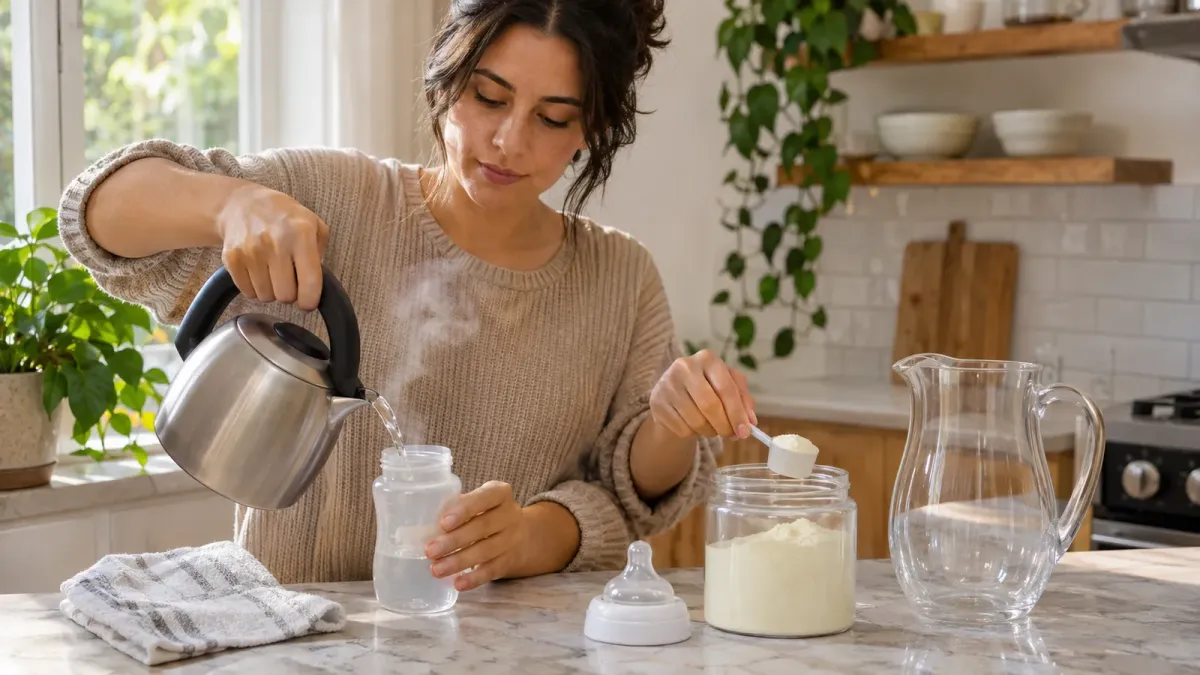
To hit this temperature at home, you do not need fancy gear. Boil fresh cold tap water in a kettle or a covered pot. Wait for it to stop bubbling. Then let it sit in the kettle or pot for no more than 30 minutes.
After 20 to 30 minutes, a full kettle of boiled water is usually still above 70°C. If you only boiled a tiny cup of water, it will cool much faster. Boil at least half a kettle, or use a clean food thermometer to check.
Why not use boiling water at 100°C?
Water straight off the boil can scald your hands if it splashes. Very hot water can also break down some vitamins in the formula, such as vitamin C. It can also make the powder clump together instead of mixing smoothly.
Why not use cold or lukewarm water?
Cool water feels easier because you can feed your baby right away. However, water below 70°C will not kill Cronobacter if it is in the tin. If your baby is under 2 months old or has health risks, warm or cool water skips an important safety step.
How to make one bottle with 70°C water
Follow these steps when you make a single feed.
- Wash your hands. Use soap and warm water for at least 20 seconds. Dry them with a clean towel or paper towel.
- Wipe the bench. Clean the counter where you will place the bottle and lid.
- Get a sterilised bottle. Wash and sterilise bottles, teats, rings and caps before use. Follow the instructions on your steriliser or boil them in a pot of water.
- Boil fresh water. Fill the kettle with fresh cold tap water. Bring it to a full boil. Never re-boil water that has been sitting in the kettle.
- Let the water cool briefly. Leave it in the covered kettle for up to 30 minutes so it stays at 70°C or above.
- Pour the water first. Check the tin for the exact water amount. Put the bottle on a flat bench and check the line at eye level.
- Add the powder. Use only the scoop that came with that tin. Fill it loosely and level it off with the flat edge inside the tin or a clean knife. Do not press the powder down. Add the exact number of scoops.
- Mix gently. Put the cap and teat on tightly. Swirl or shake gently until no lumps remain.
- Cool the bottle fast. Hold the sealed bottle under cold running tap water. Or stand it in a bowl of cold or iced water. Keep the cap and teat above the water so tap water does not touch the teat.
- Test the temperature. Shake a drop onto the inside of your wrist. It should feel lukewarm or cool, never hot.
- Feed straight away. If your baby does not finish the bottle within 1 hour, throw the rest away.
How to use the 24-hour pitcher method
Making one bottle at a time takes work, especially at 2:00 AM. The 24-hour pitcher method lets you mix a full day of formula in one go. You pour what you need into clean bottles and warm them only when your baby is hungry.
Parents like this method for three main reasons:
- Less waste: If your baby only drinks 75 mL or 110 mL, you can pour that exact amount.
- Fewer bubbles: Mixed formula sits in the fridge and the foam settles. This can mean less wind for your baby.
- Faster night feeds: You only have to pour and warm, not boil and measure while half asleep.
Is the pitcher method safe?
Yes, when you follow strict cooling and fridge rules. The WHO, the US Centers for Disease Control and Prevention (CDC), Health Canada and Australia's Raising Children Network all say you can make formula ahead of time and keep it in the fridge for up to 24 hours. The UK National Health Service (NHS) strongly prefers making each bottle fresh, because germs grow faster in stored milk. If you do make feeds ahead in the UK, the NHS says to cool them fast and use them within 24 hours.
Always check the tin first. A few special medical formulas must be mixed fresh and cannot be stored. Ask your doctor or child health nurse if your baby uses a special formula.
Step-by-step pitcher method
- Sterilise your pitcher. Use a clean, heat-safe glass or BPA-free plastic jug with a tight lid. Sterilise the pitcher, lid and mixing paddle or spoon.
- Boil fresh water. Boil cold tap water and let it sit for no more than 30 minutes so it stays at 70°C or above.
- Measure the water into the pitcher first. Check how much your baby usually drinks in 24 hours. Never guess the lines on the side of the jug.
- Count your scoops carefully. Add the exact number of level scoops for that amount of water. Count out loud or write tally marks on a notepad. Losing count in a big batch is a common mistake.
- Mix smoothly. Stir or pump the mixer until all the powder dissolves.
- Cool the pitcher fast. Stand the sealed pitcher in a large bowl of ice water for 10 to 15 minutes. Cooling it first stops it from warming up your fridge.
- Put it at the back of the fridge. Keep your fridge at 4°C (39°F) or colder. Never store the pitcher in the fridge door, where the temperature rises every time the door opens.
- Label the pitcher. Stick a piece of tape on the lid with the time and date you made it.
- Pour and serve within 24 hours. Pour each feed into a sterilised bottle. You can serve it cold, or warm it in a bowl of warm water for a few minutes. Throw away any formula left in the pitcher after 24 hours.
Single bottle vs pitcher method vs ready-to-feed
Each way of feeding has pros and cons. Many families use more than one method as their baby grows.
| Feature | Single bottle (70°C) | 24-hour pitcher method | Ready-to-feed liquid |
|---|---|---|---|
| Is it sterile? | No, but 70°C kills germs | No, but 70°C kills germs | Yes, sterile until opened |
| Time to prep each feed | 10 to 15 minutes | 2 to 3 minutes to pour and warm | Ready right away |
| Best for newborns under 2 months | Yes | Only if cooled fast and fridge is 4°C | Best choice for high-risk babies |
| Waste if baby drinks odd amounts | Medium | Low | High once carton is open |
| Air bubbles in milk | More from shaking | Very few | Very few |
| Easy for travel | Needs boiled water | Needs a cold cooler bag | Very easy, no water needed |
Official rules in Australia, the UK, the US and Canada
Parents often feel confused because health websites in different countries give slightly different water advice. Here is what the main health bodies say side by side.
| Country | Main health bodies | Water temperature rule | Pre-making and storing |
|---|---|---|---|
| Australia | NHMRC, Raising Children Network, Pregnancy, Birth and Baby | Boil fresh water and let it cool to lukewarm (around body heat) for healthy term babies, or follow the tin. | Safe to pre-make and store at the back of the fridge at 4°C or colder for up to 24 hours. |
| United Kingdom | NHS | Boil fresh water, cool for no more than 30 minutes so it stays at least 70°C. Use for every feed under 12 months. | Strongly prefers making each bottle fresh. If stored, cool fast and use within 24 hours. |
| United States | CDC, FDA, American Academy of Pediatrics (AAP) | Use 70°C (158°F) water or ready-to-feed liquid for babies under 2 months, premature, or with weak immune systems. Safe tap water can be used for older healthy babies. | Safe to pre-make and store in the fridge at 4°C (39°F) or colder for up to 24 hours. |
| Canada | Health Canada, Canadian Paediatric Society (Caring for Kids) | Boil water for 2 minutes. Cool to at least 70°C for babies under 2 months, premature, low birth weight, or weak immune systems. Cool to room temp for healthy older babies. | Safe to pre-make and store in the fridge at 4°C or colder for up to 24 hours. |
Why do the rules differ? In Australia, Cronobacter illness from formula has been very rare, so the National Health and Medical Research Council (NHMRC) focuses on boiling water to kill germs in the water itself. The UK NHS and the WHO take a stricter line and ask all parents to use 70°C water for every powdered feed. Using 70°C water is safe in all four countries, as long as you cool the bottle before feeding.
Safe storage times and temperatures
Bacteria multiply fast in warm milk. Once mixed, formula has strict time limits. Stick to the shortest time if you are unsure.
| Situation | Safe time limit | What to do after |
|---|---|---|
| Freshly made, not drunk yet, at room temperature | Use within 2 hours | Put in the fridge right away if not used, or throw out after 2 hours |
| Baby has started drinking from the bottle | Use within 1 hour | Throw away any leftover milk after 1 hour |
| Freshly made, stored at back of fridge (4°C or colder) | Use within 24 hours | Throw away any leftover milk after 24 hours |
| Opened ready-to-feed liquid carton in the fridge | Check the label (often 24 to 48 hours) | Throw away after the time on the carton |
| In the freezer | Never freeze | Freezing separates the fat and changes the texture |
How to warm cold formula safely
Many babies happily drink formula straight from the fridge. Cold formula is completely safe. If your baby prefers warm milk, warm the bottle gently:
- Stand the sealed bottle in a bowl or jug of warm tap water for a few minutes.
- Or use an electric bottle warmer on a gentle setting.
- Swirl the bottle gently so the warmth spreads evenly.
- Test a drop on your inner wrist before feeding.
- Never warm formula in a microwave. Microwaves heat unevenly and leave scalding hot spots inside the milk.
- Never reheat a bottle a second time.
Formula safety by baby's age
Your baby's immune system and tummy grow stronger every month. What you need to do changes as they grow.
| Age stage | Main focus | Safety steps |
|---|---|---|
| Birth to 2 months | Highest risk from Cronobacter | Use ready-to-feed liquid or the 70°C water method. Sterilise all bottles, teats and scoops every time. |
| 2 to 6 months | Larger feeds and growth spurts | Keep using boiled water (70°C is safest). The 24-hour pitcher method helps with bigger daily amounts. Keep sterilising gear. |
| 6 to 12 months | Starting solid foods | Formula is still your baby's main drink until 12 months. In Australia and the UK, keep sterilising bottles until 12 months. In the US and Canada, hot soapy washing or a dishwasher sanitise cycle is often fine after 2 to 3 months for healthy babies. |
| 12 months and over | Moving to family drinks | Most healthy toddlers can switch to plain full-cream cow's milk or fortified soy milk in an open cup. Toddler milks are usually not needed. |
In Australia, the UK, the US and Canada, health bodies advise against giving plain cow's milk as a main drink before 12 months. It does not have the right mix of iron and other nutrients for babies under one.
Water safety and bottle choices
Safe water is the base of every bottle. Use cold water straight from the drinking tap, then boil it. Let the tap run for a few seconds first if the water has been sitting in the pipes overnight.
- Never use hot tap water: Hot water sits in a hot-water tank and can pick up lead or copper from old pipes.
- Be careful with tank or bore water: If you use rainwater, well water or bore water, check with your local council or health service. Some bore water has high nitrates or minerals that boiling does not remove.
- Skip mineral and fizzy water: Mineral water can have too much salt or minerals for a baby's kidneys.
- Check fluoride levels: Most city tap water has safe fluoride levels. If you use bottled water, pick low-mineral still water and still boil it before mixing.
Choosing safe bottles and pitchers
Pick bottles and pitchers made for hot liquids. Glass, stainless steel, silicone and BPA-free plastic are common choices. Look for clear markings on the side so you can measure water accurately.
If you use plastic bottles, replace them if they get scratched, cloudy or cracked. Scratches can trap milk residue and bacteria. They also make cleaning harder.
Making formula when you go out
Never carry warm mixed formula in a thermos or insulated bag. Keeping milk warm lets bacteria grow fast.
When you leave home, you have three safe choices:
- Carry powder and boiled water separately: Pack sterilised bottles filled with the right amount of cooled boiled water. Pack pre-measured formula powder in a clean, dry formula dispenser. Mix them when your baby gets hungry. Note that this uses cool water, so it is best for healthy older babies rather than newborns under 2 months.
- Carry chilled pre-made bottles: Make the bottles at home and chill them in the fridge. Pack them in an insulated cool bag with frozen ice packs. Use them within 2 to 4 hours while they stay cold. If you reach a fridge within 2 hours, put them straight inside and use within 24 hours of making.
- Use ready-to-feed liquid cartons: Small single-serve cartons are sterile and need no mixing. Pour into a sterilised bottle and feed straight away.
If you fly, airport security in Australia, the UK, the US and Canada allows you to carry baby formula, sterilised water and cool packs in your hand luggage. Tell the security staff at the screening belt so they can check them.
Common mistakes to avoid
Even careful parents slip into habits that cause tummy upsets or safety risks. Watch out for these common errors:
- Changing the scoop ratio: Adding extra powder makes the milk too concentrated. That can dehydrate your baby or cause constipation. Adding extra water means your baby gets fewer calories and nutrients.
- Packing powder into the scoop: Pressing the scoop against the side of the tin packs in too much powder. Scoop loosely and level it off.
- Putting the powder in first: Always pour the water first, then add the powder. If you add powder first, it takes up space and you end up adding too little water.
- Storing formula in the fridge door: The door is the warmest spot in the fridge. Always put bottles and pitchers on a middle or lower shelf near the back.
- Leaving a bottle in a warmer: Do not keep a bottle sitting in a warm water bath or electric warmer for hours. Warm it just before the feed.
- Topping up an old bottle: Never pour fresh formula into a half-finished bottle. Wash and sterilise the bottle first, or use a fresh one.
- Using a different tin's scoop: Scoop sizes vary between brands and stages. Always use the scoop from the tin you are opening.
Frequently asked questions
Can I use a boiling-water tap or kettle with a 70°C button?
Many modern kettles have a 70°C setting. Check how the kettle works first. Some kettles heat straight to 70°C without boiling the water first. If your tap water needs boiling to kill water germs, boil it to 100°C first, then let it cool to 70°C. A kettle that boils first and cools down, or a standard kettle left for 20 to 30 minutes, is safer.
How long does boiled water take to cool to 70°C?
A kettle filled with at least half a litre of water usually stays above 70°C for up to 30 minutes with the lid closed. A small amount of water cools much faster. If you are not sure, check with a clean digital kitchen thermometer.
Does 70°C water ruin the probiotics or vitamins in my formula?
Standard infant formulas have extra vitamins added so they still meet nutrition rules even when mixed with 70°C water. However, some formulas contain live probiotics (friendly bacteria). Very hot water can kill probiotics. Read the tin label or ask your pharmacist or child health nurse before using 70°C water with a probiotic formula.
Can I make a pitcher of formula and leave it out on the counter?
No. A pitcher of mixed formula must be cooled fast and placed in the fridge at 4°C or colder. Never leave mixed formula sitting on the bench for more than 2 hours.
Can my baby drink cold formula straight from the pitcher?
Yes. Healthy babies can safely drink cold or room-temperature formula. Warming it is only for comfort, not safety. If your baby refuses cold milk, stand the filled bottle in a mug of warm water for a couple of minutes.
What if I lose count of the scoops when making a big pitcher?
If you lose count, do not guess. Throw the batch out and start again. Guessing the scoop count can make your baby sick or leave them underfed. Many parents measure the full day's scoops into a dry bowl first, or tick each scoop off on paper as they go.
When can I stop sterilising bottles and pitchers?
In Australia and the UK, health services advise sterilising all feeding gear until your baby is 12 months old. In the US and Canada, daily sterilising is advised until at least 2 to 3 months old, or longer if your baby was born early or has health issues. After that, thorough washing in hot soapy water or a hot dishwasher cycle with heated dry is usually enough.
Sources
- World Health Organization – Safe preparation, storage and handling of powdered infant formula
- NHMRC – Infant Feeding Guidelines
- Pregnancy, Birth and Baby – Feeding your baby with formula
- Raising Children Network – Baby formula: how to make and store it
- NHS – How to make up baby formula
- NHS – Sterilising baby bottles
- CDC – Infant formula preparation and storage
- Caring for Kids, Canadian Paediatric Society – Feeding your baby in the first year
Related guides
More Parental Tips →
Crawling and Baby Development: How to Encourage Floor Play Safely
Which Water Is Safe for Baby Formula? Tap, Bottled, Filtered, Fluoride and Boiling Rules

The Soak and Seal Method for Baby Eczema: Bath Timing, Ceramide Ointments and Clothing
