Glass vs. PPSU vs. Silicone Baby Bottles: Heat, Safety and Teat Venting
Compare glass, PPSU and silicone baby bottles. Simple guide to heat safety, leaching, teat venting, cleaning and official advice.
On this page
- Key points
- What the three bottle materials are
- Thermal shock: how each bottle handles fast temperature changes
- Chemical safety, leaching and microplastics
- Teat venting and how it affects feeding
- Glass vs. PPSU vs. Silicone: side-by-side comparison
- Choosing by baby's age and daily routine
- Washing, sterilising and checking for wear
- Official advice in Australia, the UK, the US and Canada
- Common mistakes parents make with baby bottles
- Frequently asked questions
- Sources
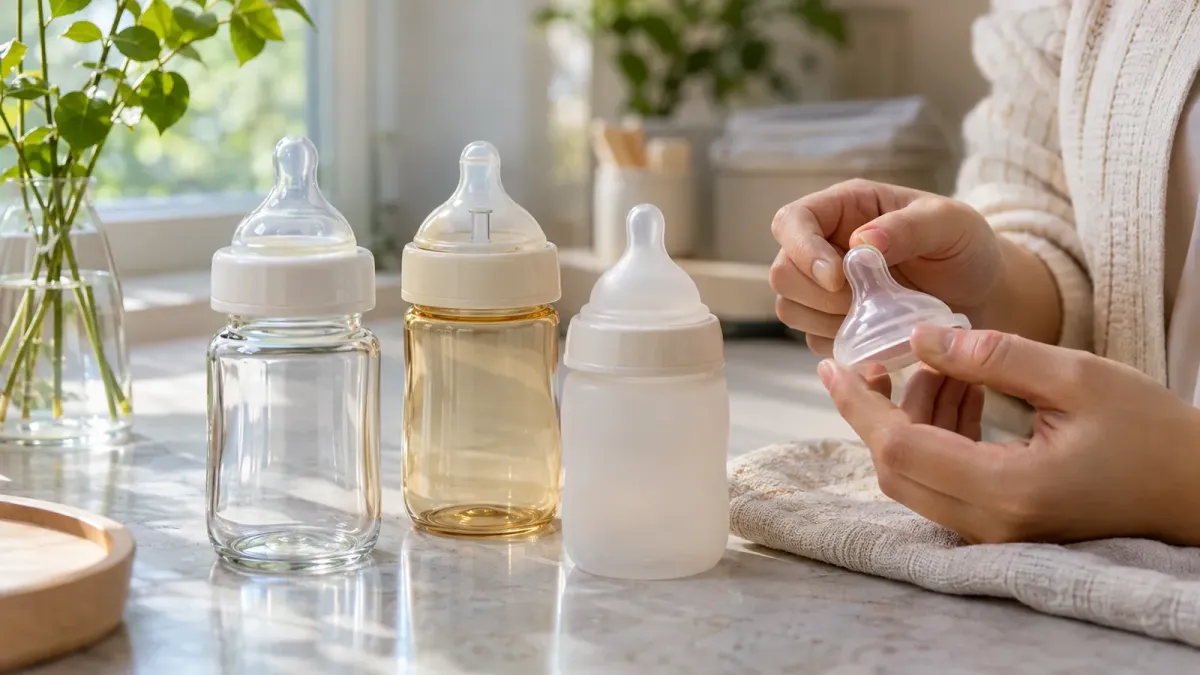
Short answer: Glass, PPSU and silicone are all safe choices for baby bottles when made to modern food-contact rules. Glass is the easiest to clean and releases no plastic, but it is heavy and can break if dropped. PPSU is a tough, amber-tinted plastic that handles high heat well and will not shatter. Silicone is soft, light and drop-proof, but it warms milk more slowly and can hold onto soap smells if not rinsed well.
Health and safety bodies in Australia (FSANZ and the NHMRC), the UK (NHS and OPSS), the US (FDA and CDC) and Canada (Health Canada and the Canadian Paediatric Society) all focus on safe materials, proper cleaning and safe milk warming. None of these three materials is banned. The best pick depends on where you feed your baby, how you warm milk, and who is holding the bottle.
Key points
- Glass: Does not stain, hold smells or shed plastic. Choose borosilicate glass for better heat resistance. Always use a silicone sleeve to protect it from knocks.
- PPSU: A strong, BPA-free plastic with a natural honey colour. It copes with boiling water and steam sterilisers better than standard cloudy plastic.
- Silicone: Soft, squeezable and shatterproof. It is great for travel and older babies who hold their own bottle.
- Thermal shock: Never pour boiling water into a cold glass bottle. Never put a hot glass bottle straight into cold water.
- Teat venting: A small vent lets air into the bottle as your baby drinks. This stops the teat from going flat and helps your baby swallow less air.
- Care: Wash all bottle and vent parts in hot soapy water after every feed. Replace any bottle that is cracked, chipped or deeply scratched.
What the three bottle materials are
Most baby bottles sold today are made from glass, plastic or silicone. Each material feels different in your hand. Each one also reacts differently to heat, soap and drops on the floor.
Glass baby bottles
Glass is the oldest bottle material. Most modern baby bottles use borosilicate glass. Borosilicate glass has a special mix of minerals that helps it handle quick heat changes better than ordinary jar glass. Some brands wrap the outside in a thin silicone sleeve. The sleeve gives you a better grip and cushions the bottle if it tips over.
PPSU baby bottles
PPSU stands for polyphenylsulfone. That is a long name for a very tough, high-heat plastic. Hospitals often use this type of plastic for medical tools that need repeated steam sterilising. You can spot PPSU easily because it has a natural amber or honey tint. It does not need added dyes to look that way. Unlike clear or cloudy everyday plastics, PPSU stays strong after hundreds of hot washes.
Silicone baby bottles
Silicone baby bottles are made from food-grade silicone. This is a soft, rubbery material made mostly from silica, which comes from sand. You can squeeze the sides gently while feeding. Silicone does not shatter when dropped on tiles or concrete. Many parents like it because it feels soft and warm to touch, much like skin.
What about regular plastic (PP) bottles?
Many budget bottles are made from polypropylene, or PP. PP is the cloudy white plastic you see on supermarket shelves. It is light and cheap, and it is BPA-free. However, PP scratches more easily than PPSU and breaks down faster under high heat. That is why many parents compare glass, PPSU and silicone when looking for a longer-lasting bottle.
Thermal shock: how each bottle handles fast temperature changes
Thermal shock happens when a material heats up or cools down too fast. One part of the wall expands or shrinks faster than the rest. That stress can make glass crack or even shatter. Understanding thermal shock keeps your kitchen safe and saves you from ruined feeds.
How glass reacts to heat and cold
Glass is rigid. When you pour boiling water into an ice-cold glass bottle, the inside wall heats up and expands right away. The outside wall stays cold. This mismatch creates stress in the glass, which can cause a crack.
Borosilicate glass handles temperature jumps much better than ordinary soda-lime glass. Still, it is not immune to thermal shock. Follow three simple habits with glass bottles:
- Let a fridge-cold glass bottle sit at room temperature for a few minutes before warming it.
- Warm it in a jug of warm tap water, not boiling water.
- Never plunge a freshly sterilised, piping-hot glass bottle into cold tap water or an ice bath.
How PPSU reacts to heat and cold
PPSU handles fast temperature changes very well. Because it is a flexible polymer, it expands and shrinks without cracking. You can take a PPSU bottle from the fridge and place it straight into a warm water bath or an electric bottle warmer. It also handles boiling water and steam sterilisers day after day without warping.
How silicone reacts to heat and cold
Silicone does not crack or shatter from thermal shock. You can freeze milk in a silicone bottle and warm it up without worrying about cracks. There is one catch, though. Silicone is a natural insulator, which means heat passes through its walls slowly. Warming a fridge-cold silicone bottle in a water bath or bottle warmer takes longer than warming glass or PPSU. Plan a few extra minutes when your baby is hungry.
Safe ways to warm any bottle
Health bodies in Australia, the UK, the US and Canada agree on the safest way to warm milk:
- Stand the bottle in a bowl or jug of warm water, or use an electric bottle warmer.
- Swirl the bottle gently to mix the milk so the warmth spreads evenly.
- Never use a microwave to warm breastmilk or formula. Microwaves heat unevenly and create hidden hot pockets that can burn your baby's mouth.
- Always shake or swirl well, then drip a little milk onto the inside of your wrist. It should feel lukewarm or body temperature, never hot.
Chemical safety, leaching and microplastics
Parents often ask if chemicals can move from a bottle into their baby's milk. Scientists call this process leaching. Leaching is more likely when a bottle is very hot, scratched or worn out.
BPA and phthalates
In the past, hard clear baby bottles were made with a chemical called bisphenol A, or BPA. Phthalates were also used to soften some plastics. Today, BPA baby bottles are no longer sold in Australia, the UK, the US or Canada. The US Food and Drug Administration (FDA) banned BPA in baby bottles and sippy cups. Health Canada banned BPA baby bottles too, and the UK and European rules ban it as well. In Australia, Food Standards Australia New Zealand (FSANZ) worked with major makers to phase out BPA baby bottles. Always buy bottles from trusted local shops rather than unknown overseas sellers so you know they meet local food-contact rules.
Microplastics and heat
Even when a plastic bottle is BPA-free, heat and shaking can release tiny plastic specks called microplastics. A 2020 study published in the journal Nature Food tested common polypropylene (PP) baby bottles. The researchers found that making formula with hot water and shaking the bottle released large numbers of microplastic particles. Both FSANZ and the World Health Organization (WHO) note that scientists are still studying what microplastics mean for human health. Even without all the answers yet, many parents choose to lower their baby's contact with heated plastic where they can.
How each material performs
- Glass: Glass is non-porous and chemically inert. It does not release microplastics, BPA or plasticisers into milk. If you want to avoid plastic contact with hot water or milk, glass is the clearest choice. Keep in mind that the collar ring and sealing disc on most glass bottles are still made from plastic, and the teat is silicone.
- PPSU: PPSU is free from BPA and phthalates. It resists heat damage and chemical breakdown much better than regular PP plastic. Because it is harder and smoother, it scratches less easily during brushing. Even so, it is still a plastic. Replace PPSU bottles if they turn cloudy, crack or get deep scratches inside.
- Silicone: Food-grade silicone is free from BPA, phthalates and latex. It does not shed microplastics like rigid plastics do. Its one quirk is that it is slightly porous to fats and scents. Milk fat and scented dish soap can cling to the inside wall over time. Using fragrance-free dish soap and boiling the bottle now and then helps clear away any film.
Teat venting and how it affects feeding
The bottle body is only half the story. The teat (also called a nipple) and its venting system control how smoothly your baby drinks. A good bottle with a poor vent can still make feeds frustrating.
Why bottles need a vent
Think about drinking from a sealed juice box. As you suck liquid out, air cannot get in to replace it. Soon the box caves in and nothing comes out. The same thing happens inside a baby bottle. Without a vent, a vacuum builds up inside the bottle. The soft teat collapses flat. Your baby has to let go of the teat to let air back in, or suck much harder. That stop-start pattern often makes babies swallow extra air, which can lead to burping, discomfort and spit-up.
Two main types of vents
Bottle makers solve this problem in two main ways:
- Teat-base vents: A tiny slit or valve sits in the soft rim of the silicone teat. As your baby sucks, the slit opens slightly to let air slip past the collar into the bottle. This style has no extra tubes to wash. It works well for most healthy babies.
- Internal vent tubes: A plastic tube, wheel or valve sits inside the bottle neck and directs air straight to the bottom of the bottle, behind the milk. This keeps air bubbles out of the milk itself. Some parents find these helpful for babies who gulp fast or struggle with wind. The downside is extra small parts to scrub after every feed.
Matching the teat flow to your baby
A vent only works well if the hole size in the teat matches your baby's suck. Boxes often label teats as slow, medium or fast flow, with age guides like 0+, 3+ or 6+ months. Treat those ages as rough hints only. Breastfed babies who also take a bottle often do best on a slow-flow teat for many months, so the bottle does not pour faster than the breast. If milk dribbles out the corners of your baby's mouth or they cough and gulp, the flow is too fast. If they suck hard for a long time, get tired or flatten the teat, try the next flow rate up.
Glass vs. PPSU vs. Silicone: side-by-side comparison
This table compares all three materials across the things that matter most in daily life.
| Feature | Glass (borosilicate) | PPSU | Silicone |
|---|---|---|---|
| Weight | Heavy; tiring for long feeds or small hands | Very light; easy for babies to hold later | Light to medium; easy to grip |
| Drop safety | Can chip or shatter on hard floors; use a sleeve | Shatterproof; survives drops on tiles | Shatterproof and soft; bounces if dropped |
| Thermal shock | Sensitive to sudden hot-to-cold jumps | Handles rapid heat and cold changes well | Handles rapid heat and cold changes well |
| Warming speed | Warms up fast in a water bath | Warms up at a steady, medium pace | Warms up slowly because silicone holds heat out |
| Chemical leaching | Zero plastic; inert food-safe surface | BPA-free; resists heat breakdown better than PP | BPA-free; no microplastics |
| Stains and smells | Never stains or holds odours | Rarely stains; may hold faint smell after heavy use | Can absorb soap scents or milk fat film |
| Scratch resistance | Does not scratch from bottle brushes | Resists light wear, but brushes can scratch it over time | Soft surface; avoid sharp or stiff wire brushes |
| Lifespan | Can last through several children if not chipped | Lasts well, usually a year or more before clouding | Long-lasting, though it can look dull over time |
| Daycare and travel | Heavy to carry; some centres ban glass | Ideal for daycare, nappy bags and flights | Great for travel and outings; light and safe |
Choosing by baby's age and daily routine
Many families do not stick to just one bottle material. You might use glass at home and keep a couple of PPSU or silicone bottles in the nappy bag. Your baby's age also changes what works best.
| Baby's age | What is happening | Bottle material tip |
|---|---|---|
| Newborn to 3 months | You hold the bottle for every feed. Feeds happen day and night. | Glass or PPSU works well. Both warm fast for sleepy night feeds. Use slow-flow vented teats. |
| 3 to 6 months | Babies start batting at the bottle and kicking their legs. | Use a silicone sleeve on glass bottles, or switch to PPSU or silicone if feeds get wiggly. |
| 6 to 12 months | Many babies try to hold their own bottle. Daycare may start. | PPSU or silicone is lighter and safer for dropping. Check if your daycare allows glass. |
| 12 months and over | Health groups advise moving from bottles to open or free-flow cups. | Start phasing out bottles for water and milk to protect baby teeth. |
Choosing for breastmilk vs. formula
If you feed expressed breastmilk, you often warm small amounts straight from the fridge or freezer. Glass and PPSU warm up faster than silicone in a warm water jug, which helps when a newborn wants milk right away. Notice also that breastmilk fat sticks slightly to all plastics and silicone. Wash bottles right after the feed with hot soapy water so fat does not build up.
If you make powdered formula, check your country's water advice. In the UK, the NHS tells parents to make formula with freshly boiled water that has cooled for no more than 30 minutes, so it stays hot enough to kill germs in the powder. At that high temperature, glass and PPSU are strong choices because they handle hot water safely without shedding the microplastics seen in some studies of regular PP plastic.
Washing, sterilising and checking for wear
Warm milk is an ideal food for bacteria. No matter which bottle material you buy, proper cleaning is what keeps your baby well. Health bodies in Australia (Raising Children Network), the UK (NHS), the US (CDC) and Canada (Caring for Kids) all stress thorough washing after every feed.
Step-by-step daily washing
- Take every part apart. Separate the teat, collar ring, bottle body and any internal vent tubes or discs.
- Rinse straight away. Rinse with cool or lukewarm water right after the feed so milk does not dry onto the walls.
- Wash in hot soapy water. Use a clean bottle brush for the body and a tiny teat brush for the teat and vent holes. Check that no milk film is left in the screw threads.
- Rinse well. Rinse all parts in clean running water to remove every trace of soap. With silicone bottles, use a mild, scent-free dish soap so the bottle does not taste like perfume.
- Air dry. Place parts on a clean drying rack or paper towel. Do not dry with a kitchen tea towel, which can carry germs.
Sterilising methods for each material
Young babies have developing immune systems. In Australia and the UK, health services advise sterilising bottles until your baby is 12 months old. In the US and Canada, health bodies advise sterilising new bottles before first use and sterilising daily for babies under 2 or 3 months, babies born early, or babies with weak immune systems. Follow your local health service's advice.
- Boiling: Submerge clean parts in a pot of water, bring to a rolling boil, and boil for 5 minutes. Glass, PPSU and silicone all handle boiling well. Use tongs to lift glass out and let it cool on a dry cloth, not a cold wet sink.
- Electric steam sterilisers: These use hot steam for a set cycle. All three materials work in steam sterilisers. Place glass bottles carefully so they do not knock against each other.
- Microwave steam bags or sterilisers: Check the bottle label first. Glass, PPSU and silicone are usually safe in microwave steam sterilisers, as long as there are no metal parts.
- Cold-water sterilising tablets: These use a mild food-safe bleach solution. They work well for glass, PPSU and silicone, and cause no heat stress at all. Rinse or drain exactly as the tablet pack says.
When to throw a bottle or teat away
Nothing lasts forever. Check your bottles and teats in good light once a week.
- Glass bottles: Throw away any bottle with a chip on the rim, a hairline crack, or a rough spot inside. Even a tiny chip can break off into the milk or cut a lip.
- PPSU bottles: Replace the bottle if it looks hazy, cracked, warped or deeply scratched inside. Germs can hide in deep scratches where a brush cannot reach.
- Silicone bottles: Replace if the silicone tears, peels or stays sticky after a thorough wash.
- Silicone teats: Tug gently on the teat tip before feeds. Throw it away if it looks swollen, sticky, cracked or discoloured, or if the hole has stretched and pours too fast.
Official advice in Australia, the UK, the US and Canada
Here is how official health and safety bodies compare across all four countries.
| Topic | Australia | UK | US | Canada |
|---|---|---|---|---|
| Main bodies | FSANZ, NHMRC, ACCC / Product Safety Australia, Raising Children Network | NHS, UK Office for Product Safety and Standards (OPSS) | FDA, CDC, CPSC, American Academy of Pediatrics (AAP) | Health Canada, Canadian Paediatric Society (Caring for Kids) |
| BPA in bottles | Phased out across baby bottles | Banned in baby bottles | Banned by FDA in baby bottles and sippy cups | Banned in baby bottles |
| Sterilising bottles | Sterilise until 12 months (NHMRC / Raising Children Network) | Sterilise until 12 months (NHS) | Sterilise before first use; daily under 2 months or for preterm/ill babies (CDC) | Sterilise before first use and for young or vulnerable babies (Caring for Kids) |
| Water for powdered formula | Boil water and cool to lukewarm or room temperature before mixing | Boil water and cool for up to 30 minutes (still hot, at least 70°C) before mixing | Safe tap or bottled water; use hot boiled water (at least 70°C) for babies under 2 months or preterm | Boil water and cool to room temperature, or use hot boiled water (at least 70°C) for high-risk babies |
| Microwaving bottles | Do not microwave; warm in warm water | Do not microwave; warm in warm water | Do not microwave; warm in warm water | Do not microwave; warm in warm water |
Common mistakes parents make with baby bottles
Most bottle problems come down to small daily habits. Fixing these saves time and keeps your baby safer.
- Pouring boiling water into a cold glass bottle: A sudden jump from fridge temperature to boiling water can crack glass. Let the bottle warm up in the room first, or use warm tap water.
- Microwaving feeds to save time: A bottle can feel cool on the outside while the milk in the middle is scalding hot. Always warm bottles in a jug of warm water or a proper warmer.
- Poking a bigger hole in the teat: Making the hole wider with a pin or knife weakens the silicone. Pieces can tear off and become a choking risk, and the milk can pour too fast.
- Forgetting to clean the vent parts: Milk gets trapped inside tiny vent valves and tubes. If you skip them, mould and germs grow fast.
- Using scented dish soap on silicone: Silicone absorbs strong smells easily. A baby may refuse a bottle that tastes like lemon or lavender soap.
- Leaving mixed formula at room temperature: Prepared formula spoils quickly in warm rooms. Follow your local health guide on safe storage times, and throw away any milk left in the bottle after a feed.
- Keeping bottles past 12 months: Health bodies in all four countries advise moving to open cups or free-flow cups around 12 months to help protect teeth and speech.
Frequently asked questions
Which baby bottle material is safest overall?
All three materials—glass, PPSU and food-grade silicone—are safe when bought from trusted brands and cared for properly. Glass is the most inert because it contains no plastic at all and never scratches from brushes. PPSU and silicone are safer choices against drops and breaks, especially when an older baby starts holding the bottle.
Can glass baby bottles go straight from the fridge into a bottle warmer?
It is safer to wait a couple of minutes first. Putting an ice-cold glass bottle straight into a hot steamer or boiling water can cause thermal shock and crack the glass. Let the bottle sit on the bench briefly, or start warming it in lukewarm tap water before turning the heat up.
Why do PPSU baby bottles look yellow or amber?
The amber colour is the natural shade of PPSU plastic. Makers do not add dye to make it look that way. It is completely normal and does not mean the bottle is dirty or old.
Do silicone baby bottles absorb soap smells?
Yes, silicone can pick up smells from strong dish soaps, dishwasher tablets and milk fats. To prevent this, wash silicone bottles with plain, fragrance-free dish soap and rinse well. If a smell lingers, boiling the clean bottle in plain water for 5 minutes often clears it out.
Do anti-colic vented bottles really stop wind and crying?
Vented bottles help reduce the air vacuum inside the bottle so your baby does not have to fight a collapsed teat. That can help some babies swallow less air. Still, crying and wind have many causes, such as feeding position, teat flow speed and normal newborn digestion. No bottle can cure colic on its own.
How often should I replace baby bottles and teats?
Check teats every week and replace them as soon as they look cloudy, sticky, cracked or stretched, or every 2 to 3 months of heavy use. Glass bottles can last for years unless they chip or crack. Replace PPSU and silicone bottles if they crack, warp, get deep scratches inside, or hold onto smells you cannot wash out.
When should my baby stop using a bottle?
Health groups in Australia, the UK, the US and Canada all suggest introducing an open cup or free-flow cup around 6 months and phasing out baby bottles completely by 12 months. Drinking milk from a bottle past the first birthday raises the risk of tooth decay and ear infections.
Sources
- Food Standards Australia New Zealand – Bisphenol A (BPA)
- Food Standards Australia New Zealand – Microplastics in food
- Raising Children Network – Baby formula: how to make and store it
- NHS – Sterilising baby bottles
- U.S. FDA – Bisphenol A (BPA): use in food contact application
- CDC – Infant formula preparation and storage
- Caring for Kids (Canadian Paediatric Society) – Feeding your baby in the first year
- Li D. et al. (2020) – Microplastic release from the degradation of polypropylene feeding bottles during infant formula preparation, Nature Food
Related guides
More Feeding & Baby Food →
Glass vs Plastic vs Stainless Steel Baby Bottles: Pros, Cons and Safety

Silicone vs Mesh Baby Feeders: Safe Ways to Offer Chilled Fruit

Glass vs Stainless Steel Baby Food Jars: Freezing, Lids and Safe Storage