Portable Battery Bottle Warmers for Flights and Road Trips: What Works and What's Allowed
Battery bottle warmers can warm milk on planes and in the car. How they work, battery rules for flights, safe formula steps and how to avoid hot spots.

On this page
- How a battery bottle warmer works
- Does my baby actually need warm milk?
- Making formula safely when you're away from home
- Warming breast milk on the go
- Taking a bottle warmer on a plane
- Using a warmer on road trips
- Warming options compared
- How to choose a portable bottle warmer
- Cleaning and caring for your warmer
- Who sets the rules in each country
- A simple feeding kit for trips
- By age and stage
- Common mistakes
- FAQ
- Sources
Short answer: A battery-powered bottle warmer is a small, rechargeable unit that warms milk or water away from a power point. It is handy on long flights, in the car and on day trips. Most have a stainless steel cup or heating plate, a lithium battery and a seal (often a silicone O-ring) to stop leaks. They are slow and can only warm a few bottles per charge, so plan ahead. For flights, the battery must go in your carry-on bag and is usually well under the 100 watt-hour limit set by airline safety rules. Always test the milk on the inside of your wrist before feeding: it should feel warm, not hot.
Key points
- Babies don't need warm milk. Room-temperature formula or breast milk is fine if your baby will take it. A warmer is about comfort and convenience.
- Warm slowly and test on your wrist. Never use a microwave; the NHS warns it can heat unevenly and burn your baby's mouth.
- Powdered formula needs water that was boiled and cooled to no less than 70°C. Most battery warmers can't reach that, so plan how you will make formula safely.
- Airline rules: spare lithium batteries and power banks go in carry-on only. Batteries up to 100 Wh need no airline approval. Batteries of 100 to 160 Wh need airline approval.
- In the car, stop to feed. Don't feed your baby while the car is moving, and don't leave a bottle propped in your baby's mouth.
How a battery bottle warmer works
Most portable warmers have three parts: a heating base with a rechargeable battery inside, a cup or sleeve that holds the milk or water, and a lid that seals.
- Heating plate or cup. A thin heating element sits under a stainless steel plate or inside a steel cup. Stainless steel is easy to clean and doesn't hold smells.
- Battery. A lithium-ion battery powers the heater. Its size is shown in milliamp-hours (mAh) and often in watt-hours (Wh).
- Seal. A silicone ring, called an O-ring, sits in the lid or between parts to stop leaks. A damaged or missing O-ring is the most common cause of a leaky warmer.
- Controls. Some let you choose a temperature. Others have a single setting, usually around body temperature.
There are two main designs. One warms milk directly in its own cup, and you pour it into a bottle. The other is a sleeve that wraps around a bottle, or a base that a bottle screws onto. Some only warm water, which you then mix with formula powder.
A few other types are worth knowing about. Thermos-style flasks hold hot water from home for hours, with no battery at all. Car warmers plug into the 12-volt socket. USB warmers draw power from a power bank. Each has strengths for different trips.
Does my baby actually need warm milk?
No. There is no health need to warm milk. Some babies are happy with room-temperature milk, and some even prefer it. Others, especially babies used to warm breast milk, may refuse a cold bottle. If your baby is fine with room-temperature milk, you may not need a warmer at all. That is simpler and safer on the go.
If you do warm milk, the NHS advice is to test it on the inside of your wrist. It should be body temperature, which means it should feel warm or cool, but not hot.
Making formula safely when you're away from home
This is the part that catches many parents out. Powdered formula isn't sterile, so it can contain germs. The NHS step-by-step guide says to boil fresh water and leave it to cool for no more than 30 minutes, so it stays at a temperature of at least 70°C. Mixing powder with water this hot kills harmful germs. Then you cool the bottle quickly under cold running water and test it on your wrist.
Most battery bottle warmers heat to around body temperature. That is fine for warming ready-made milk, but it is not hot enough to make powdered formula safely. So, on a trip, you have three practical choices:
- Ready-to-feed liquid formula. Cartons or bottles of ready-made formula are sterile until opened. They are the easiest choice for travel. Warm or serve at room temperature. Throw away anything left after the feed.
- Hot water in a good flask. Fill an insulated flask with boiling water at home, take the powder in a separate clean container, and mix when needed while the water is still at 70°C or more. Cool quickly before feeding. Check how long your flask keeps water that hot.
- A warmer that can reach high temperatures. Some travel kettles and a few portable devices can boil or reach 70°C. Check the maker's claims carefully. Many cannot.
Follow the instructions on your formula tin as well, and the advice of your own health service. In Australia, healthdirect and Pregnancy, Birth and Baby give similar advice on safe formula preparation.
Warming breast milk on the go
Expressed breast milk doesn't need to be made up, so a battery warmer suits it well. Keep it cool until you need it, using an insulated bag with ice packs. Warm it gently, swirl it to mix the fat back in, and test it on your wrist. Don't boil breast milk or heat it in a microwave. Follow your health service's advice on how long breast milk can be kept at room temperature, in a cooler bag or in the fridge, and throw away milk your baby has drunk from and not finished.
Taking a bottle warmer on a plane
Lithium batteries can overheat and catch fire, so airlines have firm rules. The rules in Australia, the US, the UK and Canada are based on the same international standards, but each airline can set extra limits.
Battery size rules
| Battery size | Rule |
|---|---|
| Up to 100 Wh | Allowed; no airline approval needed. Devices with these batteries are best kept in the cabin. Spare batteries and power banks must go in carry-on only. |
| Over 100 Wh up to 160 Wh | Airline approval needed; spares carry-on only, and usually a maximum of two. |
| Over 160 Wh | Not allowed in passenger baggage (except some mobility aids). |
Australia's Civil Aviation Safety Authority (CASA) and the US Federal Aviation Administration (FAA) both describe these limits. The FAA also says that if your carry-on bag is checked at the gate, you must take spare lithium batteries and power banks out and keep them with you in the cabin. CASA notes that airlines may limit how many power banks and spare batteries you can bring, so check with your airline.
Working out watt-hours
Many small warmers only list mAh. CASA gives this formula: volts × milliamp-hours ÷ 1,000 = watt-hours. For example, a 3.7-volt battery of 10,000 mAh is 3.7 × 10,000 ÷ 1,000 = 37 Wh, well under 100 Wh. Most bottle warmers are in this range, but check yours.
Tips for flying with a warmer
- Pack the warmer in your carry-on bag, switched off, in a case so it can't turn on by accident.
- Charge it fully before you leave. Not all airlines let you charge power banks on board.
- Tell the crew straight away if the warmer gets very hot, swells, smokes or smells odd.
- Airport security in all four countries allows baby milk, formula and water for the journey in reasonable amounts, even above the normal liquids limit. Expect it to be checked. Have it easy to reach.
- Ask cabin crew for hot water if you need it. They can often help, but don't rely on it.
Using a warmer on road trips
On the road, a warmer saves you hunting for a café with a microwave you shouldn't use anyway. A few rules keep car feeds safe.
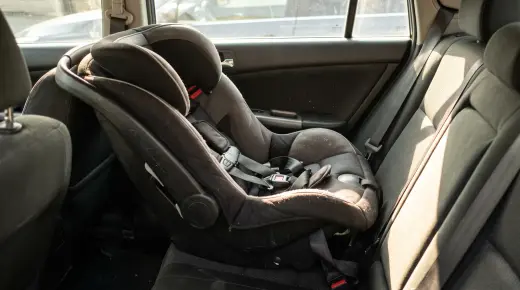
- Stop to feed. Feeding a baby while the car is moving is unsafe. If you brake hard, your baby could choke, and you can't feed properly while your baby is harnessed in a rear-facing seat. Pull over somewhere safe.
- Never prop a bottle. Propping a bottle in a car seat and walking away risks choking.
- Take your baby out of the car seat to feed when you can. Red Nose Australia advises not leaving babies to sleep in car seats outside the car and taking breaks on long drives. Use your stop to feed, change and stretch.
- Secure the warmer. A loose hard object in the car can become dangerous in a crash. Keep it in a bag on the floor or in the boot while driving.
- Use the right power. 12-volt car warmers only work while plugged in, and some drain the car battery if left on with the engine off.
- Watch the heat in summer. A hot car can make warmed milk unsafe quickly and can damage lithium batteries. Don't leave the warmer, milk or your baby in a parked car.
Warming options compared
| Option | Best for | Pros | Cons |
|---|---|---|---|
| Battery bottle warmer | Flights, day trips, breast milk | No power point needed; compact | Slow; few warms per charge; usually can't make formula safely |
| Insulated flask of hot water | Making powdered formula away from home | No battery; hot enough for formula if used in time | Water cools over time; risk of scalds |
| 12-volt car warmer | Long drives | Unlimited power while driving | Only works in the car; must stop to feed |
| USB warmer with a power bank | Travel with a power bank | Flexible | Two batteries to manage on planes |
| Bowl of warm water | Hotels, cafés | Cheap, gentle | Needs hot water to hand |
| Ready-to-feed formula at room temperature | Any trip | Simplest and sterile until opened | Costs more; bulky |
How to choose a portable bottle warmer
- Battery size in Wh clearly marked, and under 100 Wh for easy flying.
- Bottle fit. Check it fits your bottles, or comes with adapters for wide-neck and narrow-neck bottles.
- Warming time and number of warms per charge. Makers usually state these. Real results are slower in the cold.
- Temperature control and an auto shut-off, so milk doesn't keep heating.
- Leak-proof seal. Look for a replaceable O-ring. Ask if spare seals are sold.
- Easy to clean. Parts that touch milk should come apart for washing. Stainless steel cups are easy to scrub.
- Charging port. USB-C is handy because one cable can charge your phone too.
- Electrical safety marks for your country. In Australia look for the RCM mark; in the UK the UKCA or CE mark; in the US and Canada a listing from a recognised testing lab.
- No recalls. Search your country's product recall site.
Cleaning and caring for your warmer
- Wash milk parts after every use with warm soapy water, rinse and let them air dry.
- Take out the O-ring now and then, wash it and check for cracks. A tired seal leaks.
- Never put the heating base or battery under water.
- Store it partly charged if you won't use it for weeks, as the maker suggests.
- Stop using it if the battery swells, gets very hot while charging, or the case cracks. Recycle it at a battery drop-off point, not in the bin.
Who sets the rules in each country
| Country | Battery rules on planes | Feeding and formula advice |
|---|---|---|
| Australia | Civil Aviation Safety Authority (CASA) "Pack right" guidance; your airline | healthdirect, Pregnancy, Birth and Baby, the formula tin instructions |
| United Kingdom | UK Civil Aviation Authority; your airline | NHS guide to making up baby formula |
| United States | FAA PackSafe; TSA screening; your airline | CDC and AAP formula and breast milk guidance |
| Canada | Transport Canada; CATSA screening; your airline | Health Canada and your provincial health service |
The battery limits are almost the same everywhere because they come from international aviation rules. Airlines can be stricter, especially about how many power banks you carry and whether you can charge them on board. Check your airline's website a few days before you fly, because rules have changed often in recent years.
A simple feeding kit for trips
A well-packed bag means fewer stressful moments. Here's a kit that works for most trips with a bottle-fed baby:
- Clean bottles, one more than you think you'll need.
- Ready-to-feed formula cartons, or formula powder in a clean, dry container with the right scoop.
- An insulated flask of freshly boiled water if you're using powder.
- Expressed breast milk in an insulated bag with ice packs, if you use it.
- Your charged battery warmer, its cable and a spare O-ring.
- A small bottle brush and a zip bag for used bottles.
- Burp cloths, bibs and a change of clothes for your baby (and a spare top for you).
- Hand sanitiser or wipes for when you can't wash your hands.
On a plane, keep the whole kit in your cabin bag. Feeding during take-off and landing can help some babies with ear pressure, so have a bottle ready before boarding.
By age and stage
Newborns
Young babies feed often, so you will warm many bottles a day. A warmer may not keep up on a long trip. Ready-to-feed formula or expressed breast milk in a cooler bag is often easiest. Feed in a semi-upright position and hold your baby.
About 4 to 12 months
Feeds are bigger but less frequent. A warmer is more useful now. Babies may start to accept room-temperature milk, which makes travel much easier.
Toddlers
Many toddlers move to cow's milk from a cup after 12 months, as advised by health services in all four countries. Warmers become less useful. An insulated cup may be all you need.
Common mistakes
- Packing the warmer or a spare battery in checked luggage.
- Using the warmer to make powdered formula with lukewarm water.
- Not testing the milk on your wrist.
- Keeping warmed milk for later. Use warmed milk soon and throw out what's left.
- Feeding in a moving car.
- Losing the O-ring and wondering why the bag is soaked.
- Forgetting to charge it the night before.
FAQ
Can I take a battery bottle warmer on a plane?
Yes, in your carry-on bag. Batteries up to 100 Wh need no approval. Spare batteries and power banks must stay in the cabin. Check your airline's rules too.
How hot do battery bottle warmers get?
Most are designed to reach about body temperature. Some have higher settings. Check the maker's details, and always test the milk on your wrist.
Can I make formula with a battery warmer?
Usually not safely. The NHS says to use water that is at least 70°C to make up powdered formula. Most battery warmers can't reach that. Use ready-to-feed formula or a flask of hot water instead.
How many bottles can I warm on one charge?
It depends on the battery size, the amount of milk and how cold it starts. Makers often say a few bottles per charge. Expect fewer in cold weather.
Is it safe to warm breast milk in a battery warmer?
Yes, if you warm it gently and test it. Don't overheat breast milk.
Why does my warmer leak?
Usually the O-ring is missing, twisted, dirty or worn. Check it sits flat in its groove, and replace it if it is cracked.
Can my baby drink cold milk instead?
Yes. Babies don't need warm milk. If your baby is happy with room-temperature milk, that's fine.
Can I charge the warmer on the plane?
Some airlines allow charging from seat power and some don't, especially for power banks. Charge everything fully before you leave home, and check your airline's rules.
Is a car warmer better than a battery one for long drives?
A 12-volt car warmer never runs out while the engine is on, so it suits long drives. A battery warmer is better if you also fly, walk or stop at places without power. Either way, stop the car to feed.
Sources
- NHS – How to make up baby formula
- Civil Aviation Safety Authority (Australia) – Lithium batteries
- Federal Aviation Administration (US) – PackSafe: lithium batteries
- Transport Canada – What you can't bring on a plane
- HealthyChildren.org (American Academy of Pediatrics) – A parent's guide to safe sleep
- Red Nose Australia – Keeping baby safe in the car
Related guides
More Car Seats & Travel →
Kids’ Headphones for Flights and Road Trips: Volume Limits, Fit and Noise Cancelling
Baby Travel Gear: What You Need for Safer, Easier Trips

Multi-Port GaN Travel Chargers for Family Trips: Powering Monitors, Warmers, Sound Machines and Pumps From One Plug