














Kids’ Headphones for Flights and Road Trips: Volume Limits, Fit and Noise Cancelling
Learn how to choose children’s headphones for travel, compare noise cancelling with cushioned ear cups, and use them safely on flights and road trips.
On this page
- What volume limiting means
- Active noise cancelling and passive ear cups
- How to choose a pair that fits
- Using headphones on a flight
- Using headphones on a road trip
- Babies and toddlers need close attention
- Age and travel needs
- Volume, breaks and signs to stop
- Care, batteries and recalls
- Official guidance in four countries
- Common mistakes to avoid
- Frequently asked questions
- Sources
- Sources
Short answer: A “85 dB limit” is a product feature, not a guarantee that every child’s ears are protected. Sound at the ear can vary with the device, settings, fit and recording. Keep volume low, limit listening time and give your child quiet breaks. Choose headphones that fit well, feel comfortable and let you hear your child. For many young children, passive cushioned ear cups are simpler. Active noise cancelling can reduce steady background noise, but it does not make loud listening safe.
For flights, road trips and other outings, headphones are optional. They do not replace an adult’s supervision or a correctly fitted child car seat. Do not use headphones to block out sounds your child needs to hear, such as your voice, alarms or traffic.
What volume limiting means
Children’s headphones often claim to limit sound to 85 decibels, or dB. Decibels measure sound level. A limit may be set in the headphones, in the playback device, or in both. The number on a box does not tell you the sound level reaching your child’s ears in every situation.
Different devices and files can play at different levels. A loose fit can also change what a child hears. Some headphones may have a switch or app setting that changes the limit. A child might also raise the volume on a tablet or use another pair of headphones. Check the instructions and settings before each trip.
Use the lowest volume that lets your child hear the story or music. If you can hear the sound clearly while sitting beside them, it may be too loud. This is a rough check, not a sound measurement. If your child says the sound hurts, feels too loud, or makes their ears ring, stop playback and offer a quiet break.
Headphones should not be worn for long stretches without breaks. Take them off during meals, conversations and quiet time. Give your child a chance to hear the world around them. A child who is asleep should not need headphones to stay asleep.
Active noise cancelling and passive ear cups
Passive headphones use cushioned ear cups to cover the ears. The padding helps reduce some outside sound by forming a barrier. The result depends on how well the cups fit and seal around the ears.
Active noise cancelling headphones use microphones and electronics to reduce some steady background sounds. They may make the low, even rumble of an aircraft or vehicle feel quieter. They do not remove every sound. They may be less helpful for voices, sudden noises or changing sounds.
Neither type should be treated as hearing protection. Children’s listening headphones are made to play audio. Their noise reduction does not mean they protect hearing in loud places. If you need proper hearing protection for a very loud event, choose protection made for that use and seek advice from a hearing professional.
| Feature | Passive cushioned ear cups | Active noise cancelling |
|---|---|---|
| How it works | Cushions cover the ears and reduce some outside sound. | Electronics reduce some steady background noise. |
| Power | Usually no battery is needed for the sound barrier. | Noise cancelling needs power. Audio may or may not work when power runs out. |
| Travel sounds | May soften some cabin or road noise if the fit is good. | May reduce steady engine or cabin rumble. |
| Voices and alerts | Can make voices quieter, depending on fit. | Does not reliably remove voices or sudden sounds, but may still make them harder to notice. |
| Fit and comfort | Depends on cup size, headband pressure and padding. | Depends on fit and comfort, as well as the electronics. |
| Best for | Families who want a simple pair for audio and occasional travel. | Families whose child prefers less steady travel rumble and can use them with adult supervision. |
| What it cannot do | Guarantee a safe listening level or protect against every loud sound. | Guarantee a safe listening level or replace supervision and hearing protection. |
Choose based on your child’s comfort and the trip. Try the headphones at home first. If your child dislikes the pressure, heat or sound, do not force them to wear the pair.
How to choose a pair that fits
A good fit matters for comfort and sound. Headphones that slip can distract a child. Headphones that press too hard can hurt. Try them for a short time while your child is awake and calm.
- Check the age guidance. Follow the maker’s age and size guidance. A label is a starting point, not proof of a safe or comfortable fit.
- Check the cups. They should cover the ears without pressing painfully. Hair, glasses and hats can affect the fit.
- Adjust the headband. It should sit securely without squeezing. Your child should be able to move their head comfortably.
- Check for heat. Cushions can feel warm. Take the headphones off if your child gets hot, sweaty or uncomfortable.
- Look for easy controls. An adult should be able to set a low volume. Avoid relying on controls a child can change without you noticing.
- Check the cable or wireless setup. Keep cords away from a baby’s neck and hands. For wireless models, follow the charging and battery instructions.
- Inspect the parts. Look for loose padding, cracked plastic, damaged wires or parts that could come away. Stop using a damaged pair.
- Clean as directed. Follow the maker’s cleaning instructions. Do not share ear cushions if they cannot be cleaned properly.
Children grow, and a pair that fitted last season may no longer fit. Recheck the fit when you use them. Do not stretch a headband beyond its intended range or add homemade padding that could come loose.
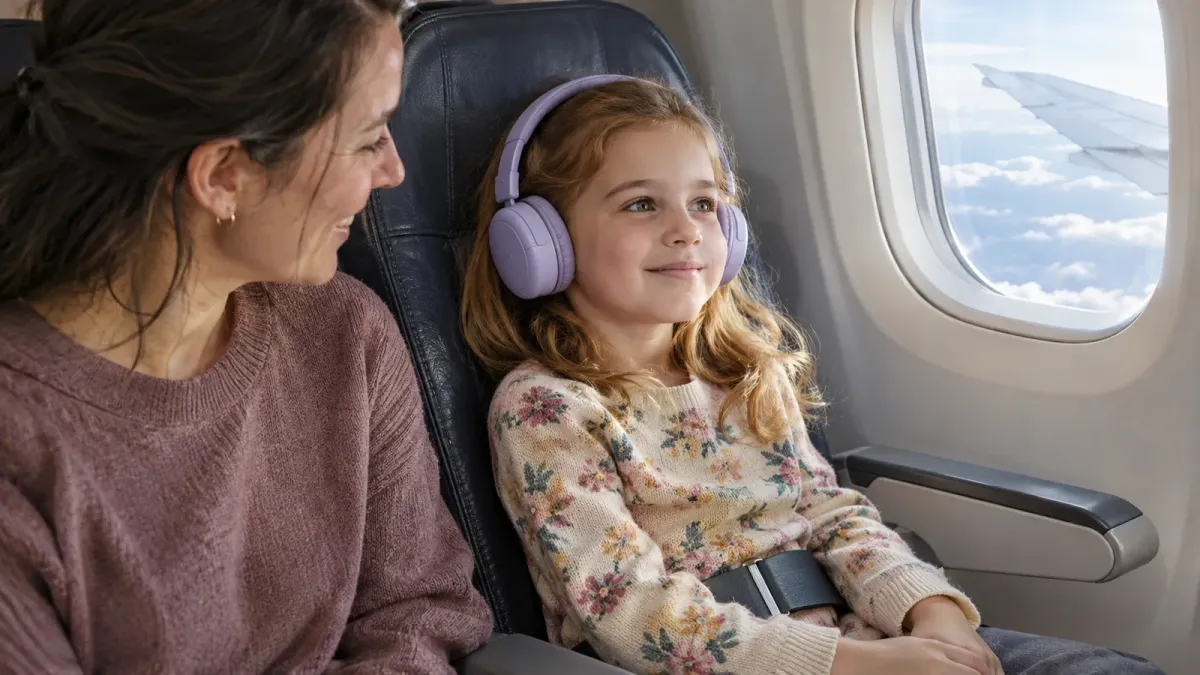
Using headphones on a flight
Air travel can be noisy and tiring. Headphones may help an older child listen to a story or show. They are not needed for every child. For babies and young toddlers, a familiar voice, feeding, cuddling or a quiet toy may be easier.
Keep one adult able to hear and see the child. Set the volume before playback. If your child needs help, remove the headphones before speaking. Do not let noise cancelling or a screen become a reason to stop watching your child.
Some children feel pressure in their ears as a plane changes height. Headphones do not prevent this. For a child who can safely drink, swallowing may help with ear pressure. Ask a health professional if your child has an ear condition or you are unsure what may help.
Pack headphones where you can reach them. Keep spare batteries or charging equipment in line with airline and security rules. Check the airline and airport guidance for your route, as rules can vary. Do not assume that a particular headphone or battery is allowed in every cabin.
During take-off, landing and crew instructions, make sure your child can hear you and the crew. Pause audio when you need their attention. If the headphones make your child upset or more restless, take them off.
Using headphones on a road trip
A child in a car must use the right child restraint for their size and age, fitted and used as instructed. Headphones do not change that. Keep the restraint’s straps and buckle in the position set out by its maker. Do not place a headphone cable under a child or through the restraint.
Before driving, set up any screen or audio for the child. The driver should not handle a device while driving. An adult passenger can help the child. Stop in a safe place if a child needs attention or an item has fallen.
Keep the driver able to hear important sounds. Do not use noise cancelling headphones while driving. A child wearing headphones may not hear the driver, another passenger or a warning. Check on them often and pause audio when you need to talk.
Plan breaks that suit your child. Take the headphones off during stops. Check that the child is comfortable and not too hot. Follow your child restraint instructions and local road rules. Never loosen or remove a restraint to make headphones more comfortable.
Babies and toddlers need close attention
Headphones are not a way to keep a baby calm or asleep. A baby needs an adult to watch and respond. Do not leave headphones on a baby who is sleeping, alone or out of your sight. Avoid placing a band or cord where it can cover the face or wrap around the neck.
Young children may not be able to explain that headphones hurt, feel hot or sound too loud. Watch for pulling them off, grimacing, crying or becoming unusually quiet. Take them off if you see signs of discomfort. Do not force a child to wear them.
For toddlers, keep the listening session short and stay nearby. Help them learn to pause audio and remove the headphones. They should still hear everyday conversation and important cues. A child who cannot reliably follow this should use headphones only with an adult close by.
Do not use headphones near roads, car parks, platforms or other places where hearing nearby sounds matters. They can make it harder for a child to notice someone speaking or a vehicle approaching.
Age and travel needs
There is no single age when every child is ready for headphones. Consider communication, comfort and supervision. Follow the product’s age guidance, but judge your own child’s response.
| Child’s stage | What to consider | Practical approach |
|---|---|---|
| Baby | Babies cannot remove headphones or explain discomfort. | Usually skip listening headphones. Keep the baby close, visible and able to hear the caregiver. |
| Young toddler | The child may pull at the pair or change controls. | Use only for short periods with an adult beside them. Take them off for sleep and conversation. |
| Older toddler or preschooler | The child may enjoy a story but still need help with volume and breaks. | Set up the device yourself. Use a low level and pause often. |
| School-age child | The child may manage basic controls, but may turn sound up. | Agree on a low setting and breaks. Check in and keep them aware of travel instructions. |
These are broad suggestions, not milestones. A child’s hearing, sensory needs and ability to follow instructions differ. Ask a health or hearing professional if you have concerns.
Volume, breaks and signs to stop
Use the device’s parental controls if available. Set a low maximum before handing over the device. If the headphones have a volume limit switch, check that it stays in the intended position. Keep the device volume low too.
Take regular quiet breaks. The right length depends on the child and the situation. Stop sooner if they show discomfort. Headphones should not cover up pain, ringing, muffled hearing or a change in how your child responds to sounds.
After a loud event or long trip, check in with your child. If they report ear pain, ringing, muffled hearing or trouble hearing, stop headphone use. Contact a health professional if symptoms persist or concern you.
A product claim cannot tell you the actual sound level at the ear. Do not treat “85 dB” as permission to listen at maximum volume for a long time. Lower volume and shorter listening are sensible choices.
Care, batteries and recalls
Wipe the headphones as the maker directs. Keep moisture away from ports and electronics. Let cushions dry before use. Replace worn or cracked cushions when the maker allows it. Do not use harsh cleaners unless the instructions say they are safe.
Charge rechargeable headphones away from a child’s bed and follow the maker’s instructions. Do not use a damaged battery or charger. Store small batteries and loose parts out of children’s reach. Check local product recall notices if you are concerned about a safety issue.
For a flight, check current airline and airport rules for batteries and devices. Keep any required battery information or charging limits in mind. Guidance may differ between countries and airlines.
Official guidance in four countries
This article offers practical buying and use advice. It does not claim that a headphone model meets a special child hearing standard. The source library for this article includes travel guidance, not a product testing rule for children’s listening headphones. Check the product instructions and seek hearing advice when needed.
| Country | Relevant official body or service | What to check |
|---|---|---|
| Australia | Product Safety Australia and the Civil Aviation Safety Authority (CASA) | Check product safety notices and airline battery guidance for travel. |
| United Kingdom | Office for Product Safety and Standards (OPSS) and the NHS | Check product safety information and seek NHS advice for hearing concerns. |
| United States | Consumer Product Safety Commission (CPSC), Federal Aviation Administration (FAA) and American Academy of Pediatrics (AAP) | Check product safety notices, flight guidance and paediatric advice. |
| Canada | Health Canada, Transport Canada and the Canadian Paediatric Society | Check recalls, travel rules and child health guidance. |
Rules for airport screening and batteries can change. Check the current guidance for your airport, airline and country before travelling. A listed safety body may not have a headphone-specific rule.
Common mistakes to avoid
- Trusting the number alone. “85 dB” does not prove the sound at the ear stays at that level in every setup.
- Turning volume up to cover noise. Instead, pause audio or move to a quieter place when possible.
- Leaving a child out of earshot. Keep close enough to notice discomfort and give instructions.
- Using noise cancelling while driving. Drivers need to hear the road and other people.
- Using headphones as ear defenders. Listening headphones are not a substitute for hearing protection designed for loud events.
- Letting a child sleep in them. Remove headphones before sleep and keep the child’s face and airway clear.
- Ignoring a poor fit. A tight or slipping pair can hurt and distract your child.
- Forgetting breaks. Pause listening and let your child hear the people around them.
Frequently asked questions
Are 85 dB headphones safe for children?
The number alone cannot prove that a pair is safe in every situation. Sound at the ear can depend on the device, settings, fit and audio. Use low volume, take breaks and stop if your child reports pain or ringing.
Do noise cancelling headphones protect a child’s hearing?
They reduce some background sounds, especially steady noise. They are still listening headphones. Do not count them as hearing protection for loud events.
Are passive ear cups better than active noise cancelling?
Neither type is best for every child. Passive cups are simple and need no noise cancelling power. Active noise cancelling may reduce some steady travel rumble. Try a comfortable fit and keep volume low with either kind.
Can my child wear headphones during a flight?
An older child may use them for a short time with an adult nearby. Pause audio when you need the child to hear you or crew instructions. Check airline and airport rules for devices and batteries.
Can my child wear headphones in a car seat?
Headphones do not change how the car seat must be fitted. Keep the restraint harness as instructed. Avoid cords that can catch or wrap around the child. Keep the driver able to hear the road.
Can a baby wear headphones on a plane?
Babies cannot tell you that headphones hurt or remove them safely. It is usually simpler to skip listening headphones and keep the baby close and visible. Ask a health professional if you have a specific concern about sound.
How can I tell if the volume is too high?
If you can clearly hear the audio beside your child, lower it. This is only a rough check. Take the headphones off if your child says it hurts, reports ringing, or seems uncomfortable.
Should children wear headphones while sleeping?
No. Remove headphones before sleep. Keep cords and devices away from a baby’s face and neck. Do not use headphones to mask sounds instead of checking on your child.
Do the volume controls on a tablet work with every headphone?
Not always. Settings and controls vary by device and headphone. Check both, set the level yourself and test playback before giving the device to your child.
Sources
- Civil Aviation Safety Authority (Australia) – Lithium batteries
- UK Office for Product Safety and Standards
- Federal Aviation Administration (US) – Flying with children
- American Academy of Pediatrics – Flying with baby
- CATSA (Canada) – Families
- Health Canada – Recalls and safety alerts
Disclaimer: This article is general information, not medical advice. Ask a health or hearing professional about your child’s hearing or symptoms. BabyGearFinder may earn a commission from eligible purchases. This does not change the price you pay.
Sources
Related guides
More Car Seats & Travel →
Portable Battery Bottle Warmers for Flights and Road Trips: What Works and What's Allowed
Road Trips with Kids: Car Seat Tray Safety, Breaks and Easy Activities
Portable White Noise Soothers for Prams and Car Seats: Volume, Placement and Safety
