













Nursery Night Lights: Red or Amber vs Blue-White Light, Melatonin and Baby Sleep
What the research says about blue and red night lights and melatonin in children, what is not yet proven for babies, and how to light a nursery for night…

On this page
- How light shapes your baby's sleep
- What is melatonin?
- Blue light vs red light: what's the difference?
- What the research says
- Do babies need a night light at all?
- Lighting the nursery by time of day
- Choosing a night light safely
- Other light sources in the nursery
- Blackout blinds and early waking
- Screens and baby sleep
- A simple evening routine that uses light well
- Day and night light for preterm and newborn babies
- Jaundice and light
- Age stages
- Sleeping safely whatever the lighting
- Advice from different countries
- Common mistakes to avoid
- FAQ
- Sources
Short answer: blue-rich light, like the cool white light from many LEDs, phones and tablets, reduces the sleep hormone melatonin more than warm red or amber light does. Studies in children show this. For babies, the picture is thinner. Raising Children Network says there is currently no good-quality evidence that red light helps babies sleep, and we found no trial that tests nursery night light colour on infant sleep. So the careful advice is simple. Keep the nursery dark for sleep where you can, use a very dim, warm (red or amber) light for night feeds and changes, avoid bright white or blue light at night, and make sure any light and its cord are safe and out of your baby's reach.
Key points
- Melatonin: the body's "it's night" hormone. Light at night, especially blue-rich light, can lower it.
- Evidence in children: blue-enriched white LED light lowered melatonin more than other lighting in a study of children.
- Evidence in babies: thin. Red light is not proven to help babies sleep.
- Practical choice: a dim, warm red or amber light is the lowest-risk choice for night care.
- Safety first: no cords near the cot, no heat, no small parts, and never put a light inside the cot.
How light shapes your baby's sleep
Your baby's body has a natural 24-hour clock, called the circadian rhythm. Light is its main signal. Bright light tells the body it's daytime. Darkness tells it that night has come. Tresillian, a child and family health service in New South Wales, explains that light, darkness, body temperature and the hormone melatonin all help shape this clock.
Newborns don't have a working clock yet. Over the first few months, it develops. Tresillian says that natural daylight in the morning and early afternoon helps set your baby's body clock. It adds that bright artificial light at night can delay the development of a baby's natural circadian rhythm.
A review of studies on light and infant circadian rhythms (a "scoping review") looked at how light exposure affects the clock in babies. It shows this is an active research area, and it fits the same basic idea. Daytime light and night-time dark are helpful signals.
What is melatonin?
Melatonin is a hormone made in the brain, mostly at night. It helps the body get ready for sleep. As bedtime nears, melatonin rises and body temperature falls. This helps us feel sleepy.
Newborns get some melatonin through breast milk. Tresillian explains that babies' own melatonin rhythm develops around 10 to 12 weeks of age. After that, their own night-time melatonin rise starts to matter more.
Light, especially blue-rich light, can lower melatonin levels. Scientists call this "melatonin suppression". The more melatonin is suppressed, the longer it may take to feel sleepy.
Blue light vs red light: what's the difference?
Visible light is made of different colours, called wavelengths. Our eyes have special cells that respond most to blue light and send "it's daytime" signals to the brain's clock.
| Light colour | Where you find it | Effect on melatonin |
|---|---|---|
| Blue or cool white (high blue content) | Phone and tablet screens, TVs, many LED bulbs, some baby monitors and night lights | Strongest effect on melatonin suppression |
| Warm white | Incandescent-style bulbs, "warm" LEDs | Less than cool white; still some effect when bright |
| Amber or orange | Some night lights, salt lamps, sunset-coloured bulbs | Much lower effect |
| Red | Red night lights and bulbs | Lowest effect on melatonin in the studies we found |
Brightness matters too. A bright light of any colour is more likely to affect your baby's sleep than a very dim one.
What the research says
Studies in children
A study in children looked at blue-enriched white LED lighting at night. It found that this lighting had a greater impact on melatonin suppression, and that it stopped the usual rise in sleepiness during the night. A review published in 2026 on nightlights and child sleep reported that children may be more sensitive to light than adults. It also noted that formal guidelines for children are lacking.
One study measured commercial children's night lights. It found that the red version of a handheld night light was well below the thresholds linked to melatonin effects, while the blue version was not. The authors suggested that doctors could advise families to choose night lights with lower blue content, such as red or amber, at the dimmest setting. But this study measured the light itself. It didn't test whether using a red night light leads to better sleep.
Studies in babies
Evidence in babies is thinner. Here's what we found:
- Raising Children Network says there is currently no good-quality evidence to say that red light helps babies sleep.
- A small hospital study of preterm babies compared normal white LED lighting with red LED lighting during night nursing care. It found no significant difference in rest-activity patterns, night-time crying or weight gain. This was in hospital, not at home.
- The Sleep Foundation, a US sleep education group, gives general advice that blue light at night can affect children's sleep. It's a guide from an education body, not a trial.
So the honest message is this. We know blue-rich light at night affects melatonin in children. We don't know whether switching to a red night light changes how well a baby sleeps. Choosing warm, dim light for night feeds is a sensible, low-risk step. But it's not a proven sleep fix, and a light isn't a replacement for good sleep habits.
Do babies need a night light at all?
No. Many babies sleep well in a dark room. A night light is mostly for you, so you can see to feed and change your baby without turning on bright lights. Some older babies and toddlers like a dim light because it makes them feel safe, once they start to notice the dark.
A few ideas:
- Newborns: they don't mind the dark. A dim light helps you.
- Babies over about 6 months: still fine in the dark for most, but some start to fuss when they wake in darkness. If so, you can try a very dim light.
- Toddlers: many go through a phase of fear of the dark. A dim, warm night light can help.
If you use a light for your baby's sleep, keep it very low and warm, and away from where they can reach it.
Lighting the nursery by time of day
| Time | Light to use | Why |
|---|---|---|
| Morning | Open curtains; bright natural light | Daylight helps set the body clock |
| Daytime | Normal room light and daylight; naps in normal light for young babies | Helps your baby tell day from night |
| Late afternoon and evening | Slowly dim the lights; avoid bright overhead lights and screens | Signals that night is coming |
| Bedtime | Dim, warm lamp for the routine; then dark or very dim light | Supports melatonin rising |
| Night feeds and changes | Very dim, warm (amber or red) light | Lets you see without a bright wake-up signal |
| Early morning | Keep dark and quiet until the usual wake time; open curtains after | Helps avoid very early waking |
Choosing a night light safely
What to look for
- Warm colour. Choose a red, amber or very warm white light. Avoid blue, cool white or multi-colour lights that cycle through colours.
- Dimmable. A light with a low setting gives you control. Aim for just enough light to see your baby's face and the nappy.
- Cool to touch. LED lights stay cool. Don't use lights that get hot.
- No small parts. Battery covers should be screwed shut, as button batteries are very dangerous if swallowed. Product Safety Australia warns that they can cause serious injury quickly.
- No cords near the cot. A plug-in light needs a cord. Place it where your baby can't reach the cord, and don't run cords near or over the cot. Rechargeable lights avoid this.
- Stable. It shouldn't tip or fall easily.
- Meets safety rules. Check for safety marks for your country, and check recalls on Product Safety Australia, the UK Product Safety Database, the US CPSC or Health Canada before buying second-hand.
- Sound and projector features. Some lights play music or project stars. These are fine if they're not too bright or loud, but keep volume low and turn them off once your baby is settled.
Where to put it
- Across the room, or low on a wall, not pointed at the cot.
- Out of reach of your baby, including when they can stand in the cot.
- Away from curtains and blinds, and away from the cot, so it can't fall into it.
- Never inside the cot, and never attached to the cot.
Other light sources in the nursery
- Baby monitors: many have small, bright LEDs and night vision lights. Turn display brightness down, face the screen away from your baby, and keep the monitor out of reach. Follow the maker's instructions for placement and cords.
- Chargers, clocks and standby lights: small LEDs can glow all night. Cover or switch them off.
- Streetlights and car headlights: blackout blinds can help, but keep the cords out of reach. Product Safety Australia has advice about blind cords.
- Phones and tablets: avoid screens at night, including your own, when feeding your baby. Use the lowest brightness and a warm filter if you do need to use your phone.
- Hallway and bathroom lights: leave doors almost closed, or use a dim light in the hall.
Blackout blinds and early waking
Blackout blinds help block light, especially in summer when it gets bright early. This can help some babies sleep longer in the morning and nap better. But there are safety points:
- Choose cordless blinds, or keep cords tied up well away from the cot and from where a toddler can climb.
- Avoid taping foil or cardboard over windows. It can fall or trap heat.
- Don't block ventilation, and keep the room at a comfortable temperature. The Lullaby Trust and Red Nose both give advice on room temperature and dressing your baby for the conditions.
Screens and baby sleep
Screens give off blue-rich light. Health bodies recommend no screens for under-2s, apart from video calls, and avoiding screens in the hour before bed for older children. For babies, it also means taking care with your own screen use at night feeds. A bright phone screen next to a drowsy baby can wake them up. Try audiobooks, music or a quiet song instead.
A simple evening routine that uses light well
You don't need special gear to use light well. A simple routine does most of the work:
- From late afternoon, dim the main lights and close the curtains as it gets dark.
- At bath time, keep the bathroom light warm and soft if you can.
- In the nursery, use a lamp with a warm bulb rather than the bright overhead light.
- Feed, read or sing in the dim light. Keep voices low and calm.
- Put your baby down on their back, drowsy but awake if you like.
- Switch to the darkest setting that works for your family: dark, or a very dim, warm night light out of reach.
- At night, use the same very dim light for feeds and changes, and go back to dark straight after.
Doing the same steps each evening teaches your baby that dim light means sleep is coming.
Day and night light for preterm and newborn babies
Hospitals sometimes use cycled lighting in neonatal units, with brighter light in the day and lower light at night, to support preterm babies. A study of preterm babies found no significant difference in sleep patterns, night-time crying or weight gain between normal white LED light and red LED light during night care. That means we can't say one colour is better in those settings. If your baby was born early, ask your neonatal team or paediatrician about lighting at home.
Jaundice and light
Some newborns have jaundice (yellow skin from a build-up of a substance called bilirubin) and may be treated with special blue light, called phototherapy. This is a medical treatment given in hospital or at home under clinical supervision. It's different from everyday lighting. Never try to treat jaundice with household lights or sunlight on your own. If your baby looks yellow, talk to your midwife or doctor.
Age stages
Newborn to 3 months
Your baby's body clock hasn't started yet. Give plenty of daylight in the day and keep nights dim and quiet. Use a very low, warm light for feeds and changes.
3 to 6 months
The clock starts to take shape. Keep bright light for the morning and early evening to a minimum, and keep to a calm routine with dim lights at bedtime.
6 to 12 months
Babies become more aware of their surroundings. A dark room still works for most. If your baby wakes and is upset in the dark, a very dim, warm night light may help.
Toddlers
Many toddlers like a night light. Choose a warm, dim one, put it away from the bed, and consider a toddler clock that changes colour at wake-up time.
Sleeping safely whatever the lighting
Light is a small piece of baby sleep. The most important steps come from safe sleep guidelines in all four countries:
- Put your baby on their back for every sleep.
- Keep their face and head uncovered.
- Use a safe cot with a firm, flat mattress and nothing else in it.
- Keep the room smoke-free, and room-share for at least the first 6 months.
- Dress your baby for the room temperature, and check their chest or back for warmth.
Don't use a dark room as a reason to skip checks. If you have a camera or monitor, it doesn't replace being in the same room as your baby in the first 6 months.
Advice from different countries
| Country | Who to check with | On light and sleep |
|---|---|---|
| Australia | Raising Children Network; Tresillian; Red Nose | Daylight in the day, dim and calm at night; no good-quality evidence that red light helps babies sleep |
| United Kingdom | NHS; The Lullaby Trust | Safe sleep advice and room temperature guidance; no specific advice on light colour |
| United States | AAP; Sleep Foundation | Avoid screens before bed; blue light can disrupt children's sleep |
| Canada | Canadian Paediatric Society; Health Canada | Screen advice for young children; safe sleep guidance |
Common mistakes to avoid
- Using a bright, cool-white light at night for feeds and changes.
- Believing red light is a proven sleep cure. It's a sensible choice, not a guarantee.
- Putting a light in the cot or attaching one to the cot.
- Cords and chargers near the cot.
- Battery covers not screwed shut.
- Scrolling on your phone beside your baby during a night feed.
- Keeping the nursery too dark in the daytime, so your baby doesn't learn the difference between day and night.
- Using lights with heat, like a lamp with an old-style bulb, next to the cot.
FAQ
Is red light better for baby sleep?
Red light affects melatonin less than blue-rich light in studies of children. But Raising Children Network says there's no good-quality evidence that it helps babies sleep.
Should my baby sleep in a completely dark room?
Many babies do. A dark room is a good choice for sleep if your baby is happy with it. A very dim light is fine if your baby or toddler prefers it.
What colour night light is best for night feeds?
A very dim red, amber or warm light is the lowest-risk choice. Avoid bright white or blue light.
Do phone screens wake my baby?
Bright screens can stimulate a baby and may suppress melatonin in children. Keep your screen brightness low, or avoid screens at night feeds.
Can I use a night light with a projector or music?
Yes, if it's dim, quiet and out of reach. Turn it off once your baby is settled.
Do blackout blinds help?
They can help block early light and support naps. Choose cordless blinds or keep cords out of reach.
How does daylight help my baby's sleep?
Natural light in the morning and early afternoon helps set your baby's body clock, according to Tresillian. Get outside or near a window each day.
Sources
- Raising Children Network – Light, noise and baby sleep: frequently asked questions
- Tresillian (NSW Health) – Baby sleep
- Melatonin suppression and sleepiness in children exposed to blue-enriched white LED lighting at night (2018), PubMed Central
- Quantifying the biological impacts of nightlights: implications for sleep and circadian health in children, PubMed Central
- Influence of light exposure at nighttime on sleep development and body growth of preterm infants, PubMed Central
- The role of light exposure in infant circadian rhythm establishment: a scoping review (PubMed)
- Sleep Foundation – How does blue light affect children's sleep?
- Red Nose Australia – What is a safe sleeping environment
- The Lullaby Trust (UK) – Room temperature
- NHS – Baby and toddler safety
Related guides
More Parental Tips →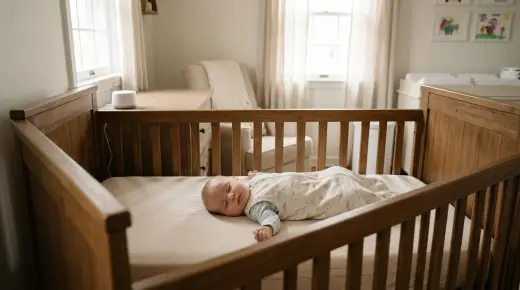
Baby Sound Soothers and White Noise: How to Use Them Safely in Your Baby's Sleep Routine

Helping Your Baby Sleep Through the Night: A Simple, Safe Guide

Split Nights: Why Your Baby or Toddler Is Awake for Hours at Night
