













Nappy and Diaper Bag Essentials: How to Choose a Bag and Pack Safely for Every Outing
Learn how to choose a practical nappy or diaper bag and pack it safely. Includes age checklists, safe milk transport, pram tipping rules, and four-country…
On this page
- Key points at a glance
- What a nappy or diaper bag really does
- Bag styles compared: backpack, tote, messenger, and waist pack
- How to balance style and practical features
- What to pack: the everyday checklist
- Packing by outing length and baby age
- Safety rules every parent must know
- Safety and hygiene guidance across Australia, the UK, the US, and Can…
- How to organise and reset your bag in 3 minutes
- Special outings: flying, hot weather, and rainy days
- Common mistakes parents make (and how to fix them)
- Frequently asked questions
- Sources
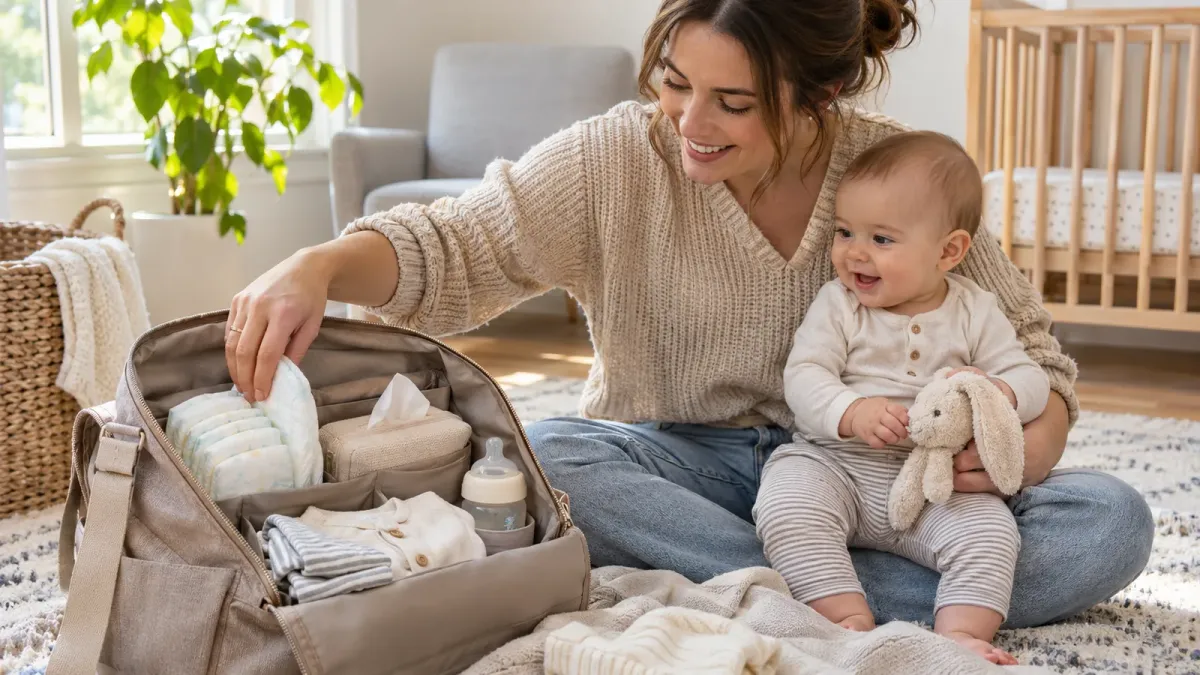
Short answer: A good nappy bag holds your baby's daily supplies without hurting your back. Parents in the US and Canada call it a diaper bag. Pick a bag with wide straps, wipe-clean fabric, and clear pockets. Pack nappies, wipes, a foldable change mat, spare clothes, and safe feeding gear. Never hang a heavy bag on your pram handlebars. It can tip the pram backwards. Put the bag in the basket under the pram instead. Keep nappy sacks, coins, medicines, and hand sanitiser in a high zipped pocket. Keep them well out of your baby's reach.
This advice matches official guidance in Australia (Product Safety Australia, Raising Children Network, and the Australian Breastfeeding Association), the UK (the NHS, the Office for Product Safety and Standards, and the Royal Society for the Prevention of Accidents), the US (the Consumer Product Safety Commission, the American Academy of Pediatrics, and the Centers for Disease Control and Prevention), and Canada (Health Canada and the Canadian Paediatric Society).
Key points at a glance
- Best style for most parents: a backpack spreads weight across both shoulders. It leaves both hands free to hold your baby.
- Pram safety rule: never hang a nappy bag over pram or stroller handles. Use the under-seat basket so the pram cannot tip over.
- Safe milk transport: carry cooled boiled water and measured formula powder separately. Otherwise, pack expressed milk in an insulated cooler bag with ice bricks.
- Hidden hazards inside the bag: plastic nappy sacks, painkillers, coin purses, button batteries, and nappy rash creams must stay out of reach.
- Pack by outing length: pack one nappy for every two hours you plan to be out. Add two extra nappies for delays.
- Comfort and style: pick neutral colours and washable fabrics. Then every caregiver can use the same bag comfortably.
What a nappy or diaper bag really does
In Australia and the UK, parents usually call it a nappy bag. In the US and Canada, parents call it a diaper bag. Both names mean the exact same thing. It is your mobile care station whenever you leave the house.
When you go out with a baby, simple errands take longer. Babies get hungry, wet, cold, or messy without warning. A well-packed bag means you do not have to rush home early. You can change a wet nappy cleanly in a park or car. You can feed a hungry baby safely on time. You can swap out a wet jumpsuit in two minutes.
Many shops sell expensive designer bags with dozens of gadgets. You do not need built-in bottle warmers or USB charging ports. In fact, battery packs inside bags can overheat or break. What you really need is a light bag that opens wide. You should be able to find a clean wipe with one hand. Your other hand must stay on your baby on the change mat.
Style still matters to many parents. You will carry this bag almost every day for two or three years. Choosing a look you enjoy makes daily outings feel pleasant. The trick is making sure good looks never spoil comfort, hygiene, or safety.
Bag styles compared: backpack, tote, messenger, and waist pack
Nappy bags come in five main shapes. Each shape suits a different way of travelling. Think about how you move around each day. Do you walk long distances with a baby carrier? Do you drive everywhere? Do you take buses and trains?
1. Backpack nappy bag
A backpack is the most practical choice for most families. It puts equal weight on both shoulders. The American Physical Therapy Association says to carry weight evenly on both shoulders. This protects your back and neck from strain. Backpacks also do not swing forward when you bend down. If you use a front baby carrier, check the backpack straps first. Make sure they sit comfortably over the carrier straps without rubbing your neck.
2. Tote nappy bag
A tote bag looks like a large handbag or work bag. It has two long handles that sit on one shoulder. Totes open very wide at the top. This makes it easy to see everything inside at once. However, a heavy tote pulls down on one shoulder. It can also slip off your arm while you carry a baby capsule. Totes suit short trips where the bag stays in the car boot or pram basket.
3. Messenger or crossbody bag
A messenger bag has one long strap that goes across your chest. You can swing the bag around to your front to grab a wipe. You do not even have to take the bag off. Like a tote, it puts all the weight on one shoulder. If you pack heavy bottles, a single strap can dig into your neck.
4. Convertible bag
A convertible bag has clip-on straps that tuck away. You can wear it as a backpack at the playground. Later, you can carry it by the top handles for a tidy look. Make sure the metal clips and sliders are strong and smooth. Cheap clips can unhook when the bag is full.
5. Compact change clutch or waist bag
A change clutch is a tiny pouch for quick errands. It holds two nappies, travel wipes, and a thin fold-out mat. It fits inside your normal handbag or clips onto your waist. It is great for thirty-minute walks or older toddlers who rarely need a change.
| Bag style | Hands-free use | Back and shoulder comfort | Storage space | Best for |
|---|---|---|---|---|
| Backpack | Yes, fully hands-free | Best, spreads weight across both shoulders | Large, holds full day supplies | Walking, public transport, toddler chasing, full days out |
| Tote bag | No, slips off one shoulder easily | Fair, pulls on one side if heavy | Large, wide top opening | Car trips, dinners, parents who want a handbag look |
| Messenger / crossbody | Mostly, rests against hip | Fair, one shoulder takes the load | Medium, flat profile | Easy reach on buses, shorter town errands |
| Convertible bag | Yes, in backpack mode | Good, extra straps add slight weight | Medium to large | Parents who share the bag and want two looks |
| Change clutch / waist pack | Yes, on waist or inside a backpack | Great, very light weight | Small, holds bare basics only | Quick neighbourhood walks, toilet-training toddlers |
How to balance style and practical features
A good-looking bag can still work hard every day. Before you buy a bag for its colour, check seven simple design details.
Weight when empty
Pick up the empty bag first. Thick leather, heavy metal chains, and big buckles add weight right away. Once you add water bottles, milk, wipes, and clothes, a heavy bag feels exhausting. Lightweight nylon, canvas, or coated cotton feels much lighter on your shoulders.
A light-coloured lining
Many stylish bags have black fabric on the inside. A black lining looks neat in a shop. In real life, it acts like a dark cave when you need a dummy. Look for a light grey, cream, beige, or patterned lining. You will spot small items right away.
Wide zip openings
A narrow zip top forces you to dig around blindly. Choose a bag with a double zip that opens down the sides. A structured frame top that stays open on its own also works well. Make sure the zips slide smoothly with one hand.
Wipe-clean and machine-washable surfaces
Milk spills, leaky fruit pouches, and muddy shoes happen to every family. Check the care tag inside the bag before you buy. Pick fabrics you can wipe with a damp cloth or wash in a machine. Check that the bottom of the bag has a waterproof base or plastic feet. You will often set the bag down on damp grass or bathroom floors.
Sensible pockets
A bag with one giant hole turns into a messy pile. A bag with twenty tiny pockets is frustrating too. Aim for six to eight clear zones:
- two outside side pockets for your drink bottle and a baby bottle;
- one zipped pocket at the back for your phone, keys, and wallet;
- one easy-reach front pocket for tissues and hand sanitiser;
- two elastic inner pouches for nappies and wipes;
- one large central space for spare clothes, muslins, and food.
Comfortable straps for every parent
Two parents, or a parent and a grandparent, often share the same bag. Test the strap adjusters in the shop. The straps should lengthen and shorten in seconds. Padded mesh straps let air flow on hot days. They also stop rough webbing from cutting into your neck.
Hardware that lasts
Look closely at the zips, rings, and stitching. Metal zips or thick moulded plastic zips last much longer than thin coil zips. Pull gently on the pocket seams to check that the stitching is tight and strong. Good hardware stops a full bag from bursting open at the bus stop.
What to pack: the everyday checklist
Packing a nappy bag is easiest when you split items into four clear groups. These are changing, feeding, clothing, and parent supplies. You can pack each group into its own lightweight zip pouch. That way, when you use a tiny toilet room, you just grab the changing pouch.
1. Changing kit
- Nappies (diapers): pack one for every two hours you will be out, plus two spares. If you use cloth nappies, pack clean shells, inserts, and a larger waterproof wet bag.
- Wipes: pack a travel pack of fragrance-free water wipes. Washable cloth wipes in a sealed tub also work well.
- Foldable change mat: use a wipe-clean mat on public change tables. Your baby should never lie directly on a cold or dirty surface.
- Barrier cream: pack a small tube of zinc cream or plain petroleum jelly. Healthdirect Australia and the AAP say barrier cream protects skin from nappy rash.
- Wet bag or disposal bags: a reusable zipped waterproof wet bag holds dirty nappies and wet clothes safely. If you carry disposable plastic nappy sacks, lock them in an adult-only zip pocket.
- Hand sanitiser or soap sheets: use these to clean your hands after a change when there is no sink.
2. Feeding kit
- For breastfed babies: pack a clean muslin cloth, nursing pads, and a bottle of water for the mother.
- For expressed breastmilk: store sterilised bottles of milk inside a separate insulated cooler bag with frozen ice bricks.
- For formula-fed babies: fill sterilised bottles with cooled boiled water and seal them tightly. Pack a dry formula dispenser holding pre-measured scoops of powder.
- For babies on solids (around 6 months and up): pack a leak-proof tub of food, a soft baby spoon, a washable bib, and a water cup.
- Burp cloths: pack two cotton or muslin squares to catch milk spit-up.
3. Clothing and comfort kit
- Spare outfits: pack two full changes of clothes for a newborn. Include singlets, all-in-one suits, and socks. Pack one full change for an older baby, plus extra pants if toilet training.
- Weather layer: include a light cotton cardigan or warm jumper to match the weather.
- Sun and outdoor care: pack a broad-brimmed sun hat and baby sunglasses meeting AS/NZS 1067.1 or ISO 12312. For babies over 6 months, pack broad-spectrum sunscreen.
- Soothers and toys: pack one clean spare dummy in a hard case. Add one or two washable teethers or small board books.
4. Parent and emergency kit
- Your own items: pack your keys, wallet, phone, lip balm, hair tie, and a one-handed snack.
- Spare top for you: roll up a thin plain t-shirt at the bottom of the bag. You will thank yourself if your baby vomits or leaks on your chest.
- Mini first-aid pouch: pack band-aids, sterile saline pods, tweezers, and a digital thermometer in a high zipped pocket.
- Health record book: pack your baby's personal health booklet for clinic visits or trips away from home.
Packing by outing length and baby age
Your bag should change as your child grows. A newborn needs lots of spare clothes and milk gear. A two-year-old needs snacks, water, and sun protection. Use the table below to trim weight and pack only what fits your trip.
| Age or stage | Quick trip (under 2 hours) | Half day out (2 to 5 hours) | Full day trip (6+ hours) |
|---|---|---|---|
| Newborn (0 to 3 months) | 3 nappies, travel wipes, change mat, 1 wet bag, 1 spare suit, 1 muslin, 1 bottle feed if needed | 5 nappies, wipes, change mat, 2 wet bags, 2 full outfits, 2 muslins, cooler bag and bottles if needed | 8 nappies, full wipes pack, 3 outfits, 3 muslins, warm layer, sun hat, full feeding kit with ice bricks |
| Infant (4 to 12 months) | 2 nappies, travel wipes, change mat, 1 spare outfit, 1 bib, 1 teether, milk or water cup | 4 nappies, wipes, change mat, 1 wet bag, 1 outfit, 2 bibs, solid meal tub, spoon, milk feed, sun hat | 6 nappies, wipes, 2 outfits, 2 meals and snacks, water cup, milk feeds in cooler, hat, sunscreen (if 6m+) |
| Toddler (1 to 3 years) | 2 nappies or pull-ups, wipes, change mat, water bottle, 1 piece of fruit, sun hat | 3 nappies, wipes, change mat, spare trousers and socks, snack box, water bottle, hat, sunscreen | 5 nappies or 4 pairs of pants, wipes, 2 outfits, lunch box, water, hat, sunscreen, small book |
| Two children (baby + toddler) | 2 nappies per child, shared wipes and mat, 1 baby suit, 1 toddler snack and water | Colour-coded pouches for each child, 3 nappies each, 1 spare outfit each, feeds and toddler snacks | Backpack bag only, 5 nappies each, spare clothes for both, insulated food bag, water bottles, hats for both |
Safety rules every parent must know
A nappy bag seems completely harmless at first glance. However, safety regulators in Australia, the UK, the US, and Canada warn parents about several serious hazards.
1. Never hang a bag on pram or stroller handlebars
Many nappy bags are sold with stroller clips or hooks. These hooks hang the bag from the pram handlebar. Product Safety Australia (ACCC), the UK Office for Product Safety and Standards (OPSS), the US Consumer Product Safety Commission (CPSC), and Health Canada all warn against hanging bags on pram handles. A heavy bag pulls the weight backwards. The pram can tip over suddenly and throw your baby onto the ground.
Prams are tested for stability under AS/NZS 2088 in Australia and New Zealand, BS EN 1888 in the UK, and ASTM F833 in the US. These tests require loads to stay in the manufacturer's storage basket. Always place your nappy bag in the basket underneath the pram seat, or wear it on your back.
2. Keep plastic nappy sacks out of reach
Thin plastic nappy sacks are a major suffocation and choking hazard. In the UK, the Royal Society for the Prevention of Accidents (RoSPA) and the NHS have issued serious alerts about nappy sacks. Babies have died after pulling thin nappy sacks over their faces or putting them in their mouths. Babies cannot easily pull thin plastic film away because it clings tightly to skin.
Never leave loose nappy sacks in open side pockets or on the change mat. Keep them locked in a top adult zip pocket. Better yet, switch to a thick fabric zipped wet bag that you wash at home.
3. Safe transport of formula and expressed breastmilk
Warm milk inside a nappy bag grows harmful bacteria very quickly. Never make up a bottle of warm formula at home to carry in a bag pocket. Built-in foil pockets inside nappy bags only slow down heat for a short time. They do not work like a fridge.
Follow the safe transport rules from the Raising Children Network, the Australian Breastfeeding Association, the NHS, the US CDC, and the Canadian Paediatric Society:
- Safer way to pack formula: fill sterilised bottles with cooled boiled water and seal them tightly. Pack the dry formula powder separately in a clean, dry pot. Mix the powder into the water only when your baby is ready to drink.
- Packing ready-made or pre-mixed milk: chill made-up formula or expressed breastmilk in the fridge at home first. Pack it into a separate insulated cooler bag surrounded by frozen ice bricks. Use made-up formula within 2 hours at room temperature, or within 4 hours in an ice-brick cooler bag.
- Throw away leftovers: once your baby starts drinking from a bottle, bacteria from their mouth enters the milk. Throw away any leftover formula within 1 hour, or within 2 hours for breastmilk. Never put a half-finished bottle back into the nappy bag for later.
4. Poisoning and choking hazards inside the bag
Curious babies and toddlers love unzipping bags left on the floor. Healthdirect Australia, the NHS, the American Academy of Pediatrics (AAP), and Health Canada warn that bags are a common source of child poisoning and choking.
- Medicines: paracetamol, ibuprofen, adult painkillers, and allergy pills must stay in child-resistant bottles. Zip them into the highest adult pocket.
- Hand sanitiser: travel bottles of alcohol hand gel often smell sweet or fruity to toddlers. Swallowing even a small squirt can cause alcohol poisoning. Make sure the cap clicks shut tightly and store it out of reach.
- Nappy rash creams and ointments: never give a tube of barrier cream to a baby to hold on the change table. Give them a safe washable teether that meets AS/NZS ISO 8124, BS EN 71, or ASTM F963 instead.
- Button batteries and coins: car key fobs, mini torches, digital thermometers, and coins must stay sealed in an adult pocket. Product Safety Australia warns that swallowed button batteries can cause deadly internal burns in under two hours.
5. Safe nappy changing on the go
Public change tables are often high off the ground over hard tiled floors. Product Safety Australia, Kidsafe, the AAP, and Caring for Kids all stress one vital rule. Keep one hand on your baby at all times on any raised surface. Do not rely on a change table strap alone to stop a fall. Open your nappy bag and lay out your nappy, wipes, and mat first. Only lift your baby onto the table when everything is in reach. If a public change table looks broken or shaky, lay your mat on the floor or car seat instead.
6. Safe materials and chemical rules
Babies often chew on change mats, bag straps, and dummy pods. Choose bags and change mats made from materials free of BPA, lead, and harmful phthalates. The US CPSC, European Chemicals Agency, and Food Standards Australia New Zealand restrict these chemicals in children's items. Avoid strong-smelling cheap vinyl plastics. If you pack a spare dummy, check that it meets AS/NZS 2195 or equivalent safety rules. Store the dummy in a clean breathable pod rather than loose at the bottom of the bag.
Safety and hygiene guidance across Australia, the UK, the US, and Canada
Core safety rules for nappy bags, pram stability, and milk transport match closely across all four countries. Here is how official bodies set out the rules side by side.
| Safety area | Australia | United Kingdom | United States | Canada |
|---|---|---|---|---|
| Pram and stroller stability | Product Safety Australia (ACCC) and AS/NZS 2088: never hang bags on handles; use the basket | OPSS and BS EN 1888: hanging bags on handles affects stability; use approved basket only | CPSC and ASTM F833: do not hang diaper bags on handlebars; tipping hazard | Health Canada carriage and stroller rules: store bags in lower basket to prevent tipping |
| Formula and milk transport | Raising Children Network and NHMRC: carry cooled boiled water and powder separately, or use ice bricks | NHS Start for Life: use a cool bag with ice packs (up to 4 hours) or mix fresh when needed | CDC and AAP: transport prepared bottles in cooler with ice packs; use within 2 hours at room temp | Health Canada and CPS: keep prepared milk cold with ice packs; discard unfinished feeds promptly |
| Plastic nappy / diaper sacks | Kidsafe and Red Nose: keep all thin plastic bags away from babies due to suffocation risk | RoSPA and NHS: explicit warnings against loose nappy sacks near cots or change mats | CPSC and AAP: keep plastic film bags out of children's reach to prevent suffocation | Health Canada: plastic bags pose a severe suffocation risk to infants and toddlers |
| Sun protection in the bag | Cancer Council Australia: pack hat, shade cloth, and SPF 50+ sunscreen (over 6 months); sunglasses to AS/NZS 1067.1 | NHS: keep babies under 6 months out of direct sun; pack wide hat and SPF 30+ for older babies | AAP: shade, hat, and UPF clothing first; sunscreen for babies over 6 months | Canadian Paediatric Society: shade, hat, sunglasses (ISO 12312), and SPF 30+ over 6 months |
| Airport carry-on rules for baby milk | Home Affairs (TravelSECURE): baby milk, sterilised water, and baby food allowed in carry-on above 100 ml | GOV.UK: enough baby milk, sterilised water, and food for the flight allowed in hand luggage over 100 ml | TSA: formula, breastmilk, toddler drinks, and ice packs allowed in carry-on above 100 ml; declare at screening | CATSA: breastmilk, formula, water, and gel ice packs for babies under 2 exempt from 100 ml limit |
How to organise and reset your bag in 3 minutes
Even the best nappy bag fails if you leave it half-empty by the front door. When you rush out the next morning, you will find one dry wipe and no clean nappies. Building a three-minute reset habit keeps you ready for any sudden trip or doctor visit.
- Empty the wet and cold items first: as soon as you walk inside, take out the cooler bag, dirty bottles, and wet clothes bag. Put the ice bricks straight back into the freezer so they are frozen for tomorrow.
- Restock from a hallway basket: keep a small basket near your front door or change table. Stock it with nappies, spare wipes, and two folded baby suits. Top up the bag right away so it has its full count of nappies again.
- Check the change mat: wipe down your foldable change mat with warm soapy water if you used it on a public table. Let it air-dry before folding it back into the bag.
- Shake out crumbs weekly: once a week, empty all pockets and shake out biscuit crumbs, sand, and lint. Wipe the inside lining with a damp cloth and mild soap.
- Check sizes every two months: babies grow fast in the first year. A spare outfit you packed in autumn might be two sizes too small by winter. Whenever your baby moves up a nappy or clothing size, swap the spares inside the bag that day.
Special outings: flying, hot weather, and rainy days
Everyday errands are simple once you have a routine. Special trips need a few extra checks before you leave home.
Flying with a nappy bag
Aeroplane cabins are cramped, and flight delays happen often. Pack double the nappies and milk feeds you think you will need for the flight time. Put a small change clutch with two nappies, wipes, and a thin mat at the very top of your bag. Airplane toilet cubicles are tiny, so taking your whole backpack inside is very hard. Keep your baby's milk, water, pouches, and gel ice bricks in one clear zip bag. Under security rules from the Australian Department of Home Affairs, GOV.UK, the US TSA, and Canada's CATSA, baby milk and cooling bricks are allowed through security over the 100 ml limit. Keeping them together makes screening fast and stress-free.
Hot summer days
In hot weather, cars and pram baskets warm up fast. Never leave your nappy bag sitting in direct sun or inside a parked car. Heat spoils milk, melts barrier creams, and ruins sunscreen. Pack an extra water bottle for yourself and offer breastfeeds or bottle feeds more often so your baby stays hydrated. Cancer Council Australia, the NHS, the AAP, and the Canadian Paediatric Society advise keeping babies out of direct sun. Pack a light muslin cloth to shade your baby's legs while keeping air flowing freely. Never drape a thick blanket over a pram hood, as it traps dangerous heat inside.
Cold and rainy days
Even water-resistant bags can leak through the zip seams in heavy rain. Pack spare baby clothes inside a sealed waterproof wet bag or zip-lock bag so they stay bone dry. Pack a dry warm beanie and socks for your baby, but take the beanie off as soon as you go indoors or put your baby down to sleep. Red Nose and the Lullaby Trust warn that hats indoors can make a baby overheat quickly.
Common mistakes parents make (and how to fix them)
- Mistake 1: Packing the whole nursery. Carrying ten nappies, three toys, two blankets, and big lotion bottles for a one-hour trip hurts your back. Fix: decant creams into tiny travel pots, use travel wipe packs, and pack for your actual trip time.
- Mistake 2: Forgetting a spare shirt for yourself. Parents always pack clothes for the baby. Then they spend the afternoon walking around with sour milk or nappy leaks on their own top. Fix: keep one thin, dark cotton t-shirt rolled tightly at the bottom of your bag.
- Mistake 3: Putting bottles loose beside phones and keys. Even a tight bottle cap can leak when squashed inside a full bag. Fix: always stand bottles upright in an outside pocket or separate cooler bag, away from electronics.
- Mistake 4: Using an unwashed bag for years. Change mats and bag bases pick up germs from public bathroom floors and park benches. Fix: wash your foldable mat after messy trips and wipe the outside base of your bag every week.
- Mistake 5: Relying on built-in foil pockets in warm weather. The shiny silver pocket inside a nappy bag is very thin. On a warm day, milk inside that pocket will not stay safely cold. Fix: use a separate zip-up cooler bag with a solid ice brick for any milk or perishable food.
- Mistake 6: Leaving the bag on the floor around toddlers. A bag left open on the living room floor invites a toddler to eat barrier cream or swallow coins. Fix: hang your nappy bag on a high coat hook or put it in a cupboard when you get home.
Frequently asked questions
Do I need to buy a special nappy bag, or can I use a normal backpack?
You can use any comfortable normal backpack you already own. A regular backpack works well if you add a foldable wipe-clean change mat, a waterproof wet bag, and a small cooler bag. Many parents prefer a regular daypack because the shoulder straps are well padded. Dedicated nappy bags simply include the change mat and extra elastic pockets already built in.
How many nappies (diapers) should I pack in my bag?
Pack one nappy for every two hours you plan to be away from home. Then add two extra nappies in case of traffic delays or sudden messy poos. For a young newborn, pack at least four to five nappies even for a short two-hour outing.
Is it safe to use stroller clips to hang my bag on the pram?
No. Safety regulators in Australia (Product Safety Australia), the UK (OPSS), the US (CPSC), and Canada (Health Canada) all warn against hanging bags on pram handlebars. Weight on the handles can make the pram tip backwards and injure your baby. Always put your bag in the storage basket underneath the pram seat.
How do I safely carry baby formula when going out for the day?
The safest way recommended by the Raising Children Network and the NHS is to carry cooled boiled water in a sealed sterilised bottle. Carry measured formula powder in a separate dry pot, and mix them right when your baby needs a feed. If you carry pre-mixed formula, chill it first and pack it in an insulated cooler bag with ice bricks. Use it within 4 hours from the cooler bag, or within 2 hours at room temperature.
Can I take a nappy bag as extra carry-on luggage on an aeroplane?
Many airlines let parents travelling with an infant bring a nappy bag into the cabin alongside their normal carry-on bag. Always check your airline's baggage rules before you fly. At airport security in Australia (Home Affairs), the UK (GOV.UK), the US (TSA), and Canada (CATSA), breastmilk, formula, baby water, and gel ice packs are exempt from the 100 ml liquid limit. Pack them near the top of your bag so security staff can check them easily.
When can I stop carrying a full nappy bag?
Most families switch from a large nappy bag to a small daypack once their child is toilet trained. This usually happens between two and three years old. Even after toilet training, it helps to carry spare underpants, trousers, wipes, a drink bottle, and a snack.
Sources
- Product Safety Australia – Prams and strollers guide
- Raising Children Network – Baby formula: how to make and store it
- Australian Breastfeeding Association – Preparing expressed breastmilk
- RoSPA (UK) – Nappy sacks safety
- NHS – How to make up baby formula
- CDC – Infant formula preparation and storage
- Caring for Kids (Canadian Paediatric Society) – Diaper rash
- American Physical Therapy Association, ChoosePT – Tips to prevent new parenting injuries
Related guides
More Parental Tips →
Nappy and Diaper Rash Cream: How to Choose, Apply, and Prevent Sore Skin

Nappy Bag Hacks: Clever Ways to Organise, Save Space and Pack Safely

Baby Sleeping Bags (Sleep Sacks): 5 Reasons to Use One and How to Choose Safely
