














Baby on Board Stickers: What They Do, Myths, and Real Car Safety
Do Baby on Board stickers help? Learn what they really do, why emergency teams check the car anyway, and what actually keeps your baby safe on the road.
On this page
- Key points
- What a Baby on Board sticker actually does
- Myths and facts about emergency responders
- How to choose and place a sticker safely
- Comparison: car signs, stickers, and real safety gear
- What really keeps your baby safe in the car
- Car seat stages by age and size
- Safety standards and official guidance: Australia, UK, US and Canada
- Common mistakes parents make with car stickers and car safety
- Frequently asked questions
- Sources
Short answer: A Baby on Board sticker is a simple sign for other drivers. It asks them to give your car extra space and drive with care. It can also remind you to stay calm behind the wheel. Still, a sticker does not protect your child in a crash. Emergency crews always check the whole car anyway. What truly keeps your baby safe is a properly fitted car seat that meets your country's safety standard.
This guide covers families in Australia, the UK, the US and Canada. The advice matches official guidance from Product Safety Australia, Red Nose, the UK's RoSPA and Lullaby Trust, the US NHTSA and American Academy of Pediatrics, and Transport Canada.
Key points
- Visual cue: A sticker lets other drivers know a baby or young child may be in the car.
- Calm driving: Seeing the sign can remind you to slow down and leave more space.
- Clear view first: Never place any sticker or sign where it blocks your rear or side view.
- Avoid hard signs: Skip heavy plastic signs with suction cups that could fly off in a crash.
- Emergency myth: Paramedics and firefighters search every seat in a crash, sticker or not.
- Real protection: A rear-facing car seat, tight harness, and safe driving do the real work.
What a Baby on Board sticker actually does
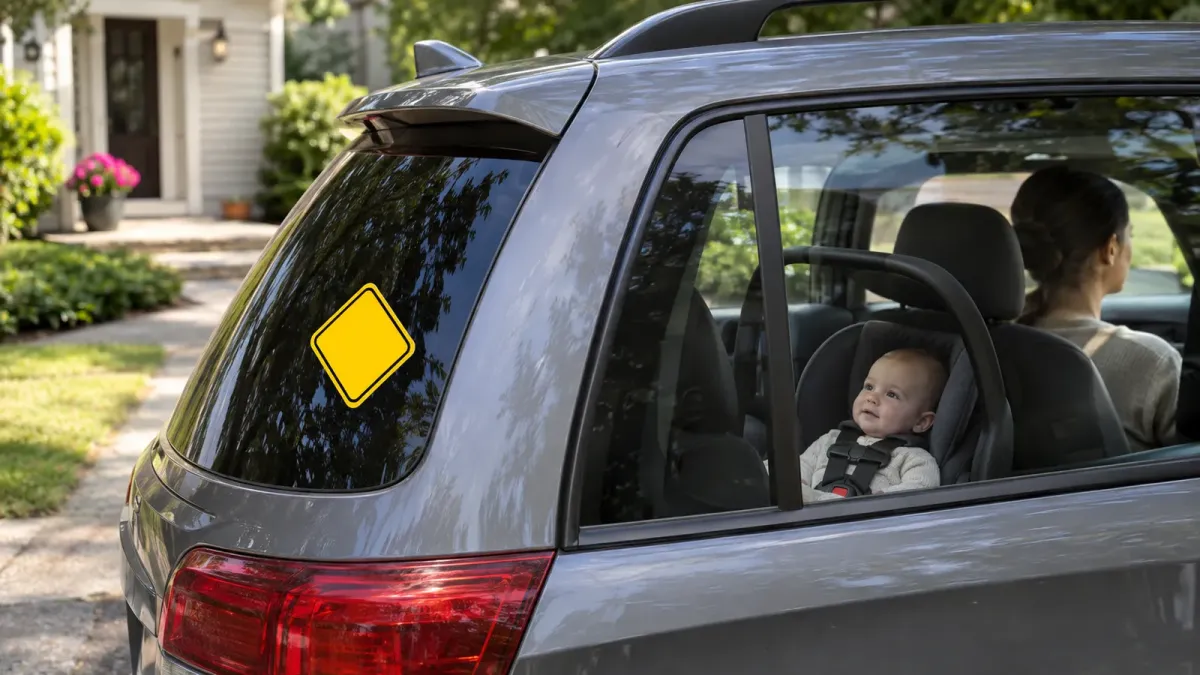
A Baby on Board sticker is a small sign for your car. Most parents put it on the rear window or bumper. You have likely seen the bright yellow diamond shape on the road.
Parents often talk about five main reasons to use one. Some of these reasons are practical. Others are more about peace of mind. Let us look at each one honestly.
1. It reminds other drivers to keep a safe gap
Roads can feel rushed and stressful. Tailgating is a common problem on busy streets. A bright sign on your back window can catch another driver's eye. It reminds them that a small child is riding inside.
Many drivers ease off the throttle when they see that sign. They may leave a bit more space behind your bumper. They may also think twice before cutting in front of you. A sticker cannot stop a careless driver, of course. Yet it is a gentle, low-cost nudge for people nearby.
2. It explains why you drive carefully
New parents often drive a little slower than usual. You might take corners gently so your baby stays asleep. You might leave extra room before braking at traffic lights. You might also pause for an extra second at a roundabout.
Without a sign, impatient drivers behind you might honk or flash their lights. With a sticker, most people understand why you are taking it steady. That can lower the tension on the road for everyone.
3. It reminds you to stay focused
Having a baby in the back seat can be distracting. A crying newborn or a dropped toy pulls at your attention. Tiredness from broken sleep also makes driving harder.
Seeing the sticker on your window or dash acts as a quiet prompt. It reminds you to keep your eyes on the road. If your baby needs you, pull over in a safe spot first. Never turn around or reach into the back seat while moving.
4. It helps in car parks and minor bumps
A sticker can also help when your car is parked. In tight car parks, other drivers might take extra care when opening doors next to you. If you have a prang in a car park, bystanders can see right away that a child may be inside.
That can bring calm, helpful people to your side faster while you check on your baby.
5. It marks your car for family and helpers
Some families share cars between parents, grandparents, and carers. A clear sign reminds anyone borrowing the car that a child seat is fitted. It can also prompt them to check the back seat before locking up. That small habit matters on hot days.
Myths and facts about emergency responders
Many websites claim that emergency teams rely on Baby on Board stickers after a crash. You may have heard that paramedics look for a yellow sticker to know a baby is inside. This is a common myth.
In real life, firefighters, police, and paramedics are trained to search every part of a crashed vehicle. They never rely on a window sticker alone. Here is why:
- A car with a sticker might have no baby inside that day.
- A car without a sticker might have two children in the back.
- Windows often shatter in a serious crash, so a sticker may be gone.
- Emergency crews check every seat, footwell, and boot area as standard practice.
Think of the sticker as a helpful bonus at most, not a safety plan. If you want to help emergency teams after a crash, put an emergency contact card on the car seat itself. Write your child's name, date of birth, allergies, and a second parent's phone number. Stick it in a clear sleeve on the side or back of the car seat shell. If you are unable to speak, paramedics will see it right away when they unbuckle your child.
How to choose and place a sticker safely
Not all Baby on Board signs are made the same way. Some are safe and simple. Others can get in your way or become a hazard inside the car.
Where to place the sign
Your first rule is clear vision. Road rules in Australia, the UK, the US, and Canada require you to see clearly out of your windows. Never put a sticker in the middle of the rear glass. Do not place it where it blocks your rear-view mirror or your blind spot.
Good spots include:
- The bottom corner of the rear window, away from the wiper path.
- The side rear quarter window, if it does not block your shoulder check.
- The painted bumper or boot lid below the glass, using an exterior vinyl sticker.
Before you stick anything down, sit in the driver's seat. Check your mirrors and look over both shoulders. Make sure you have a full, clear view of the road behind you.
Sticker vs suction sign vs magnet
In a sudden stop or crash, anything loose inside the car flies forward. A hard plastic sign held by a small rubber suction cup can pop off the glass. It can hit someone in the head or face at high speed.
A thin vinyl sticker or an outside car magnet stays flat against the surface. It will not bounce around the cabin. If you use an exterior magnet, you can also take it off when your child is not in the car.
Comparison: car signs, stickers, and real safety gear
Here is how common Baby on Board signs compare with real child car safety gear.
| Option | Main purpose | Crash protection | Cabin hazard risk | Best use |
|---|---|---|---|---|
| Exterior vinyl sticker | Alerts drivers behind you | None | None, stays outside | Budget-friendly cue on bumper or boot |
| Interior window sticker | Alerts drivers through glass | None | Very low if thin | Bottom corner of rear glass |
| Exterior magnetic sign | Removable alert for drivers | None | None, stays outside | Cars shared with non-parents |
| Suction-cup plastic sign | Removable window alert | None | Can fly off in a crash | Best avoided inside the cabin |
| Approved child car seat | Protects baby in a crash | High, when fitted right | Must be anchored tightly | Every single car trip, from birth |
What really keeps your baby safe in the car
A sticker on the glass is only a reminder. Your baby's real safety depends on how they ride inside the car. Health and road safety bodies in Australia, the UK, the US, and Canada agree on the key rules.
1. Use an approved car seat on every trip
Never hold a baby on your lap in a moving car, even for a short drive down the street. In a crash, your arms cannot hold a baby against the force of the stop. A child must travel in a properly fitted restraint that matches their size and age.
Buy a new seat if you can. If you use a second-hand seat, check its history carefully. Never use a seat that has been in a crash, has missing parts, has frayed straps, or is past its expiry date. Transport Canada and other safety agencies warn that plastic weakens over time.
2. Keep your baby rear-facing as long as possible
Rear-facing is the safest way for babies and young toddlers to travel. In a front-end crash, a rear-facing seat cradles the child's head, neck, and spine. The shell absorbs much of the force.
In a forward-facing seat, a young child's heavy head is thrown forward while their body is held by the straps. That puts huge strain on a soft neck. Keep your child rear-facing until they reach the upper height or weight limit of their seat, not just the minimum age.
3. Check the harness fit every time
A loose harness cannot hold a child safely in a crash. Follow these quick checks each trip:
- Strap height: In a rear-facing seat, straps should sit at or just below the shoulders. In a forward-facing seat, check your manual (usually at or just above the shoulders).
- Pinch test: Buckle up and tighten the straps. Try to pinch the strap fabric at the child's shoulder. If you can pinch a fold, it is too loose.
- No twists: Make sure every strap lies flat against your baby's body.
- No bulky coats: Thick winter jackets compress in a crash and leave dangerous slack. Dress your baby in thin layers, buckle them in tightly, and lay a blanket over the straps if it is cold.
4. Secure all loose items in the car
A heavy pram, nappy bag, water bottle, or tablet can turn into a dangerous projectile in a sudden stop. Keep heavy gear in the boot. Use a cargo barrier or tie-down points if you drive a hatchback, wagon, or SUV. Keep toys soft and light when your baby is holding them.
5. Never leave a baby alone in a car
Cars heat up fast, even on mild or cloudy days. Opening a window a crack does not stop the inside temperature from climbing to fatal levels. A baby's body warms up much faster than an adult's.
Both the US National Highway Traffic Safety Administration (NHTSA) and Australian safety groups urge parents to build a habit of checking the back seat every time they park. Leave your bag, phone, or left shoe in the back next to the car seat. That way you always open the back door before walking away.
6. Take sleeping babies out of car seats at home
Car seats are built for travel, not for long sleeps. Red Nose Australia and the UK's Lullaby Trust both warn against leaving a baby to sleep in a car seat once you arrive. In a seated position, a young baby's heavy head can flop forward. That can narrow their airway and make breathing harder.
When you get home, lift your baby out and place them on their back on a firm, flat mattress in a cot or bassinet. On long drives, stop every two hours or so to take your baby out for a stretch, a feed, and a nappy check.
Car seat stages by age and size
As your child grows, their car seat needs to change too. Always check the height markers or weight limits on your specific seat, because size matters more than age alone.
| Stage | Typical age | Seat direction | What to check |
|---|---|---|---|
| Newborn and infant | Birth to around 12 months (or longer) | Always rear-facing | Recline angle matches guide; harness snug at or below shoulders; no bulky clothes. |
| Toddler | 1 to 4 years (keep rear-facing as long as seat allows) | Rear-facing first, then forward-facing with 5-point harness | Top tether anchored tightly when forward-facing; shoulder height markers checked often. |
| Young child | Around 4 to 7 or 8 years (up to local height rule) | Forward-facing harnessed seat or high-back booster | Adult lap-sash belt sits low on hips and flat across the collarbone, never on the neck. |
| Older child | Around 8 to 12 years (check local height rules) | Booster until tall enough for adult belt alone | Back flat against seat, knees bend over edge, lap belt low on hips, sash across chest. |
Safety standards and official guidance: Australia, UK, US and Canada
Every country tests and approves child car seats under its own law. Because seat belt and anchor designs differ between regions, a car seat bought in one country is usually not legal to use in another. Always buy and use a seat approved for the country where you are driving.
Here is how the official bodies and standards line up across all four countries:
| Country | Main safety bodies | Car seat standard | Key rule to know |
|---|---|---|---|
| Australia | ACCC / Product Safety Australia, Red Nose, Kidsafe, Raising Children Network | AS/NZS 1754 | Top tether required on all forward-facing seats and many rear-facing seats. Rear-facing required up to at least 6 months, and advised for much longer. |
| UK | GOV.UK, RoSPA (Child Car Seats), The Lullaby Trust, NHS | R129 (i-Size) or R44 | R129 seats are chosen by child height and keep babies rear-facing until over 15 months. High-back boosters give better side protection than backless cushions. |
| US | NHTSA, American Academy of Pediatrics (AAP), CPSC | FMVSS 213 | AAP advises keeping children rear-facing as long as possible up to the seat's height or weight limit. Use a chest clip at armpit level. |
| Canada | Transport Canada, Canadian Paediatric Society (Caring for Kids) | CMVSS 213 | Must carry the National Safety Mark label. Check the expiry date moulded into the plastic shell before using any older seat. |
Notice one key difference: US and Canadian seats often include a plastic chest clip to keep the shoulder straps in place. Australian seats under AS/NZS 1754 and UK seats under R129 or R44 are designed to release with a single press in an emergency, so you should never add an aftermarket chest clip to an Australian or UK seat.
Common mistakes parents make with car stickers and car safety
Even careful parents slip up on small details. Watch out for these common mistakes:
- Blocking the rear window: Big decals, sun shades, or hanging toys can hide cyclists and pedestrians behind you. Keep the glass as clear as you can.
- Using loose suction signs: A hard plastic sign can pop off in heat or a crash and hit someone inside the car.
- Leaving the sticker up as a habit only: If you share the car, use a removable magnet so you know when a child is actually riding.
- Turning forward-facing too early: Many parents switch to forward-facing as soon as a baby's feet touch the back seat. Bent legs are safe and normal. Keep your baby rear-facing until they hit the seat's height or weight limit.
- Adding unapproved seat accessories: Soft strap pads, thick seat liners, and aftermarket headrests that did not come with your car seat can stop the harness from working in a crash.
- Using a poorly secured back-seat mirror: Many parents fit a mirror on the rear headrest to see a rear-facing baby. If you use one, pick a lightweight, shatter-resistant mirror and strap it tightly so it cannot fly forward.
- Skipping professional installation checks: Car seat fitting can be tricky. In Australia, Kidsafe and state transport agencies list trained fitters. In the UK, US, and Canada, local safety checks and certified technicians can inspect your seat for free or a low fee.
Frequently asked questions
Do Baby on Board stickers actually help?
They can help in small ways. They remind other drivers to keep a safe distance and show why you might drive gently. They also remind you to stay calm and focused. Just remember that a sticker is a polite cue, not safety gear.
Do paramedics look for Baby on Board stickers in a crash?
No, emergency crews do not rely on stickers. Firefighters and paramedics are trained to search the entire car in every crash, whether there is a sticker or not. Stickers can stay on a car when no baby is inside, and windows can break in a collision.
Is it illegal to put a Baby on Board sticker on my rear window?
A small sticker in the corner of your rear window is legal in most places, as long as it does not block your view. Road rules in Australia, the UK, the US, and Canada require a clear view through your windows and mirrors. If you are unsure, stick it on the metal boot lid or bumper instead.
Are suction-cup Baby on Board signs safe?
Hard plastic signs with suction cups are best avoided inside the car. Heat and cold can weaken the rubber suction cup, making the sign fall off. In a crash, a hard sign can fly across the cabin and injure a passenger. A flat exterior vinyl sticker or magnet is much safer.
Should I take the Baby on Board sign off when my baby is not in the car?
You do not have to, unless you want to. Some parents like using an exterior magnet so they can take it off when driving alone. That way, if emergency teams or bystanders ever see the sign, it truly means a child is on board.
What is the single most important thing for baby car safety?
Using the right car seat for your child's size, fitted tightly and used on every single trip, is the most important step. Keep your baby rear-facing as long as the seat allows, tighten the harness so it passes the pinch test, and never leave a child alone in a parked car.
Sources
- Product Safety Australia (ACCC) – Car seats guide
- Raising Children Network – Child car seats and restraints
- Red Nose Australia – Keeping baby safe in the car
- Child Car Seats (UK, RoSPA) – Choosing and using
- The Lullaby Trust (UK) – Car seats
- NHTSA (US) – Car seats and booster seats
- HealthyChildren.org (AAP) – Car seats: information for families
- Transport Canada – Child car seat safety
Related guides
More Parental Tips →
Understanding Baby Gear Safety Ratings: What Parents Should Know

PFAS "Forever Chemicals" in Baby Gear: What They Are and How to Check Cot Mattresses, Prams and More

Common Baby Gear Safety Mistakes and How to Avoid Them
