Retractable Mesh Baby Gates vs Metal Swing Gates: Skirting Boards, Hallways and Stair Safety
Compare retractable mesh baby gates and metal swing gates for busy hallways, skirting boards and stairs, with safety rules for AU, UK, US and Canada.

On this page
- Key points at a glance
- What each gate type is and how it works
- Side-by-side comparison: retractable mesh vs metal swing gates
- High-traffic hallway durability: which gate handles daily life better?
- Skirting board (baseboard) clearance: how to get a safe, flush fit
- Why stair safety is different from hallway safety
- How to measure your hallway or doorway before you buy
- Installation mistakes that ruin wall frames and skirting boards
- Age stages: when to put gates up and when to take them down
- Safety standards and official guidance: Australia, UK, US and Canada
- Living with pets and older siblings in busy hallways
- Cleaning, maintenance and weekly safety checks
- Common mistakes parents make with hallway and stair gates
- Which gate should you choose for each spot in your home?
- Frequently asked questions
- Sources
Short answer: Use a screw-in gate at the top of the stairs. A metal swing gate with no bottom bar is the safest pick there. In a busy hallway, a metal swing gate is also much faster to use. You can open it with one hand. A retractable mesh gate works well when you want a clear doorway when open. It also fits wide gaps and odd angles. If your walls have thick skirting boards (baseboards), use sliding brackets or wall spacers. These help the gate sit straight and flat.
Safety groups across the world give the same core rules. These include Product Safety Australia, Kidsafe and Raising Children Network in Australia. In the UK, check the NHS, RoSPA and the Office for Product Safety and Standards. In the US, follow the Consumer Product Safety Commission and the American Academy of Pediatrics. In Canada, check Health Canada and the Canadian Paediatric Society. All say to put gates up before your baby can crawl. Always screw gates into the wall at the top of stairs. Check the latches every single day.
Key points at a glance
- Top of stairs: Never use a pressure-fit gate at the top of stairs. A child can lean on it and push it loose. Always screw the gate into solid wood or wall studs.
- Busy hallways: Metal swing gates open in one second with one hand. Retractable mesh gates usually take two hands to pull, hook and lock.
- Trip hazard: Pressure-mounted metal swing gates have a metal bar on the floor. Screw-in swing gates and mesh gates have no floor bar.
- Skirting boards (baseboards): A skirting board pushes the bottom of a gate out. Use sliding mounts, a wooden spacer block or brand wall spacers.
- Gap under the mesh: A wide mesh gate can stretch a bit at the floor. A child might push under it if it is loose. Mount it flush with the floor and lock the roll tight.
- When to use: Put gates up around 6 months old, before crawling starts. Take them down when your child can open the latch or climb over. This often happens around age 2, or when their chin reaches the top.
What each gate type is and how it works
Parents usually pick between two main designs for hallways, doorways and stairs. You can buy a retractable mesh gate or a metal swing gate. Both keep babies out of unsafe rooms. However, they work in very different ways.
What is a retractable mesh baby gate?
A retractable mesh gate works like a sideways roller blind. A tall metal or plastic tube screws onto one side of the wall. Two catch hooks screw onto the other wall. To close the gate, you pull a strong mesh sheet across the gap. Next, you hook the handle onto the two wall catches. Finally, you push or twist a lock at the top of the tube. That lock stops the mesh from unrolling any further.
When the gate is open, the mesh rolls right back into the tube. Nothing stays on the floor. No door swings out into the hallway. Because the fabric bends, you can also fit the catches at an angle. This helps when your walls do not line up straight.
What is a metal swing baby gate?
A metal swing gate has a stiff frame made of steel or aluminium bars. A swinging door sits inside or across that frame. It has a child-resistant latch on top. You press, slide or lift the latch and swing the door open. It works just like a small garden gate. Most models swing both ways and click shut when you let go.
Metal swing gates come in two fitting styles:
- Pressure-mounted swing gates: These have a U-shaped outer frame. Four rubber bolts press hard against the two walls to hold it in place. A metal bar runs along the floor to keep the U-shape stiff. You still need to screw four small wall cups to the wall for safety. However, the gate frame itself does not bolt deep into the timber.
- Hardware-mounted (screw-in) swing gates: These screw straight into wall studs or a wooden door frame. A latch catch screws into the other wall. Because the wall carries the full weight, there is no metal bar on the floor. The whole width of the gate swings open like a regular door.
Side-by-side comparison: retractable mesh vs metal swing gates
Use this table to compare the three main gate styles for everyday family use.
| Feature | Retractable mesh gate | Pressure-mounted metal swing gate | Hardware-mounted metal swing gate |
|---|---|---|---|
| How it attaches | Screws into the wall or door frame on both sides. | Rubber bolts press into screwed-in wall cups. | Screws deep into wall studs or timber frames. |
| Safe for top of stairs? | Only if the maker allows it and you set it back from the step. | No. Never use a pressure gate at the top of stairs. | Yes. The safest pick when set to swing away from the steps. |
| Safe for bottom of stairs or rooms? | Yes. | Yes, when fitted with wall cups. | Yes. |
| Floor trip bar? | No bar on the floor. | Yes. A metal bar runs across the floor. | No bar on the floor. |
| One-hand opening in busy halls? | Hard. Usually takes two hands to pull and hook. | Easy. Opens and shuts with one hand. | Easy. Opens and shuts with one hand. |
| Noise when opening and closing | Can click or whirr loudly if you do not guide it back. | Quiet click. Soft-close latches are common. | Quiet click. |
| When left open | Rolls right out of sight into the side tube. | Door swings into the hall. Side frame narrows the gap. | Door swings flat against the wall. |
| Push-under gap at floor | Mesh can stretch a little if a child pushes under the middle. | Stiff metal bar cannot bend up. | Stiff metal frame leaves a small, fixed gap above the floor. |
| Skirting board (baseboard) fit | Many use a sliding bottom bracket or thin wall spacers. | Bottom bolts wind in or out separately from top bolts. | Needs adjustable hinges or a wooden spacer block at the top. |
| Odd angles and wide gaps | Very good. Angles across corners and spans wide rooms. | Must sit straight across. Needs extension bars for wide halls. | Some models adjust width and angle. Check the box. |
Health & Safety Gates worth a look
Real products from our catalogue. We don't show star ratings or review counts; check the current price, stock and reviews on Amazon before you buy.
 Reviewed
Dreambaby Freedom Security Gate
A low-cost metal gate that opens both ways. A stopper can make it open one way only, for stairs.
Read our full review →
Dreambaby Freedom Xtra-Wide Hallway Gate
A wide metal gate for hallways. It opens both ways and can stay open.

Dreambaby Cosmopolitan Security Gate
A metal-and-timber pressure-fit gate that opens both ways and can stay open.

Dreambaby Freedom Glide N Hide Retractable Gate
A roll-away mesh gate that fits gaps from 60 to 140 cm and hides away when open.
High-traffic hallway durability: which gate handles daily life better?
The hallway between the kitchen, living room and bedrooms gets heavy use. Parents walk through it dozens of times a day. Often you are holding a baby, a hot drink or a basket of washing. How a gate works during a busy day matters a lot.
One-hand vs two-hand operation
This is the biggest daily difference between the two gate types. A metal swing gate is built for busy walkways. You walk up and squeeze the handle with one hand. Then you nudge the door open with your hip or foot and walk through. Many swing gates swing shut behind you on a spring hinge. Most also have a stay-open catch for when your baby is asleep.
A retractable mesh gate takes much longer to open and close each time. First, you unlock the top button. Next, you pull the handle a little to free the hooks. Then you unhook both the top and bottom catches. After that, you must walk the mesh all the way back to the tube. If you let go early, the sheet whips back with a loud bang. Closing it while holding a wriggling baby is even harder. You have to pull the tight fabric across the hall and line up two hooks. Because of this, many parents leave a mesh gate open all day. A gate that stays open cannot keep your child safe.
Walkway width and the floor trip bar
A pressure-mounted metal swing gate is very easy to unlatch. Even so, it has two downsides in a narrow hallway. First, the fixed side bars take up space on both sides of the door. That leaves a narrow walking gap in the middle, often only 50 centimetres wide. If you carry a laundry basket through, your elbows may hit the frame.
Second, every pressure-mounted swing gate has a metal bar on the floor. Every person walking down the hall must step over that bar. Tripping on that bottom bar while holding a baby is a real danger. Grandparents and older kids can also catch their toes on it. If you want a swing gate with no trip bar, pick a screw-in metal swing gate. It bolts to the wall and has no bar on the floor at all. The whole width of the hallway opens up when it swings back.
How gates handle bumps from prams, laundry baskets and toys
Busy hallways see more than just feet. Families roll prams through, carry heavy boxes and push vacuum cleaners from room to room. Toddlers also push ride-on cars and toy trolleys down the hall.
In a narrow doorway, the side struts of a pressure gate get bumped often. Each hard knock from a pram wheel or vacuum head can shift the rubber feet a little. A screw-in swing gate or a retractable mesh gate clears the whole doorway when open. You can wheel a pram straight through without hitting any metal frame on the floor.
When the gate is closed, metal bars stand up well to toy crashes. If a toddler drives a plastic trike into a metal gate, the bars do not bend. If they drive a sharp toy into taut mesh, the weave can scuff or stretch over time.
Wear and tear over months of heavy use
All gates wear down in busy homes, but they wear out in different places:
- Pressure-mounted metal swing gates: Each time the door slams or a toddler shakes it, the frame vibrates. Over days or weeks, that shaking loosens the four pressure bolts. The top latch gap grows wider until the door will not lock. Screwing the four plastic wall cups into the wall stops the rubber feet from slipping.
- Hardware-mounted metal swing gates: These stay rock-solid when screwed into timber studs or a solid door frame. Never screw them into hollow plasterboard (drywall) with plastic plugs alone. A heavy door and a toddler hanging on the bars will rip the plugs right out of the plaster.
- Retractable mesh gates: The spring inside the roller winds up thousands of times. Still, dust, pet hair and rough handling can jam it. If adults let the handle go so the mesh slams back, the plastic hooks can crack. The small locking teeth inside the spool can also strip. Plus, if a toddler leans into the mesh every day, the fabric can stretch in the middle. That leaves the bottom edge looser over time.
Skirting board (baseboard) clearance: how to get a safe, flush fit
Most hallways and doorways have a wooden board along the bottom of the wall. In Australia and the UK, this is called a skirting board. In the US and Canada, it is called a baseboard. These boards are usually 1 to 3 centimetres thick and 7 to 20 centimetres tall. A baby gate must sit very close to the floor so a baby cannot crawl under it. Because of this, the bottom of the gate hits the skirting board while the top sits against the bare wall.
Do not just force a gate onto a wall with a thick skirting board. The gate will lean at an angle, the latch will miss the catch, or the top screws will pull loose.
How retractable mesh gates handle skirting boards
A retractable mesh gate must stand straight up and down. If the roller tube tilts at all, the mesh rolls up crooked. It will bunch up at one end and jam inside the tube. You have three safe ways to fit a mesh gate over a skirting board:
- Pick a gate with a sliding bottom bracket: Many mesh gates have a bottom mount that slides up and down on a track. You slide the bottom bracket up so it sits on the flat wall right above the skirting board. The mesh skirt still hangs down close to the floor. Always check that the gap under the mesh is still too small for a baby to push through.
- Use brand skirting board spacers: Many gate makers sell flat plastic spacer blocks in different thicknesses. You put these spacers behind the top wall brackets. They build the top wall out to match the thickness of the skirting board below. Always use the longer screws that come with the spacer kit.
- Fit a solid wooden batten (mounting strip): You can screw a smooth piece of solid wood vertically onto the wall stud above the skirting board. Pick wood that is the exact same thickness as your skirting board. Paint it to match your wall. Then screw the gate brackets flat into that wooden strip. Never stack loose metal washers or scrap wood behind a long screw.
How pressure-mounted metal swing gates handle skirting boards
Pressure-mounted gates are often the easiest type to fit over a skirting board. Each of the four corners has its own threaded spindle rod with a rubber foot. You simply wind the two top bolts out further than the two bottom bolts. The bottom pads press flat against the skirting board. The top pads press flat against the wall above.
Before you buy, measure the height of your skirting board. Compare it with the height of the gate's bottom frame bar. Some old houses have very low or curved skirting boards. Make sure the bottom wall cup sits on a flat part of the wood. It must not hang half off the top curve of the board. Always screw all four wall cups into place.
How hardware-mounted metal swing gates handle skirting boards
Some screw-in metal gates have top and bottom hinges that adjust on threaded bolts. You can wind the top hinge out a centimetre or two to match the skirting board below. Then the gate hangs dead straight. Other screw-in gates have flat, fixed brackets. For those, screw a solid wooden spacer block into the wall stud at the top. Make it the same thickness as the skirting board so both brackets line up straight.
Step-by-step check after fitting over a skirting board
Once your gate is up over a skirting board, run through these four quick checks:
- Use a spirit level: Hold a level against the upright frame or roller tube. The bubble should sit right in the middle.
- Check the floor gap: Measure the space between the floor and the bottom of the gate. It should be less than 5 to 6 centimetres so a baby cannot squeeze under.
- Test the latch slowly: Swing the door shut gently or pull the mesh across. The latch should line up with the catch without you lifting or bending the gate.
- Give it a firm tug: Pull and push the top of the gate hard with both hands. Nothing should shift, creak or slide on the skirting board.
Why stair safety is different from hallway safety
Falls down stairs cause many serious head injuries in babies and toddlers every year. Kidsafe Australia, RoSPA in the UK, the US CPSC and Health Canada all warn parents about stair gates. Choosing the wrong gate for stairs is very risky.
Top of the stairs: hardware-mounted swing gates come first
Never put a pressure-mounted gate at the top of the stairs. Even a tight pressure gate can shift or pop out if a toddler runs into it or leans on it. Also, every pressure gate has a metal bar along the floor. At the top of a staircase, that bar sits right on the edge of the top step. An adult can easily catch a heel on that bar and fall down the stairs.
For the top of the stairs, a screw-in metal (or solid wood) swing gate is the safest choice:
- It screws deep into wall studs or solid stair posts, so a child cannot push it out.
- It has no bottom bar on the floor to trip you up.
- It has a stop bracket so the door can only swing back over the flat landing. It can never swing out over the open steps.
Can you use a retractable mesh gate at the top of stairs?
Always read the warning label and manual for the exact model before buying. Retractable mesh gates do screw into the wall. Even so, the fabric sheet bends a little when pushed. Suppose you fit a mesh gate right on the nose of the top step. If a crawling baby pushes under the bottom of the mesh, the fabric can bow out over the drop. The child's body can then slip under the bottom edge and down the stairs.
Because of this risk, many makers and safety guides have a strict rule for mesh gates at the top of stairs. First, the gate must be tested and approved for top-of-stairs use. Second, you must fit it at least 15 to 20 centimetres (6 to 8 inches) back from the edge of the top step. That way, there is flat floor under both sides of the mesh. Third, the bottom of the mesh must sit flush with the floor, and the lock must be on every time. If your top landing does not have room to set the gate 20 centimetres back from the step, do not use a mesh gate there. Fit a rigid screw-in swing gate instead.
Bottom of the stairs
At the bottom of the stairs, the gate stops a crawling baby from climbing up the steps. Here, the drop hazard is much smaller. You can use a screw-in swing gate, a retractable mesh gate, or a pressure-mounted swing gate with screwed-in wall cups. Set the gate on the flat floor in front of the first step, or on the first step if the manual says it is safe.
How to measure your hallway or doorway before you buy
Many parents have to return baby gates to the shop because of measuring mistakes. A hallway often looks straight, but the bottom is narrower than the top because of the skirting boards. Grab a steel tape measure and write down these numbers before you shop.
- Measure at floor level between the skirting boards: Lay your tape across the floor from the front face of one skirting board to the front face of the other. Write this down as your bottom width.
- Measure at the top between the walls: Move 75 to 90 centimetres up from the floor. This is where the top of the gate will sit. Measure from wall to wall. Because there are no skirting boards up here, this top width will be 2 to 6 centimetres wider than the bottom width.
- Measure the height and thickness of your skirting board: Measure from the floor to the top edge of the skirting board. Then measure how far the board sticks out from the plaster wall.
- Find the wall studs or solid wood: Knock on the wall or use an electronic stud finder where the gate will sit. Screw-in swing gates and mesh gates must screw into solid wood or metal studs behind the plasterboard.
- Check which way room doors open: Look at nearby bedroom or bathroom doors in your hallway. Make sure a swinging metal gate will not bang into an open door handle.
- Check if you need extension bars: Most pressure-fit metal swing gates fit standard doors (around 73 to 80 centimetres) out of the box. For a wide hallway, you will need matching metal extension bars from the same brand. Never add more extensions than the manual allows. Too many extensions make a pressure gate weak in the middle.
Installation mistakes that ruin wall frames and skirting boards
Fitting a gate the wrong way can damage your walls and make the gate unsafe. Avoid these common setup mistakes:
- Screwing into hollow plasterboard (drywall): Plasterboard is just chalk between sheets of paper. Even heavy-duty wall plugs will pull out when a toddler shakes a gate every day. Always screw into a timber stud, a solid door frame, or a wooden batten anchored to studs.
- Over-tightening pressure bolts until the door frame bows: Some adults use a spanner to crank pressure bolts way too tight. This can crack wooden door frames, pop paint off skirting boards, and bend the gate so the latch sticks. Tighten the bolts just until the latch gap matches the manual, and use the wall cups to hold it in place.
- Splitting thin skirting boards with thick screws: Old timber skirting boards can split if you drive a thick gate screw straight in near the top edge. Always drill a small pilot hole first, and keep screws away from the very top lip of the board.
- Fitting a mesh gate at a slight tilt: If the roller side and the hook side are not at the exact same height, the mesh will crease diagonally. A diagonal crease leaves a loose gap at the bottom corner where a baby can crawl under. Use the paper template in the box and a spirit level.
- Drilling into thin stair spindles (balusters): The thin upright rods on a staircase are not strong enough to hold gate screws. Never drill into them. Clamp a solid wood post against the thick main stair post (newel post) instead.
Side by side: more health & safety gates to compare
Real products from our catalogue. We don't show star ratings or review counts; check the current price, stock and reviews on Amazon before you buy.
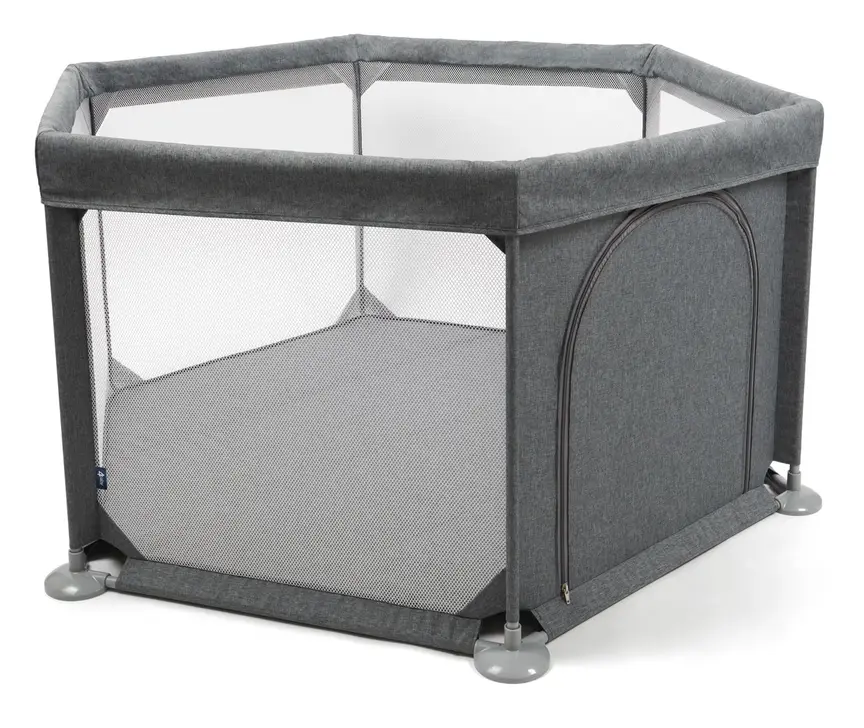
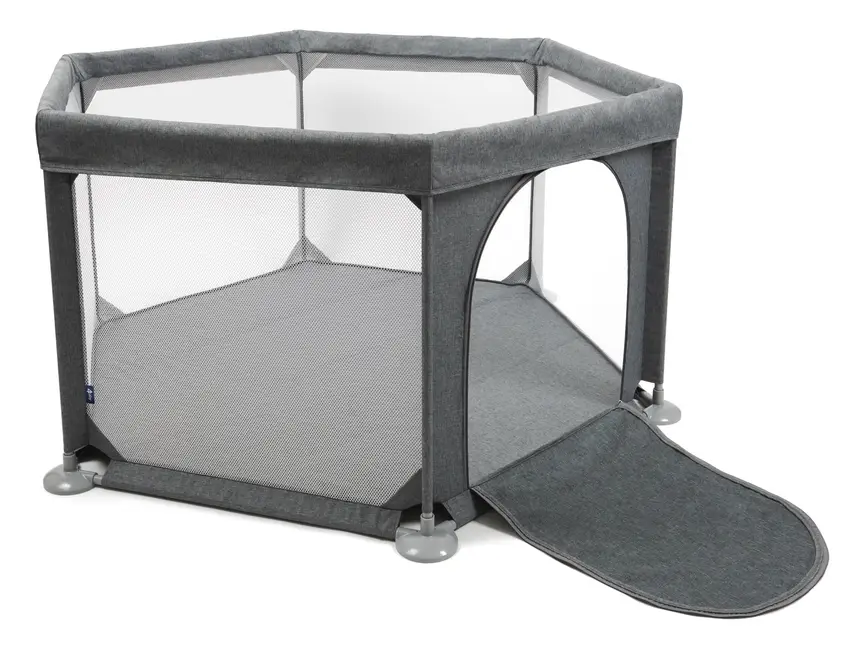
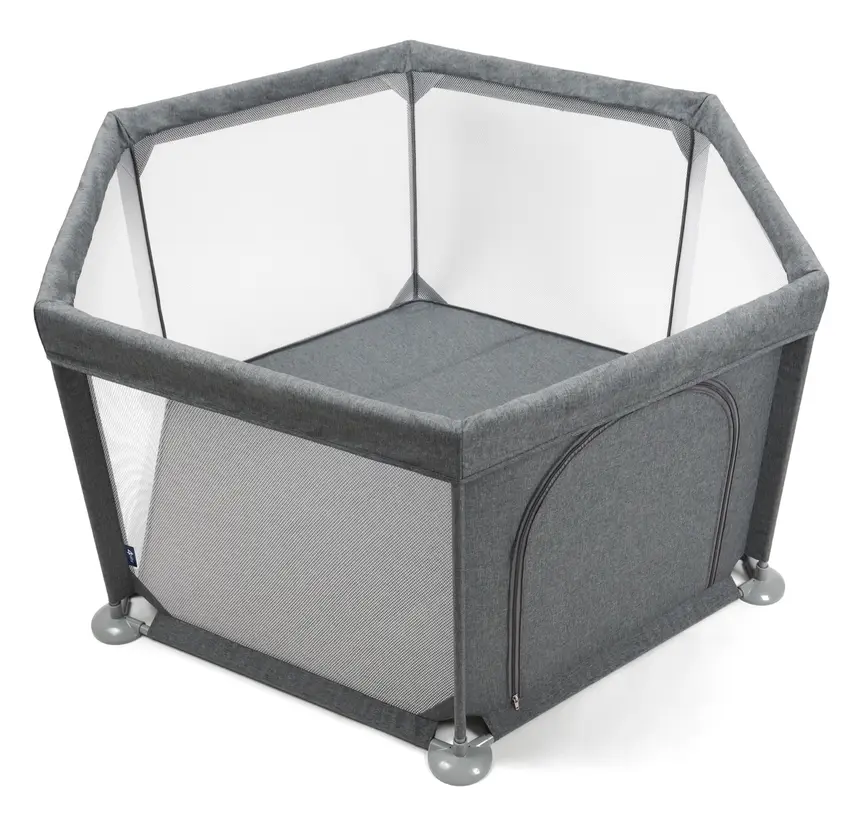
4baby Hex Playpen
A six-sided mesh playpen with a zip door. It packs into a carry bag.
Read our full review →
4baby Safety Gate
A low-cost pressure-mounted gate with a double lock. It opens both ways with one hand.

Dreambaby Home Safety Essentials Kit (46 pieces)
A 46-piece starter kit of latches, socket covers and corner guards for baby-proofing a home.
 Reviewed
Lindam Sure Shut Deco Safety Gate
A wood-and-metal pressure-fit gate with a push-to-shut lock.
Read our full review →Age stages: when to put gates up and when to take them down
A safety gate is built for a specific stage of childhood. Putting it up too late or keeping it up too long can both lead to falls.
| Age or stage | What your child is doing | What to do with your safety gates |
|---|---|---|
| Around 4 to 6 months | Rolling over, pushing up on arms, getting ready to commando crawl. | Buy and fit your gates now. Do not wait until the day your baby reaches the stairs. |
| 6 to 12 months | Crawling fast, pulling up to stand on bars, chewing and shaking the gate. | Check pressure bolts and screws every week. Keep mesh gates locked tight so baby cannot push under. |
| 12 to 24 months | Walking, running in halls, watching how you open the latch, trying to climb. | Never step over the gate in front of your toddler. Keep chairs, boxes and big toys away from the gate. |
| Around 24 months (or chin at top of gate) | Tall enough to throw a leg over the top, or strong enough to work the latch. | Take the gate down and teach safe stair use. A fall from the top of a gate is twice as high as the floor. |
Safety standards and official guidance: Australia, UK, US and Canada
Product safety agencies in Australia, the UK, the US and Canada all publish strict advice on baby gates. Standards test how strong the gate is, how far apart the bars sit, and whether a child can get their head trapped. Look for the safety standard mark printed on the box and on the gate frame itself.
| Country | Official bodies | Standard or rule | Key official guidance |
|---|---|---|---|
| Australia | Product Safety Australia (ACCC), Kidsafe, Raising Children Network | BS EN 1930 or the US ASTM safety standard for gates (see Product Safety Australia safety gate guide) | Fit gates before your baby can crawl. Use screw-in gates at the top of stairs. Never use old concertina gates with V-shaped gaps. |
| United Kingdom | Office for Product Safety and Standards (OPSS), NHS, RoSPA | BS EN 1930 | NHS and RoSPA say to fit safety gates to keep babies off stairs, close the gate every time, and remove gates around age 2. |
| United States | Consumer Product Safety Commission (CPSC), American Academy of Pediatrics (AAP) | Federal safety standard for gates and enclosures (ASTM standard) | AAP (HealthyChildren.org) says to use hardware-mounted gates at the top of stairs, keep slats under 6 cm apart, and avoid accordion gates. |
| Canada | Health Canada, Canadian Paediatric Society (Caring for Kids) | Health Canada Expansion Gates and Expandable Enclosures Regulations | Check Health Canada recall lists before buying. Screw gates into the wall at the top of stairs and test latches every day. |
What safety standards check on a baby gate
- Safe bar spacing: On a metal swing gate, the upright bars must sit close together (under 6 centimetres or 2 3/8 inches apart). That stops a baby from sliding their body through the bars and trapping their head. Old wooden concertina (accordion) gates with diamond holes and V-shaped tops are dangerous. They can trap a child's neck and are warned against in all four countries.
- No footholds for climbing: Standards such as BS EN 1930 stop makers from putting horizontal bars across the middle of the gate. A toddler could use a middle bar like a ladder rung to climb over.
- Two-action latches: The latch must need two moves (such as pressing a button and lifting the gate) or strong hand grip to open. This stops toddlers from unlatching it while letting adults open it fast in an emergency.
- Impact and shake testing: Labs drop heavy weights against the gate and shake it thousands of times. This checks that the gate will not pop out or snap when a child runs into it.
- Safe paints and plastics: Babies chew on gate bars when teething. Safety rules ban toxic levels of lead, phthalates and small plastic caps that could pop off and cause choking.
Living with pets and older siblings in busy hallways
Many homes use hallway gates to manage both young children and family dogs. Older brothers and sisters also walk through these gates many times a day.
Dogs and baby gates
Raising Children Network, RSPCA Australia, the UK RSPCA, Blue Cross and the US ASPCA all give clear advice on dogs and babies. Never leave a baby and a dog together unsupervised. Use a strong baby gate to give your dog a safe, quiet resting space where a crawling baby cannot crawl onto them or grab their food bowl.
If you have a medium or large dog, a metal swing gate usually lasts much longer than a mesh gate:
- Claw resistance: Dogs that scratch at doors can fray or tear fabric mesh over time. Steel bars do not tear when scratched.
- Pushing under: A clever dog will nose under the bottom edge of a wide mesh gate. A stiff metal gate frame cannot be nosed up.
- Visibility: Both metal bars and see-through mesh let your dog see you, so they feel less shut away.
- Skip gates with small built-in "pet doors": Some metal gates are sold with a tiny cat flap in the bottom corner. Never use a gate with a small pet door where a baby can reach it. A baby can crawl through the pet hole or get their head and chest stuck inside it.
Older siblings opening the gate
Children aged 4 to 7 often need to walk down the hallway to reach the bathroom or their bedroom. Most school-age kids can open a metal swing gate latch, which is helpful for you. The danger is that young children easily forget to pull the gate shut behind them.
If you have older kids in the house, look for an auto-close metal swing gate. Its spring hinge swings the door shut and clicks the latch automatically whenever someone walks through. Make sure you turn off any "stay-open" feature when your baby is awake. Also pick a gate with a clear red-and-green lock indicator on the handle. That way, you can see from across the room whether the latch is locked.
Cleaning, maintenance and weekly safety checks
Hallway and kitchen gates get sticky fingers, food smears, dust and pet hair on them every day. Keeping them clean and tight makes them last longer and stay safe.
How to clean each gate style
- Metal swing gates: Wipe the bars and latch once a week with a damp cloth and warm, mild soapy water. Dry with a towel. Do not spray harsh bleach or oily sprays into the plastic latch, as that can make the spring stick.
- Retractable mesh gates: Pull the mesh all the way across the doorway and lock the spool so it stays flat. Wipe both sides of the fabric with a soft sponge and mild soapy water. Rinse with a clean damp cloth. Leave the gate pulled out until the mesh is 100% dry. If you roll wet mesh back into the metal tube, mould and mildew can grow inside the roll. Vacuum dust and pet hair out of the bottom bracket slot once a month.
Your two-minute weekly safety check
Pick one day each week to test every gate in your home:
- Give the top of the gate a firm push and pull to check that the brackets or pressure bolts have not loosened.
- Close the gate and try to pull it open without touching the latch button. It should stay locked tight.
- On a pressure gate, check that the four rubber pads still sit flat inside their screwed-in wall cups and that the latch gap matches the indicator line.
- On a mesh gate, check the stitching along the top and bottom edges and make sure the top lock button clicks fully into the locked position.
- Look around both sides of the gate and move away any footstools, diaper boxes or large toys that your toddler could stand on.
Common mistakes parents make with hallway and stair gates
- Stepping over a closed gate: Stepping over a 75-centimetre gate is a common cause of adult trips and falls, especially while holding a baby. Worse still, your toddler will watch you step over it and try to climb over it too. Always unlatch and open the gate.
- Leaving the wall cups in the box on a pressure gate: Those four small plastic cups with screws are vital safety parts. Without screwed-in wall cups, rubber pressure pads can slide right off glossy paint or smooth skirting boards when a toddler pushes hard.
- Forgetting to press the lock on a retractable mesh gate: Hooking the handle onto the wall catches is only step one. If you forget to push or twist the top spool lock, the mesh will unroll freely as soon as your baby leans against it.
- Using a pressure gate at the top of the stairs: A pressure gate can shift out of place if pushed from behind, and its bottom metal bar is a trip hazard at the top step. Always use a screw-in gate at the top of stairs.
- Buying a second-hand gate with missing parts or no manual: Used gates often lack wall cups, skirting spacers, warning labels or the paper fitting guide. They may also be recalled models. Always check recall lists at Product Safety Australia, OPSS, CPSC or Health Canada before using any gate.
- Adding makeshift spacers behind brackets: Never pack loose washers, cardboard or random wood scraps behind a single long screw to clear a skirting board. Use a solid one-piece wooden batten screwed into the wall stud, or use the official spacer kit made for your gate.
More options, from budget to premium
Real products from our catalogue. We don't show star ratings or review counts; check the current price, stock and reviews on Amazon before you buy.

Perma Child Safety Easy Fit Timber Baby Gate
Wall-mounted safety gate

Cherub Baby 4-in-1 Ear and Forehead Thermometer
2-in-1 thermometer

Cherub Baby Ear & Forehead Thermometer
Reads the ear or forehead in about 1 second, with a colour fever light and a fever alarm.
Which gate should you choose for each spot in your home?
Most families do not use the exact same gate in every doorway. Matching the gate to the spot gives you the safest and easiest home setup:
- Top of the stairs: Choose a hardware-mounted (screw-in) metal swing gate. Set the stop bracket so it only swings over the landing, never out over the stairs.
- Busy hallway between living room and bedrooms: Choose a hardware-mounted metal swing gate if you can drill into the wall studs, as it has no floor trip bar and opens with one hand. If you cannot drill deep into the studs, use a pressure-mounted metal swing gate with its screwed-in wall cups, and remind everyone to step over the bottom bar.
- Wide open-plan doorway or angled corner: Choose a retractable mesh gate, or a hardware-mounted multi-panel metal system bolted to the walls. A retractable mesh gate rolls out of sight when guests visit or when your child is asleep in bed.
- Bottom of the stairs: A hardware-mounted metal swing gate, a pressure-mounted metal swing gate (with wall cups), or a retractable mesh gate all work well here.
- Doorway with thick, tall skirting boards: Pick a pressure-mounted metal swing gate (adjusting the top bolts out further than the bottom bolts), a retractable mesh gate with a sliding bottom bracket, or fit a solid painted wooden strip above the skirting board for a screw-in gate.
Frequently asked questions
Can a baby crawl under a retractable mesh gate?
A baby can push under a mesh gate if it is mounted too high off the floor, stretched across a very wide gap, or left unlocked at the spool. To prevent this, fit the gate so the bottom edge of the mesh brushes the floor. Always lock the top spool button every time you close the gate so the fabric stays drum-tight. Never mount a mesh gate right on the edge of a top stair step.
Do pressure-mounted metal swing gates damage walls and skirting boards?
The rubber feet alone rarely dent solid walls, though they can leave a faint ring on soft paint if tightened too hard. However, to make a pressure gate safe and compliant with standards such as BS EN 1930, you must screw the four small mounting cups into the wall or skirting board. When you take the gate down later, you will have four small screw holes to fill and paint.
Which gate is quieter during night feeds and nap time?
A metal swing gate is almost always quieter at night. On most models, you can hold the latch button in as you close the door and let it go gently so it makes almost no sound. Many retractable mesh gates make a loud clicking ratchet sound as the roll unwinds. Also, if your hand slips off a mesh handle, it snaps back into the casing with a loud bang.
How do I fit a baby gate when one side is a flat wall and the other is a round stair post?
Never drill screws into thin stair spindles, because they can snap. Instead, strap or clamp a solid wooden mounting board vertically onto the thick main stair post (newel post) using a stair post adapter kit. Once that wooden board is rock-solid, screw your gate brackets into the board. For bottom-of-stairs pressure gates, some brands also sell Y-shaped spindle forks that grip around a thick post.
How high should a baby gate be?
Standard baby gates stand at least 73 to 76 centimetres (29 to 30 inches) high when fitted. If you have a tall toddler or a large dog, look for an extra-tall metal swing gate or tall mesh gate. Those measure about 85 to 91 centimetres (33 to 36 inches) high. Once your child's chin reaches the top of the gate, or around age 2, take the gate down so they do not climb over and fall.
How do you stop a retractable mesh gate from jamming in the roller?
A retractable mesh gate jams when the roller tube is not mounted dead straight, or when someone lets the handle fly back on its own. Check the roller tube with a spirit level and use wall spacers if a skirting board is tipping the bottom out. Always walk the handle all the way back to the tube by hand so the mesh winds up flat and even.
Sources
Related guides
More Sleep & Nursery →
Baby Bouncers vs. Motorised Swings: Bounce, Spine Support, and Safety

Drop-Side vs Fixed-Side Baby Cots: Safety Bans, Rules and How to Choose

How to Choose a Baby Swing: Comfort, Fit and Safe Use