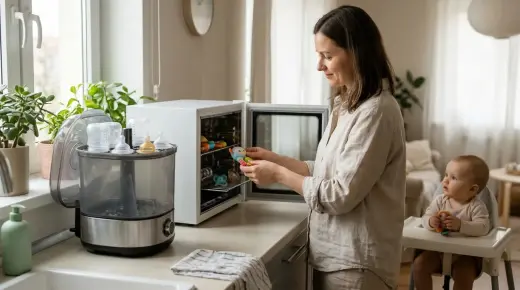
UV Sterilisers vs Electric Steam Sterilisers: Which Is Better for Baby Bottles?
Compare UV and electric steam baby bottle sterilisers. Learn how each kills germs, handles drying, affects bottle wear, and fits health advice.
On this page
- Key points
- What UV and steam sterilisers actually do
- How UV-C sterilisers work, and their limits
- How electric steam sterilisers work, and their limits
- UV vs electric steam: side-by-side comparison
- What official health bodies say in Australia, the UK, the US and Cana…
- Bottle materials, heat, and wear over time
- Sterilising by age and feeding stage
- How to clean and sterilise safely, step by step
- Common mistakes parents make
- Frequently asked questions
- Sources
Short answer: Both UV sterilisers and electric steam sterilisers can kill germs on clean baby bottles. Electric steam uses hot water vapour. It reaches inside narrow parts and costs less to buy. UV sterilisers use ultraviolet light and warm air to dry bottles without water. They keep bottles dry, but light cannot reach into deep shadows or narrow tubes. Neither machine replaces washing bottles in warm soapy water first.
Health groups in Australia, the UK, the US and Canada agree on the main rule. You must wash all feeding gear with soap and water before you sterilise it. Boiling in a pot or using an electric steam steriliser are the most widely recommended home methods.
Key points
- Wash first: Milk leaves behind fat and protein. Germs hide under milk film, so always wash and rinse first.
- Steam reaches everywhere: Hot steam flows around corners, into bottle teats (nipples), and inside small vent tubes.
- UV needs direct light: UV-C light only kills germs where the light beam lands. Shadows block it.
- Drying matters: UV units dry bottles with warm air. Standard steam units leave bottles wet unless they have a built-in dryer.
- Materials age differently: High steam heat can warp thin plastic over time. UV light can make silicone teats turn yellow or brittle faster.
- Check your baby's age: Sterilising matters most for newborns, premature babies, and babies under 12 months on formula.
What UV and steam sterilisers actually do
Babies are born with immune systems that are still learning. Milk is a rich food for bacteria. A tiny drop of old milk inside a bottle can grow harmful germs fast. Those germs can cause tummy upsets, diarrhoea, and thrush.
Washing with warm soapy water removes milk, grease, and dirt. Sterilising (some countries call it sanitising) goes one step further. It kills the germs left behind after washing.
A home steriliser does not make a bottle hospital-sterile forever. As soon as you touch a bottle or leave it in open air, new germs can land on it. The goal is to cut down germs to a very safe level before each feed.
Why waterless drying became popular
Old-style steam sterilisers leave bottles dripping wet. Bacteria grow much faster on wet surfaces than on dry ones. Parents had to shake bottles dry or let them air-dry on a rack. That extra step takes time and bench space.
UV sterilisers solved this problem by adding a warm air fan. They dry the bottles first, then shine UV light on them. Many newer electric steam sterilisers now include a drying fan as well.
How UV-C sterilisers work, and their limits
A UV steriliser looks like a small boxy microwave or mini fridge. Inside, it has reflective metal walls and one or more UV-C lamps or LEDs. When you close the door and press start, the machine usually runs a fan with gentle heat to dry the bottles.
Once the gear is dry, the UV-C light turns on. UV-C is a short wave of ultraviolet light. It damages the DNA of bacteria, viruses, and mould so they cannot grow or make your baby sick.
The shadow problem
UV-C light travels in straight lines. Even with shiny mirrored walls, it cannot bend around solid objects. If a bottle sits upside down over a teat, the bottle blocks the light. If you stack bowls or spoons on top of each other, the bottom layer sits in shadow.
Narrow parts are the hardest for UV light to reach. Anti-colic bottles often have long thin vent tubes or valves. Light may not reach deep inside those tubes. If you use anti-colic bottles with internal tubes, steam or boiling is a safer choice.
Waterless care and multi-use
Because UV sterilisers use no water, they do not build up chalky mineral scale. You do not need to pour water in before every cycle. You can also put items inside that hate water or high heat. Many parents use UV boxes for dummies (pacifiers), teethers, breast pump parts, and small toys.
Always check the label on each item first. Some plastics and soft rubbers break down under UV light. Over weeks of use, clear silicone teats can turn cloudy or yellow. Natural rubber teats can crack and go sticky.
Filters and bulbs
UV boxes pull room air in to dry the bottles. Most models have a small dust filter on the air intake. You need to clean or swap that filter on schedule so dusty air does not blow onto clean bottles. Traditional UV bulbs also wear out over time and need replacing. LED UV units last longer, though you still need to keep the inside clean.
How electric steam sterilisers work, and their limits
An electric steam steriliser has a heating plate at the base, a main basket for bottles, a top tray for teats and lids, and a vented lid. You pour a measured amount of tap water onto the heating plate. When you switch it on, the plate boils the water into hot steam.
Steam fills the closed chamber and heats every surface. Because steam is a gas, it moves around corners and flows up into bottles, caps, and narrow anti-colic vents. Heat destroys germs even in spots that light cannot reach.
Wet bottles vs steam-and-dry units
A basic electric steam steriliser stops as soon as the water boils away. When you lift the lid, the bottles are hot and covered in water drops. If you keep the lid shut, the bottles stay clean inside for a set number of hours. Check your manual for how long.
Some newer steam units add a hot air dryer after the steam cycle. This gives you the deep reach of steam plus dry bottles at the end. Like UV boxes, steam-and-dry units have an air filter you must keep clean. They are also taller and take up more room under kitchen cupboards.
Limescale and burn risks
Tap water leaves mineral marks on the heating plate. In hard-water areas, white chalky scale builds up fast. Scale makes the plate heat slower and can trigger early shut-off before the cycle finishes. You need to descale the plate regularly with white vinegar or citric acid, following the manual.
Steam also burns skin fast. Never open the lid right after a cycle ends. Wait for the unit to cool down, or use tongs to lift hot parts. Keep the cord and plug away from the edge of the bench so a toddler cannot pull it down.
UV vs electric steam: side-by-side comparison
Here is how the two main types compare for daily family use.
| Feature | UV-C steriliser | Electric steam steriliser |
|---|---|---|
| How it kills germs | Ultraviolet light (UV-C) | Boiling water vapour (steam) |
| Drying | Built-in warm air fan | Wet at end, unless it is a steam-and-dry model |
| Reaches inside narrow tubes | Poor. Shadows block light | Good. Steam fills narrow vents and tubes |
| Water needed | None | Tap or distilled water every cycle |
| Limescale build-up | None | Yes, on the heating plate. Needs descaling |
| Air filter care | Yes, clean or swap filter | Only on models with a drying fan |
| Effect on silicone and rubber | Can yellow or weaken teats over time | High heat can wear out soft rubber faster |
| Risk of burns | Low. Uses gentle drying heat | High. Boiling water and hot steam inside |
| Other items you can sterilise | Teethers, small toys, pump parts (check labels) | Heat-safe feeding gear and pump parts only |
Notice that neither machine is magic. Both work best when bottles are spotless before they go in.
What official health bodies say in Australia, the UK, the US and Canada
Health advice on sterilising is very similar across all four countries, though a few details differ. Here is what the main official bodies say.
Australia
The National Health and Medical Research Council (NHMRC) sets Australia's Infant Feeding Guidelines. It advises parents to sterilise all bottle-feeding gear until a baby is 12 months old. Raising Children Network and Pregnancy, Birth and Baby list boiling, steam sterilisers, microwave steam units, and cold-water tablets as proven methods. They remind parents to wash bottles in hot soapy water and rinse well before sterilising.
For electrical safety, Product Safety Australia (part of the ACCC) oversees recalls and electrical rules for home appliances sold locally. Always check that any plug-in unit has a valid local safety mark and plug.
United Kingdom
The NHS advises sterilising all baby feeding equipment until your baby is at least 12 months old. The NHS lists cold-water sterilising solution, steam sterilising (electric or microwave), and boiling in water for at least 10 minutes. The NHS notes that you should always wash and rinse bottles first, and follow the maker's instructions closely for any electric unit.
The UK Office for Product Safety and Standards (OPSS) handles product safety and recalls. Check recalls if you buy a second-hand unit.
United States
The Centers for Disease Control and Prevention (CDC) recommends sanitising feeding items daily for babies under 2 months old, babies born prematurely, and babies with weak immune systems. For healthy older babies, the CDC says thorough daily washing in hot soapy water or a hot dishwasher cycle is often enough once they pass 2 months.
The CDC lists boiling, steaming (electric or microwave), and a dishwasher with hot water and a heated dry cycle as main ways to sanitise. The American Academy of Pediatrics (AAP) supports this same approach. If you buy a UV box in the US, remember that the US Food and Drug Administration (FDA) and CPSC watch safety claims and recalls, and home UV boxes are not all tested the same way as medical gear.
Canada
Health Canada and the Canadian Paediatric Society (via Caring for Kids) advise sterilising bottles, teats, and caps before first use. For young babies, especially under 4 months or babies born early, they advise sterilising after each use by boiling in water for 2 minutes or using a trusted steam steriliser. Always check Health Canada's recalls and safety alerts page before using an older or second-hand appliance.
| Country | Main health bodies | How long to sterilise | Main methods named |
|---|---|---|---|
| Australia | NHMRC, Raising Children Network, Pregnancy, Birth and Baby | Until 12 months old | Boiling, steam steriliser, cold-water solution |
| United Kingdom | NHS, OPSS | At least 12 months old | Steam steriliser, boiling, cold-water solution |
| United States | CDC, AAP, CPSC | Daily under 2 months, or if premature/unwell | Boiling, steam, hot dishwasher with heated dry |
| Canada | Health Canada, Canadian Paediatric Society | Before first use, and regularly in the early months | Boiling, steam steriliser |
You may notice that UV sterilisers are rarely named on older government checklists. That does not mean UV-C light fails to kill germs on open surfaces. It means steam and boiling have decades of home testing behind them, and they do not suffer from shadow blind spots.
Bottle materials, heat, and wear over time
What your baby's bottles are made of matters when you choose between UV and steam.
Glass bottles
Glass handles both steam heat and UV light very well. It does not warp, absorb smells, or break down from light. The main downside is weight and the risk of breaking if dropped. If you use glass bottles, both electric steam and UV sterilisers are safe choices.
Plastic bottles (polypropylene and other plastics)
Most clear plastic baby bottles today are made from polypropylene or similar BPA-free plastics. Food Standards Australia New Zealand (FSANZ) and the US FDA confirm that Bisphenol A (BPA) is no longer used in baby bottles sold in these markets. Still, plastic is not indestructible.
A 2020 study by researchers at Trinity College Dublin, published in Nature Food, found that polypropylene bottles release tiny microplastic particles when exposed to hot water during formula making and sterilising. Letting steam-sterilised plastic bottles cool before pouring in water, or rinsing them with cooled boiled water, can reduce extra heat wear. Never scrub plastic bottles with harsh scourers, as scratches trap milk and speed up wear.
UV light also ages some plastics. Over many months, clear plastic can turn slightly yellow or hazy. If a bottle looks cracked, warped, or deeply scratched, throw it out and replace it.
Silicone and latex teats (nipples)
Bottle teats are soft and take the most wear. Electric steam heats silicone gently, though repeated boiling or steaming softens it over time. UV-C light breaks down natural rubber (latex) very quickly, making it brittle or sticky. Even clear silicone can yellow after weeks in a UV box.
Give every teat a quick tug test before each feed. If it feels sticky, shows tiny splits, or looks swollen, replace it right away. A damaged teat can tear in your baby's mouth and become a choking hazard.
Sterilising by age and feeding stage
Your routine will change as your baby grows. You do not need to run the steriliser the same way forever.
| Age or stage | What is happening | What to do |
|---|---|---|
| Newborn to 2–3 months | Immune system is very new. Feeds happen day and night. | Wash and sterilise every bottle, teat, cap, and dummy after every use. |
| Premature or medically fragile baby | Higher risk from common germs. | Follow your hospital or doctor's plan. Steam or boiling is often preferred over UV for deep reach. |
| 3 to 6 months | Baby puts hands and toys in mouth more often. | Keep sterilising bottles and teats in AU and UK. In US and Canada, follow local nurse or doctor advice. |
| 6 to 12 months | Solid foods start. Baby drinks water from cups. | Keep sterilising formula bottles and teats to 12 months in AU and UK. Wash spoons and bowls in hot soapy water. |
| 12 months and over | Cow's milk or water in open or straw cups. | You can stop sterilising bottles. Wash cups well in hot soapy water or a dishwasher. |
If your baby is sick with thrush or a tummy bug, go back to sterilising all bottles, teats, and dummies after every feed until they recover. Ask your child health nurse or doctor if you are unsure.
How to clean and sterilise safely, step by step
Whichever machine you pick, the steps before and after the cycle matter just as much as the cycle itself.
- Wash your hands first. Use soap and warm water, then dry with a clean towel.
- Take every bottle apart. Separate the bottle, collar ring, teat, cap, and any internal vent tubes or valves.
- Rinse straight after a feed. Cold tap water rinses out fresh milk before it dries into a sticky film.
- Wash in hot soapy water. Use a clean bottle brush for the inside of bottles and a small teat brush for teats and vent holes. Squeeze soapy water through the teat hole.
- Rinse well in clean water. Leftover soap can upset your baby's tummy and leave a film.
- Load your steriliser the right way.
- For electric steam: Place bottles upside down so steam rises inside. Put teats and small parts on the top tray. Pour in the exact amount of water listed in the manual.
- For UV-C: Shake off big water drops first so drying is faster. Place bottles upright or facing the UV lamps, not stacked over teats. Leave space between every item so light hits all sides.
- Run the full cycle. Do not open the door or lid halfway through.
- Store safely. Wash your hands again before touching clean gear. If you are not using the bottles right away, put the teats and lids back on the dry bottles and store them in a clean, closed container or inside the closed steriliser.
Common mistakes parents make
Most problems with bottle sterilisers come from small daily habits. Watch out for these common traps.
- Skipping the soap wash: Rinsing with water alone leaves milk fat behind. Neither steam nor UV light can clean through dried milk film.
- Overcrowding a UV box: Cramming ten bottles into a small UV cabinet creates deep shadows. The outer bottles block light from hitting the ones in the middle.
- Putting bottles face-down in a UV box: In a steam steriliser, bottles go upside down so steam rises in. In a UV steriliser, the UV bulb is usually at the top or back. Putting bottles upright or angled toward the lamp helps light reach inside. Check your manual.
- Using UV for anti-colic vent tubes: Long narrow straw vents block UV light. Use a steam steriliser or a pot of boiling water for those parts.
- Leaving wet bottles in a turned-off steam unit: Once a steam unit cools down, warm damp air inside becomes a cosy spot for mould if you leave it for days. Air-dry or use bottles within the time window stated in the manual.
- Forgetting to descale or change filters: A scaled-up steam plate can switch off early. A clogged dust filter in a UV dryer blows dirty air onto clean bottles.
- Putting the wrong items inside: Never put metal foils, batteries, or non-heat-safe items in a steam unit. Never put natural latex teats in a UV box unless the teat maker says it is safe.
Frequently asked questions
Can a UV steriliser replace washing bottles with soap?
No. You must always wash bottles, teats, and caps in warm soapy water and rinse them first. Milk residue blocks UV light and shields germs from heat. A steriliser only works on gear that is already visibly clean.
Do UV sterilisers work inside bottle teats and narrow straws?
Light cannot bend around corners or pass through thick rubber. UV light cleans the outside of a teat well, as long as nothing shades it. It struggles to reach deep inside narrow anti-colic vent tubes or closed valves. For bottles with thin internal tubes, electric steam or boiling is more reliable.
Is an electric steam steriliser better than boiling in a pot?
Both use boiling heat to kill germs, and both work very well. A pot of water on the stove costs nothing extra if you already own a big saucepan. An electric steam steriliser is easier to leave on the bench, shuts off by itself, and keeps bottles clean inside with the lid shut. Pick whichever fits your kitchen and budget.
How long do bottles stay sterile after the cycle ends?
If you leave the lid or door closed, most makers say bottles stay clean inside for several hours or up to a full day. Once you open the unit or take a bottle out, use it soon or assemble it cleanly with washed hands. Always check your own unit's manual for its storage window.
Are UV sterilisers safe for breast pump parts?
Most hard plastic and silicone pump parts fit nicely in a UV box and come out dry. Check your pump maker's guide first, because some silicone valves soften or discolour under UV light. Also make sure no small valve sits inside a larger shield where light cannot reach it.
Should I buy a UV steriliser or a steam-and-dry steriliser?
Choose a UV steriliser if you want waterless drying, have hard tap water that causes heavy scale, or want to dry and freshen items like teethers and small toys. Choose an electric steam-and-dry steriliser if you use anti-colic bottles with narrow tubes, want heat to reach every hidden crease, and have tall bench space under your cupboards. If budget is tight, a simple electric steam unit without a dryer, or a saucepan on the stove, still keeps your baby completely safe.
Sources
- NHS – Sterilising baby bottles
- CDC – Infant formula preparation and storage
- Raising Children Network – Baby formula: how to make and store it
- NHMRC – Infant Feeding Guidelines
- Caring for Kids (Canadian Paediatric Society) – Feeding your baby in the first year
- Pregnancy, Birth and Baby – Feeding your baby with formula
- Food Standards Australia New Zealand – Bisphenol A (BPA)
- Li D. et al. (2020) – Microplastic release from the degradation of polypropylene feeding bottles during infant formula preparation, Nature Food
Related guides
More Feeding & Baby Food →
UV-C LED Sterilisers vs Steam Microwave Bags for Baby Bottles: How They Work and Which to Choose
All-in-One Bottle Washers vs. Steam Sterilisers: Which Machine Suits Your Home?

Electric Steam Bottle Sterilisers and Dryers: How They Work and How to Choose