UV-C LED Sterilisers vs Steam Microwave Bags for Baby Bottles: How They Work and Which to Choose
Compare UV-C LED sterilisers and steam microwave bags for baby bottles. Learn how each kills germs, dries bottles, and fits official safety rules.

On this page
- Key points
- Why we sterilise baby bottles
- How UV-C LED bottle sterilisers work
- How steam microwave bags work
- Side-by-side comparison: UV-C LED vs steam microwave bags
- Drying and storage: why wet bottles matter
- Step-by-step: washing before you sterilise
- What materials can go inside each one
- Age stages: when you can stop sterilising
- Official advice in Australia, the UK, the US and Canada
- Common mistakes to avoid
- How to choose between them
- Frequently asked questions
- Sources
Short answer: Both UV-C LED sterilisers and steam microwave bags kill harmful germs on clean baby bottles. A UV-C LED box uses ultraviolet light and usually dries bottles with warm air. A steam microwave bag uses boiling water vapour in your microwave, so bottles come out hot and wet. Pick a UV-C box if you want dry, ready-to-use bottles on your bench. Pick microwave bags if you want a small, low-cost option for travel or tight spaces.
Health bodies in Australia (NHMRC and Raising Children Network), the UK (NHS), the US (CDC) and Canada (Health Canada and the Canadian Paediatric Society) all agree on one main rule. Washing bottles well with warm soapy water always comes before sterilising.
Key points
- Wash first: Milk leaves a thin film. Neither UV-C light nor steam can kill germs hiding under dried milk.
- How UV-C LED works: Special LED lights shine UV-C rays onto surfaces. The rays break down germs, and most boxes dry the bottles too.
- Line of sight matters: UV-C light only kills germs where the light hits. Shadows inside narrow bottles or stacked parts can block the light.
- How steam bags work: Water in the bag boils in the microwave. Hot steam kills germs in a few minutes.
- Steam is hot: Microwave bags let out scalding steam and hot water. Wait before opening them, and keep them away from children.
- No metal in microwaves: Never put metal bottle parts or foil into a steam microwave bag.
- Drying matters: Germs grow fast in trapped water. Dry bottles completely or use them straight away.
Why we sterilise baby bottles
A newborn baby's immune system is still learning to fight off illness. Their tummy and gut are very sensitive in the first months of life.
Milk is a rich food for bacteria, viruses and mould. Even a tiny drop of old milk left inside a teat or screw ring can grow germs quickly. Those germs can cause tummy upsets, vomiting or diarrhoea.
Washing with warm soapy water removes milk fat and most germs. Sterilising goes one step further. It kills the tough germs that normal washing can miss.
This extra step is most important for young babies, premature babies and babies who are unwell. It is also important if your tap water is not safe to drink, or if you make formula feeds ahead of time.
How UV-C LED bottle sterilisers work
A UV-C LED steriliser looks like a small benchtop oven or boxy cupboard. Inside, it has tiny light bulbs called LEDs that give off UV-C light.
UV-C is a short-wave kind of ultraviolet light. Sunlight has UV-A and UV-B rays that reach the earth, while the air high above us blocks natural UV-C. Inside a sealed box, man-made UV-C rays shine onto your bottles.
When UV-C light hits a germ, it damages the germ's DNA. Damaged germs cannot copy themselves or make your baby sick. Because there is no boiling water, the box stays cool or only gently warm.
The line-of-sight rule
UV-C light travels in straight lines. It cannot bend around corners or pass through thick milk or solid plastic. The inside walls of a UV-C box are usually shiny metal, like stainless steel, to bounce light around.
Even with shiny walls, the light must reach every surface you want to clean. If you lay a bottle on its side or stack teats on top of each other, shadows form. Any spot stuck in a shadow will not be sterilised properly.
Built-in drying and storage
Most UV-C LED bottle sterilisers also have a fan and a gentle heater. They dry wet bottles with warm, filtered air before or during the light cycle. Many models also have a storage mode that runs a short light cycle every few hours while the door stays shut.
How steam microwave bags work
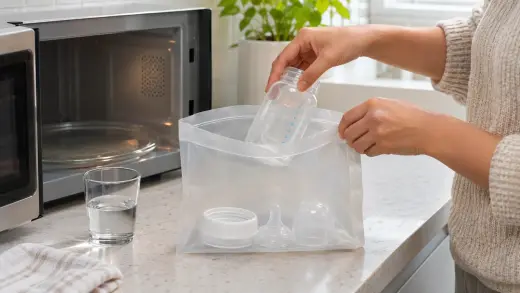
A steam microwave bag is a reusable plastic pouch made for the microwave. You wash your bottles first, put them inside the bag, and add a small amount of tap water. Then you seal the top, leaving the steam vent open as the pack shows.
When you turn the microwave on, the water inside the bag heats up and boils. Boiling water turns into hot steam. The steam fills the closed bag and wraps around every bottle, teat and ring.
The high heat kills bacteria and other germs on contact. Unlike UV-C light, steam is a gas. It can flow into tiny threads, narrow bottle necks and small breast pump valves.
What happens after the microwave stops
When the timer beeps, the bag is full of scalding steam and very hot water. You must let it cool for a short time before you touch it. Most bags have a marked cool-touch corner to lift it out, plus a pour spout to drain the leftover water.
Microwave bags do not dry your bottles. When you take the parts out, they are still wet and warm. You need to let them air dry on a clean rack, or assemble them right away for a feed.
Each bag can only be used a set number of times before the plastic wears out. Most bags have tick boxes printed on the front so you can count each use.
Side-by-side comparison: UV-C LED vs steam microwave bags
Both methods can keep your baby's bottles safe when you follow the instructions. The table below shows how they differ in daily life.
| Feature | UV-C LED steriliser | Steam microwave bag |
|---|---|---|
| How it kills germs | UV-C light damages germ DNA | Hot steam kills germs with heat |
| Reaches tiny crevices | Needs direct light, so shadows can block it | Steam flows easily into small gaps and threads |
| Drying | Usually dries bottles with warm air | No drying; bottles come out wet |
| Heat and burn risk | Low heat; gentle warm air only | High heat; scalding steam and hot water |
| Power and space needed | Needs bench space and a power point | Needs a microwave; folds flat in a drawer |
| Travel use | Bulky to pack; needs mains power | Very light and flat; fits in any bag |
| Metal parts | Safe for stainless steel bottles and spoons | Never put metal inside a microwave |
| Plastic wear | Light can yellow or stiffen some plastics over time | High heat can warp thin or soft plastics |
| Ongoing waste | No single-use bags; occasional filter changes | Bags wear out and must be replaced |
Drying and storage: why wet bottles matter
Sterilising kills germs, but it does not keep a bottle germ-free forever. Once you open the box or bag, air from the kitchen touches the bottles.
If a bottle stays wet in a closed space, stray germs or mould spores can grow again. Warm, damp places are ideal for bacteria. That is why drying is just as important as sterilising.
Drying after a UV-C cycle
A UV-C LED unit dries the bottles inside a closed box. Because air passes through a small filter, dust and kitchen splashes stay out. Once the cycle ends, the bottles are dry and ready to store or use.
Drying after a steam microwave bag
Never leave wet bottles sealed inside a steam bag after they cool. Take them out with clean, washed hands or clean tongs. Place them upside down on a clean drying rack or a clean paper towel.
Do not wipe them dry with a tea towel. Tea towels often carry germs from kitchen benches and hands. Let the air dry them completely, or put the bottle parts together right away if you need a feed.
Health services like the NHS in the UK say you can put sterilised, dry parts together and store them in a clean, closed container in the fridge or cupboard. Always check how long your local health guide says a stored bottle stays sterile.
Step-by-step: washing before you sterilise
Sterilising is never a substitute for washing. This rule applies to UV-C boxes, microwave bags, boiling water and electric steam units.
Follow these simple steps before every sterilising cycle:
- Wash your hands. Use soap and clean water, then dry your hands on a clean towel.
- Rinse right after a feed. Rinse bottles, teats and rings with cold water so milk does not dry on.
- Take every part apart. Separate the bottle, collar, teat, cap and any anti-colic vents or pump valves.
- Wash in hot, soapy water. Use a clean bottle brush for the inside of the bottle and a small nipple brush for the teat.
- Squeeze water through the teat hole. Make sure no dried milk is blocking the tiny opening.
- Rinse well. Wash away all soap bubbles with clean running water.
- Check for damage. Throw away any teat that is sticky, cracked, torn or discoloured.
Some parents wash bottle parts in a dishwasher first. If you do that, check that every part is dishwasher-safe and placed on the top rack. Make sure no food scraps from dinner plates wash onto the bottles.
What materials can go inside each one
Not every baby item handles UV-C light and microwave steam in the same way. Always read the care label on your bottles, breast pump parts and dummies (pacifiers).
Plastic bottles and pump parts
Most baby bottles today are made from polypropylene plastic, silicone or glass. Food regulators in Australia (FSANZ), the US (FDA), the UK and Canada have all restricted or moved away from BPA in baby bottles. Even BPA-free plastic can wear down when heated or lit up many times.
Research shows that shaking hot water in polypropylene plastic bottles can release tiny plastic specks called microplastics. High heat from steam can also warp thin plastic valves on breast pumps, making them lose suction. Always check if your pump maker allows steam sterilising for soft silicone membranes.
UV-C light uses much less heat, which helps stop warping. However, strong UV light can make clear plastics turn cloudy or yellow over months of use. It can also make soft silicone teats feel brittle faster if they sit right under the LEDs.
Glass and stainless steel
Glass bottles handle steam heat very well, as long as you do not plunge hot glass into cold water. They also let UV-C light pass through easily, though very thick or coloured glass can block some light. Always check that a glass bottle fits upright inside a UV-C box or safely inside a microwave bag.
Stainless steel bottles and baby spoons must never go into a steam microwave bag. Metal sparks in a microwave and can start a fire. Metal items are safe inside a UV-C LED box, as long as the lid or cap is off so light can shine inside.
Toys, teethers and dummies
Soft liquid-filled teethers often burst or melt in a microwave steam bag. A UV-C LED box can sanitise hard plastic toys, teethers and phones without melting them. Just remember that UV-C only cleans the side facing the light, so flip items over or place them carefully.
Age stages: when you can stop sterilising
You do not need to sterilise bottles for your child's whole toddlerhood. Guidance varies slightly between countries, so check what fits your baby's age and health.
| Baby's age or stage | What is happening | What to do |
|---|---|---|
| Newborn to 3 months | Immune system is very new. Feeds are frequent. | Wash and sterilise every bottle, teat and pump part before use. |
| 3 to 6 months | Baby starts putting hands and toys in their mouth. | Keep sterilising in Australia and the UK. In the US and Canada, ask your doctor if daily washing is enough for healthy full-term babies. |
| 6 to 12 months | Solid foods start. Baby crawls and explores. | In Australia and the UK, keep sterilising bottles until 12 months. Wash bowls and spoons in hot soapy water. |
| 12 months and older | Baby moves to open cups and family foods. | Stop sterilising. Wash cups and bottles well with hot soapy water or a dishwasher. |
| Premature or unwell babies | Higher risk of serious infection at any age. | Follow your hospital team's advice. Keep sterilising for as long as they tell you. |
Official advice in Australia, the UK, the US and Canada
Official health groups in all four countries agree on clean bottles, safe water and careful handling. They differ a little on how long to keep sterilising healthy babies' gear.
| Country | Health and safety bodies | Main bottle-cleaning advice |
|---|---|---|
| Australia | NHMRC, Raising Children Network, ACCC (Product Safety Australia) | Wash well, then sterilise all bottle gear until 12 months old. Boiling, steam and chemical soaking are standard methods. |
| UK | NHS, UK Office for Product Safety and Standards (OPSS) | Sterilise all feeding equipment until your baby is at least 12 months old. Keep everything clean and dry between feeds. |
| US | CDC, FDA, CPSC, American Academy of Pediatrics (AAP) | Clean bottles thoroughly after every use. Daily sterilising is urged for babies under 2 months, premature babies or babies with weak immune systems. |
| Canada | Health Canada, Canadian Paediatric Society (Caring for Kids) | Sterilise all bottle gear before first use, and regularly for young or vulnerable babies. Follow maker instructions for boiling or steam. |
Notice that many official guides list boiling, electric steam, microwave steam and cold-water tablets first. UV-C LED boxes are newer to home kitchens. Because UV-C boxes vary in bulb strength and shape, always check that your unit is sold safely in your country and follow the maker's exact loading guide.
Electrical safety matters too. Buy benchtop UV-C appliances from trusted local stores so the plug, voltage and safety cut-off switch meet your country's electrical laws. A safe UV-C unit must turn off its lights automatically the instant you open the door. Never look straight at a glowing UV-C LED, as UV-C light can hurt your eyes and skin.
Check national recall lists now and then, such as Product Safety Australia, OPSS in the UK, the CPSC in the US or Health Canada recalls. Also keep microwave bags and hot appliances well out of reach of children to stop burns and scalds.
Common mistakes to avoid
Even great gear fails if a small daily habit gets in the way. Watch out for these common traps:
- Skipping the wash: Putting a milky bottle straight into a UV-C box or microwave bag bakes or traps the milk. Germs can survive underneath it.
- Crowding the UV-C tray: Packing bottles tightly side by side creates dark shadows. Leave space around each bottle, point openings towards the LEDs, and take teats out of collars.
- Leaving caps on: A bottle with its lid screwed on blocks both UV-C light and steam from reaching the inside.
- Forgetting the water in a steam bag: Running a microwave bag dry can melt the plastic and cause smoke or a fire. Measure the exact water amount every time.
- Opening a steam bag too soon: Hot steam rushes out of the vent and can burn your fingers and face. Let it cool for a couple of minutes, then hold it away from your body.
- Using old, worn microwave bags: Once a bag reaches its maximum number of uses, the seams can split and spill boiling water.
- Ignoring machine cleaning: Dust builds up on a UV-C fan filter, and water stains can cloud the shiny walls. Wipe the inside gently and swap filters as the manual says.
- Putting electronics in steam: Never put battery-powered pump motors or metal tubing clips in a microwave bag.
How to choose between them
You do not have to pick just one method for every situation. Many families use one at home and keep another for trips.
A UV-C LED steriliser may suit you best if:
- you bottle-feed or pump many times every day;
- you hate waiting for wet bottles to air dry on a crowded bench;
- you have spare kitchen bench space near a power point;
- you want to sanitise dummies, teethers or small toys without heat or water.
Steam microwave bags may suit you best if:
- you mainly breastfeed and only use a bottle or pump now and then;
- you live in a small home with almost no bench space;
- you travel often and stay in places with a microwave;
- you want a simple, low-cost option while you see how much you bottle-feed.
Remember there are two other classic options too. Boiling clean bottles in a covered pot of water on the stove costs nothing extra and works anywhere with a stove. Standard electric steam sterilisers also hold many bottles at once and reach deep into narrow pump tubes with hot vapour.
Frequently asked questions
Do UV-C LED sterilisers really kill germs inside bottles?
Yes, when used the right way. The bottle must be washed clean first, completely empty of milk, and placed with the open neck facing the UV-C lights. If a bottle is dirty, wet with cloudy milk, or hidden in a shadow, the light cannot kill all the germs.
Are steam microwave bags safe for silicone and plastic bottles?
Most baby bottles and silicone teats are made to handle steam heat. Still, always check the maker's label first. Thin breast pump valves and soft teethers can sometimes warp or split in high steam heat.
Do I need to dry bottles after using a steam microwave bag?
Yes. Never leave wet bottles sealed inside the bag once it cools. Take them out with clean hands and let them air dry on a clean rack, or use them straight away for a feed.
Can UV-C light hurt my eyes or my baby?
Direct UV-C light can harm eyes and skin. Good benchtop sterilisers have a safety switch that turns the lights off the moment you open the door. Always keep the door shut during a cycle and keep the machine out of reach of curious toddlers.
How long do sterilised bottles stay clean?
If you take dry bottles out and put the clean parts together with washed hands, they stay ready in a clean, closed container for hours. Follow your local health service's exact storage time, which is often up to 24 hours when assembled and kept covered. If a bottle stays wet or open on the bench, germs can settle on it quickly.
Can I use both a UV-C steriliser and steam microwave bags?
Yes. Many parents keep a UV-C box on the kitchen bench for daily drying and sterilising. Then they pack a folded steam microwave bag in the nappy bag when visiting family or going on holiday.
Sources
- NHS – Sterilising baby bottles
- CDC – Infant formula preparation and storage
- Raising Children Network – Baby formula: how to make and store it
- NHMRC – Infant Feeding Guidelines
- Caring for Kids (Canadian Paediatric Society) – Feeding your baby in the first year
- Food Standards Australia New Zealand – Bisphenol A (BPA)
- World Health Organization – Safe preparation, storage and handling of powdered infant formula
Related guides
More Feeding & Baby Food →
UV Sterilisers vs Electric Steam Sterilisers: Which Is Better for Baby Bottles?

Electric Steam Bottle Sterilisers and Dryers: How They Work and How to Choose
Electric Bottle Sterilisers and Dryers: How They Work, How to Choose, and Safe Use