Silicone vs Natural Rubber Teethers: Nitrosamines, One-Piece Design, and Molar Reach
Compare silicone and natural Hevea rubber teethers: nitrosamine safety, one-piece moulding, molar reach, cleaning, and official rules in AU, UK, US and…
On this page
- Key points
- What silicone and natural rubber teethers are
- What nitrosamines are and why limits matter
- One-piece moulding vs multi-part teethers
- Molar reach and shapes for each teething stage
- Silicone vs natural Hevea rubber: side-by-side comparison
- Safety standards in Australia, the UK, the US and Canada
- How to clean, cool, and check teethers safely
- Common mistakes parents make with teethers
- Frequently asked questions
- Sources
Short answer: Both food-grade silicone and natural Hevea rubber can make safe teethers. Pick a solid, one-piece design with no small parts or air holes. If you choose natural rubber, look for a nitrosamine-free label on the box and never boil it. If you want easy cleaning and high heat sterilising, food-grade silicone is simpler to care for.
Safety rules for baby teethers are very similar in Australia (Product Safety Australia and Standards Australia), the UK (Office for Product Safety and Standards), the US (Consumer Product Safety Commission), and Canada (Health Canada).
Key points
- Silicone: Man-made, soft, odourless, and easy to boil or put in the dishwasher.
- Natural Hevea rubber: Made from tree sap. Soft and warm, but cannot take high heat and may trigger latex allergies.
- Nitrosamines: Unwanted chemicals that can form in poorly made rubber. Good brands check for them and keep levels within safety limits.
- One-piece moulding: Stops parts breaking off and stops water and mould getting trapped inside.
- Molar reach: Longer arms help reach back gums, but must have a wide base so they cannot go too far back.
- Cooling: Chill teethers in the fridge, never the freezer.
What silicone and natural rubber teethers are
When a baby's teeth start pushing through the gums, their mouth feels sore. Chewing on a safe teether puts gentle pressure on the gums. That pressure helps ease the ache.
Most soft teethers today are made from one of two materials. These are food-grade silicone or natural Hevea rubber.
What food-grade silicone is
Silicone is a man-made rubber-like material. Makers create it from silica, which is a natural mineral found in sand. Food-grade silicone is made to be safe for touching food and mouths.
Silicone feels smooth and slightly firm. It has no taste and no smell. It also resists heat very well, so you can wash it in hot water or a steriliser.
Good silicone teethers do not contain BPA (bisphenol A) or phthalates. BPA and phthalates are chemicals used to make some hard or soft plastics. Health bodies around the world restrict them in baby items.
What natural Hevea rubber is
Natural Hevea rubber comes from the milky white sap of the Hevea brasiliensis tree. People often call this latex or natural rubber. Makers collect the sap, shape it in a mould, and heat it so it holds its form.
Natural rubber feels warmer and slightly softer than silicone. It has a mild, earthy smell that some babies like and others do not. Because it comes from a tree, it breaks down in nature faster than silicone.
There is one important catch with natural rubber. It contains natural latex proteins. Most babies have no trouble with this. However, a baby with a latex allergy or a family history of latex allergy should avoid natural rubber teethers.
What nitrosamines are and why limits matter
You may see the words "nitrosamine-free" or "low nitrosamine" on rubber teether boxes. This can sound scary if no one explains it. Here is what it means in plain words.
How nitrosamines form
Raw tree sap is too soft and sticky to hold a shape on its own. To turn sap into strong rubber, factories add curing agents and heat it. Some older or cheap curing chemicals can leave tiny traces behind.
When those trace chemicals mix with a baby's saliva, they can form nitrosamines. Nitrosamines are unwanted chemical compounds. Health experts want babies to have as little contact with them as possible because high levels over time are linked to health risks.
Safety regulators in Europe, the UK, Australia, the US, and Canada set strict limits on nitrosamines and the chemicals that form them in rubber baby items. These limits apply to bottle teats, dummies (pacifiers), and teethers.
How silicone compares on nitrosamines
Pure food-grade silicone is made in a different way from tree rubber. It does not use the same sulphur or amine curing chemicals that create nitrosamines. Because of this, nitrosamines are generally not a concern with pure, properly cured silicone.
Still, cheap silicone can contain filler chemicals if it is not true food-grade or medical-grade silicone. One quick home check is the pinch check. Pinch and twist a flat bit of silicone. If it turns bright white at the twist, it may contain cheap fillers.
What to look for when buying
You cannot see nitrosamines with your eyes. You have to rely on honest makers and official safety rules. Here is how to shop safely:
- Check the label: Look for a clear note that the teether meets toy safety standards in your country.
- Look for nitrosamine-free labels: Good natural rubber brands state on the box that their rubber meets strict nitrosamine limits.
- Check the maker's details: The box should show a real brand name, a batch number, and a street address or website.
- Skip unknown online bargains: Very cheap unbranded teethers from overseas marketplaces may skip required safety checks altogether.
One-piece moulding vs multi-part teethers
How a teether is built matters just as much as what it is made from. One-piece moulding is one of the safest designs you can buy.
What one-piece moulding means
One-piece moulding means the whole teether is made in a single mould at the factory. There are no glued seams, no hinges, no screws, and no separate beads or caps.
A one-piece teether has no small parts that can snap off in your baby's mouth. Small parts are a serious choking hazard for babies and toddlers.
Why air holes and hollow shapes cause trouble
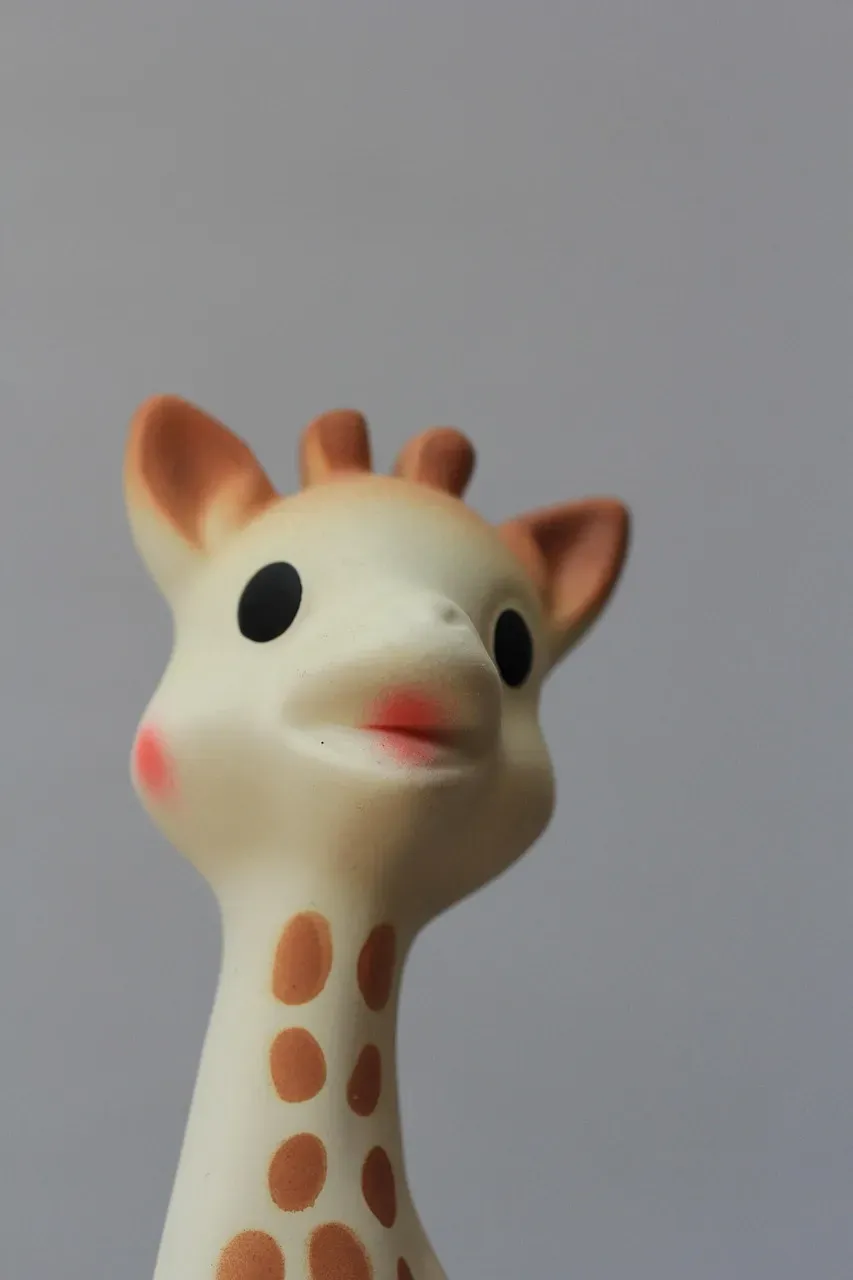
Some cute rubber animal teethers are hollow inside. Many have a tiny hole at the bottom so air can escape when a baby squeezes them. Some even have a little squeaker.
These holes cause a hidden problem. When you wash the teether or take it in the bath, water slips inside. Baby drool can get inside too. The dark, damp space inside the toy is the perfect spot for black mould and bacteria to grow.
You cannot scrub the inside of a hollow teether. When your baby chews it, dirty water or mould spores can squirt straight into their mouth. If you want a natural rubber teether, pick a solid one-piece shape or a truly sealed design with no air hole.
What about wooden, beaded, or liquid-filled teethers?
Shops also sell teethers made from mixed materials. Each type has extra things to watch out for:
- Beaded or string teethers: If the cord breaks, loose beads can choke a baby. Never leave a baby alone with a beaded teether.
- Silicone and wood combos: Wood cannot be boiled or soaked. Water can make wood swell and crack over time, which creates splinters or traps germs.
- Liquid or gel-filled teethers: Babies with sharp new teeth can bite through thin plastic pouches. If the liquid leaks out, your baby may swallow it.
For daily use, a solid one-piece silicone or solid one-piece natural rubber teether is the simplest and safest pick.
Molar reach and shapes for each teething stage
Babies do not get all their teeth at once. Teeth arrive in stages over the first two to three years. A teether that works well at four months may not help much at fourteen months.
Early teething: front gums and incisors
Most babies start drooling and chewing between three and six months. The bottom and top front teeth (incisors) usually appear first, often around six months.
At this stage, babies are still learning how to hold things. They do best with light, easy-to-grip rings or flat textured pads. Wide surfaces let them chomp with their front gums without poking the back of their throat.
Later teething: back gums and molars
First molars usually arrive between twelve and eighteen months. Second molars often come through between twenty and thirty months. Molars are bigger and wider than front teeth, so they can make back gums very sore.
A wide flat ring cannot reach the back of a toddler's mouth. That is why many brands make "molar reach" teethers. These have a longer, narrower arm or stem with bumpy textures at the tip.
Safety rules for molar-reach teethers
Any long object in a baby's mouth carries a gagging or choking risk if it goes too far back. A baby can also fall forward while holding a long teether in their mouth.
To stay safe, a molar-reach teether must have a wide guard, flared base, or large loop near the handle. That guard stops the stem from going past the back gums. Never give a baby a long, thin stick-shaped teether with no stop guard. Always supervise your baby when they use a long molar teether, and take it away when they are walking or running around.
| Teething stage | Typical age | Teeth coming through | Best teether shape |
|---|---|---|---|
| Early gum soreness | 3 to 6 months | Gums swelling before front teeth | Light ring or soft textured mitt |
| Front teeth | 6 to 12 months | Top and bottom front incisors | One-piece ring or flat textured pad |
| First molars | 12 to 18 months | First back chewing teeth | Longer molar stem with a wide safety guard |
| Canines and second molars | 16 to 30 months | Pointed eye teeth and back molars | Firm silicone or rubber molar teether with guard |
Every baby gets teeth on their own schedule. Some babies are born with a tooth, while others wait until after their first birthday. Match the teether to your baby's hands and mouth, not just the age printed on the box.
Silicone vs natural Hevea rubber: side-by-side comparison
Both materials have clear strengths and trade-offs. Use this table to compare them side by side.
| Feature | Food-grade silicone | Natural Hevea rubber |
|---|---|---|
| Where it comes from | Man-made from silica (sand) | Natural sap from the Hevea tree |
| Feel in the mouth | Smooth, bouncy, slightly firm | Warm, soft, slightly grippy |
| Smell and taste | No smell and no taste | Mild natural rubber smell |
| Nitrosamine risk | Not a typical issue in pure silicone | Must be checked to stay within safe limits |
| Latex allergy risk | Latex-free | Contains natural latex proteins |
| Boiling and steam sterilising | Usually safe (check the label) | Not safe; high heat damages rubber |
| Dishwasher safe | Usually safe on top rack | No; heat and harsh soap break it down |
| Mould risk | Very low in solid one-piece shapes | Low if solid; high if hollow with an air hole |
| Molar reach options | Many shapes with wide safety guards | Fewer long-arm shapes; mostly rings and animals |
| Biodegradable | No, though durable for years | Yes, breaks down over time |
There is no single winner for every family. Silicone is best if you want zero fuss with sterilising and no allergy worries. Natural rubber is great if you want a plant-based, softer feel and are happy to wash it by hand.
Safety standards in Australia, the UK, the US and Canada
Teethers are treated as toys or childcare items for children under three years old. Because babies put them straight into their mouths, all four countries have strict rules on size, strength, and chemicals.
Australia
In Australia, toy safety is overseen by the Australian Competition and Consumer Commission (ACCC) through Product Safety Australia. Standards Australia sets the technical rules. Toys and teethers for babies under three must meet AS/NZS ISO 8124 (or the AS/NZS 8124 series).
These rules check that no small parts can break off and choke a child. They also check that a teether will not jam in a baby's throat. Australia also restricts harmful phthalates in toys for young children, and Food Standards Australia New Zealand (FSANZ) tracks chemical safety like BPA in food-contact items.
United Kingdom
In the UK, the Office for Product Safety and Standards (OPSS) enforces product safety rules. Baby teethers must meet BS EN 71 (the British version of EN 71). This standard checks physical safety, shape, strength, and toxic elements like heavy metals and nitrosamines.
The NHS also gives parents clear advice on baby safety and choking prevention. Always look for a UKCA or CE safety mark from a trusted UK or European seller.
United States
In the US, the U.S. Consumer Product Safety Commission (CPSC) oversees toy safety. Baby teethers must meet ASTM F963, which is the main US toy safety standard. It checks for small parts, sharp edges, impact strength, and heavy metals.
The CPSC also enforces strict federal limits on phthalates in toys and childcare items. The U.S. Food and Drug Administration (FDA) oversees food-contact materials and restricts BPA in infant feeding items. The American Academy of Pediatrics (AAP) also warns parents against choking hazards and unsafe teething products like amber necklaces.
Canada
In Canada, Health Canada enforces toy safety laws and chemical bans under federal product safety rules. Teethers must meet size, strength, and chemical rules, and phthalates are tightly restricted in soft vinyl toys for children under four.
Health Canada also runs a national recalls and safety alerts database. The Canadian Paediatric Society (through Caring for Kids) gives plain advice on safe baby care and avoiding choking hazards.
| Country | Main safety body | Toy standard code | Health advice body |
|---|---|---|---|
| Australia | Product Safety Australia (ACCC) / Standards Australia | AS/NZS ISO 8124 / AS/NZS 8124 | Healthdirect / Pregnancy, Birth and Baby |
| UK | Office for Product Safety and Standards (OPSS) | BS EN 71 / EN 71 | NHS |
| US | U.S. Consumer Product Safety Commission (CPSC) / FDA | ASTM F963 | American Academy of Pediatrics (AAP) |
| Canada | Health Canada | Canadian toy safety regulations | Canadian Paediatric Society (Caring for Kids) |
No matter where you live, check your national recall website before using a secondhand teether. Even well-known brands sometimes recall a batch if a part cracks or fails a safety check.
How to clean, cool, and check teethers safely
Taking good care of a teether keeps germs away and stops the material breaking down early. Silicone and natural rubber need very different care.
Cleaning silicone teethers
- Before first use: Wash in warm soapy water. Rinse well. Follow the box instructions if you want to boil it for a few minutes.
- Daily cleaning: Wash with warm water and mild dish soap after each use, or place on the top rack of the dishwasher.
- Deep cleaning: Most pure silicone teethers handle steam sterilisers or boiling water. Always check the maker's care label first, especially if the teether has any non-silicone parts.
- Drying: Shake off water and let it air dry on a clean towel or drying rack.
Cleaning natural Hevea rubber teethers
- Before first use: Wipe or wash gently in warm soapy water. Rinse well with clean water.
- Daily cleaning: Hand wash only with warm water and mild soap.
- What never to do: Do not boil natural rubber. Do not put it in a steam steriliser, microwave, or dishwasher. High heat breaks down the tree sap, makes the surface sticky, and can cause tiny cracks.
- Sun and storage: Keep natural rubber out of direct sunlight and away from heaters. UV light and heat dry it out fast.
Cooling teethers without hurting gums
Cool objects feel soothing on hot, swollen gums. Put a clean teether in the fridge for twenty to thirty minutes before giving it to your baby.
Never put a teether in the freezer. A frozen teether becomes rock-hard. Pressing rock-hard silicone or rubber against soft baby gums can bruise or damage them. Extreme cold can also make rubber brittle so it cracks when chewed.
The daily pull and check
Babies have strong jaws, and new teeth are sharp. Before you hand over any teether, do a quick five-second check:
- Pull firmly on any arms, ears, or rings to make sure nothing feels loose.
- Squish and bend the teether under bright light to spot tiny bite tears or splits.
- Feel the surface of natural rubber. If it feels sticky, gummy, or chalky, it is breaking down.
- Sniff it. If you smell sour milk or musty mould, throw it away.
If a teether shows any tear, crack, or sticky spot, put it in the bin straight away. A small tear can quickly turn into a bitten-off chunk.
Common mistakes parents make with teethers
Most teething accidents happen because of how a teether is used, not just how it was made. Watch out for these common traps.
- Tying a teether around the baby's neck: Never attach a teether to a long ribbon, cord, or necklace. Cords around a baby's neck are a serious strangulation hazard. Even short dummy clips should never be used in a cot or when the baby is sleeping.
- Using amber teething necklaces: Health bodies in Australia, the UK, the US, and Canada all warn against teething necklaces and bracelets. Babies can choke on the beads or strangle on the cord.
- Using hollow bath-toy teethers: Squeaky toys with air holes trap water and grow mould inside. Keep bath toys out of the teething basket, and pick solid one-piece teethers instead.
- Putting natural rubber in the steriliser: Many parents sterilise everything together out of habit. One trip through a hot steam steriliser can ruin a natural rubber teether.
- Freezing teethers solid: Cold helps gums, but ice-hard plastic or rubber hurts. Stick to the fridge, or offer a clean, chilled wet face washer to chew on while you watch.
- Keeping teethers past their wear date: Once a baby has sharp top and bottom teeth, they can bite through soft silicone or rubber. Check teethers daily and replace them as soon as teeth leave deep marks.
- Leaving teething gels on without checking: Some parents rub numbing gels onto teethers. Health bodies warn against certain numbing gels and homeopathic teething tablets for babies. Ask your doctor or pharmacist before using any teething medicine.
Frequently asked questions
Is silicone or natural rubber safer for my baby?
Both are safe when made by a trusted brand that meets toy safety rules. Food-grade silicone is latex-free, easy to sterilise, and does not carry nitrosamine worries. Natural Hevea rubber is plant-based and softer, but needs hand washing and nitrosamine checks. Choose the one that fits your cleaning routine and allergy needs.
Can I boil or steam-sterilise a natural Hevea rubber teether?
No. Never boil, steam, microwave, or dishwasher-wash natural rubber. High heat breaks down the rubber sap. It can make the teether sticky, cause cracks, and shorten its safe life. Wash natural rubber by hand with warm water and mild soap, then rinse well.
Why do some natural rubber teethers smell?
Natural Hevea rubber comes from tree sap. Just like natural latex gloves or balloons, it has a mild earthy smell straight out of the box. The smell usually fades after a few washes and some fresh air. If the smell is strong or chemical-like, or if it smells mouldy, stop using it.
Are long molar teethers safe for babies?
Yes, as long as they have a wide safety guard or loop that stops the stem going too far down the throat. Only give molar teethers when an adult is watching closely. Do not let a toddler walk, crawl, or run around with a long teether in their mouth, as a fall could push it into the back of the throat.
Can I put a teether in the freezer?
No. Put teethers in the fridge, not the freezer. Frozen teethers get rock-hard and can bruise your baby's sore gums. Freezing can also make rubber brittle and more likely to split when your baby bites down.
How often should I replace a teether?
There is no set calendar rule for replacing a teether. Replace it straight away if you see any bite marks that break the surface, tiny tears, cracks, cloudiness, or sticky patches. Natural rubber tends to wear out faster than silicone, especially once sharp teeth appear.
What if my baby has a latex allergy?
If your baby has a latex allergy, or if close family members have severe latex allergies, skip natural Hevea rubber completely. Choose a one-piece food-grade silicone teether instead. Silicone is completely latex-free.
Sources
- Product Safety Australia – Recalls
- Food Standards Australia New Zealand – Bisphenol A (BPA)
- UK Office for Product Safety and Standards
- NHS – Baby and toddler safety
- U.S. CPSC – Phthalates business guidance
- American Academy of Pediatrics (US) – Choking prevention
- Health Canada – Recalls and safety alerts
- European Chemicals Agency (ECHA) – Toy Safety Directive: substances restricted in toys
Related guides
More Feeding & Baby Food →
Splat Mats for Under High Chairs: Washable Polyester vs. Wipe-Clean Silicone

Silicone vs Mesh Baby Feeders: Safe Ways to Offer Chilled Fruit

Breast Milk Storage Bags vs Reusable Silicone Pouches: How to Store Milk Safely