














Clip-On Table High Chairs: Safe Clamping, Table Limits and Travel Dining
How clip-on table high chairs work: table thickness rules, safe clamp tightening, tables to avoid, and safety advice for Australia, the UK, the US and Canada.

On this page
- Key points
- What a clip-on table high chair is
- Why table thickness and table lips matter
- Clamp torque and tightening safely
- Tables that are safe vs tables to avoid
- Comparing travel and small-space seating options
- Age, weight, and sitting stages
- Harnesses, leg holes, and posture
- Safety standards and rules in Australia, the UK, the US and Canada
- Step-by-step setup and safety check at every meal
- Cleaning, travel packing, and wear checks
- Common mistakes parents make
- Frequently asked questions
- Sources
Short answer: A clip-on table high chair clamps straight onto the edge of a table. It saves space at home and folds small for travel. To use one safely, you need a heavy, flat, solid table with no lip underneath that blocks the clamp. Always follow the maker's table-thickness limits and tightening rules. Strap your baby in with the harness every time, and never leave them alone.
This safety advice matches guidance from official bodies in Australia (Product Safety Australia, Raising Children Network and Kidsafe), the UK (Office for Product Safety and Standards, NHS and RoSPA), the US (Consumer Product Safety Commission and American Academy of Pediatrics) and Canada (Health Canada and HealthLink BC).
Key points
- Check the table first: Use only a heavy, stable table. Never clamp onto glass, plastic, loose leaves or pedestal tables with one centre leg.
- Measure the edge: Every chair has a minimum and maximum table thickness. A lip or apron under the table can also stop the clamp gripping flat.
- Tighten with care: Under-tightening lets the chair slide off. Over-tightening can crack hollow wood or strip the screw.
- Age and stage: Only use a clip-on chair once your baby can sit up well on their own. Stop when they reach the weight limit or try to climb out.
- Harness on, always: Use the waist belt and crotch strap on every meal. Keep the chair away from anything your baby can push against with their feet.
- Hands on: Stay within arm's reach the whole time your baby is in the seat.
What a clip-on table high chair is
A clip-on table high chair is also called a hook-on chair. It has a fabric seat held by a metal frame. Two arms reach out from the frame and clamp onto a table edge.
Unlike a normal high chair, it has no legs touching the floor. Your baby hangs safely from the edge of the table, at the same height as everyone else. Most models fold flat into a carry bag.
Families like them for two main reasons. First, they take up almost no floor space in a small kitchen. Second, they fit easily in a car boot, pram basket or suitcase for travel and cafes.
Because the chair hangs from the table, the table does all the work. If the table is light, wobbly or too thin, the whole setup can tip or slip. That is why knowing your table rules matters just as much as choosing the chair.
Why table thickness and table lips matter
Every clip-on chair is built for a set range of table thicknesses. You will find these numbers in the instruction manual and often printed on the frame. Never guess if a table fits.
Minimum and maximum thickness
If a table is thinner than the minimum limit, the clamp may run out of thread before it grips tightly. The chair can wobble or slide backwards when your baby leans. Thin tables can also bend or snap under the load.
If a table is thicker than the maximum limit, the clamp jaws cannot open wide enough. Forcing a clamp onto a thick edge means only the tips touch the wood. That creates a weak grip that can pop off suddenly.
What a table lip or apron is
Many dining tables have a vertical wooden strip just under the edge. Makers call this a table lip, skirt or apron. It hides the frame and supports the tabletop.
A table lip can block the lower arm of a clip-on chair. The clamp needs flat, clear space both on top of the table and underneath it. If the lip sits too close to the edge, the bottom jaw cannot slide all the way in.
Look under the table before you buy or set up. Measure from the outer edge back to the lip. Check that both the top and bottom pads sit flat against solid material. If the clamp only touches the thin rim of a lip, do not use the chair on that table.
Bevelled and rounded edges
Some modern tables have sloped, rounded or angled edges. A flat clamp pad cannot grip a sharp slope well. As your baby wiggles, the sloped edge can push the clamp outwards until it slips off.
Highchairs & Booster Seats worth a look
Real products from our catalogue. We don't show star ratings or review counts; check the current price, stock and reviews on Amazon before you buy.

Bugaboo Giraffe
Bugaboo's answer to the Tripp Trapp, with notably quick, tool-free height adjustment.

Mocka Original Highchair
Australian/NZ online brand's wooden adjustable chair — the Tripp Trapp idea at a fraction of the price, with simpler finishes.

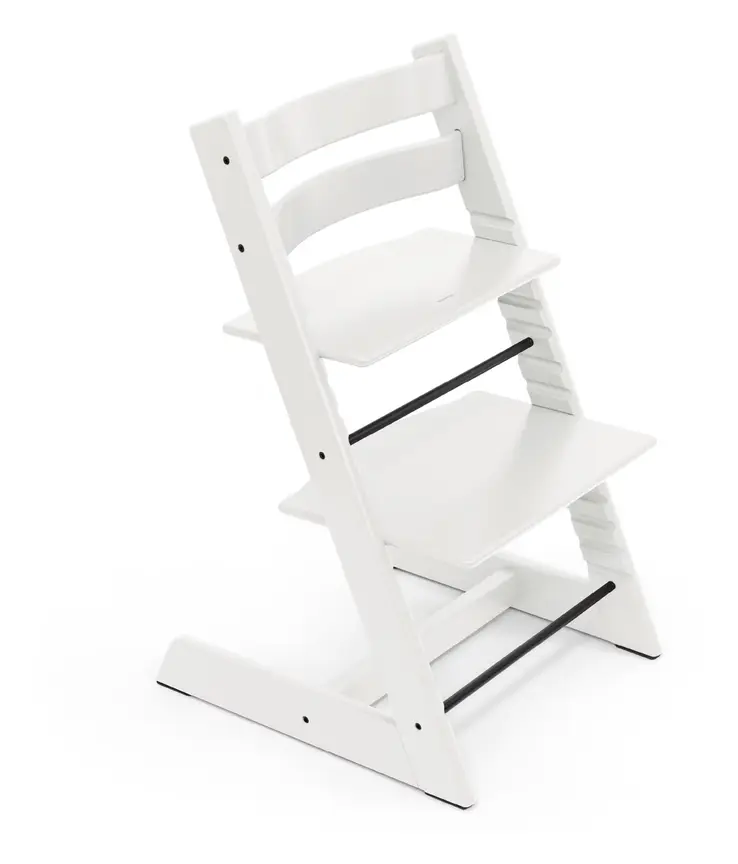


Stokke Tripp Trapp
The 1972 Peter Opsvik design: an adjustable beech chair that goes from newborn (with Newborn Set) to adult, pulled up to your own table.
Read our full review →Clamp torque and tightening safely
Torque is a simple word for twisting force. When you turn a screw clamp or pull a locking lever, you apply torque to squeeze the table between two jaws.
Getting this twisting force right is a balancing act. Too little force leaves the chair loose. Too much force can damage the table or break the chair.
Screw clamps vs lever clamps
Most clip-on chairs use one of two clamp styles:
- Screw-down clamps: You turn a knob or handle underneath until the pads press tight against the table. These fit a wide range of thicknesses. They take a bit longer to fit, and you must turn both sides evenly.
- Lever or cam-lock clamps: You slide the jaws onto the table and flip a lever to lock them. These are fast to put on and take off. Some use a small dial to fine-tune the grip before you snap the lever shut.
The risk of under-tightening
If you stop turning too soon, the rubber pads do not bite into the surface. When your baby kicks or leans back, the arms can inch forward. Over a few minutes, a loose clamp can walk right off the edge of the table.
Check both clamps separately. Sometimes one side feels tight while the other side sits slightly crooked. Both arms must grip with equal pressure.
The risk of over-tightening
More force is not always safer. Tightening a screw clamp as hard as you can with both hands can cause real problems:
- Crushed tabletops: Many budget or flat-pack tables are made of honeycomb paper or particleboard inside a thin shell. Too much clamp force crushes the core and leaves a permanent dent. Once the wood caves in, the clamp loses its grip.
- Stripped threads: Metal or plastic screw threads can wear out or snap if forced past their limit. A stripped clamp cannot hold weight safely.
- Damaged rubber pads: Extreme squeezing flattens or tears the grip pads, making them slippery on future trips.
Follow the maker's tightening guide. Tighten until the pads grip firmly and the chair does not shift when you tug it. Stop there. You should not hear wood creaking or see the tabletop bending.
Tables that are safe vs tables to avoid
Not every table can hold a baby hanging off one side. A child's weight pulls down and outwards at the same time. That puts tipping force on the table.
Tables that usually work well
- Heavy solid-wood dining tables with four legs at the corners.
- Sturdy restaurant tables bolted to the floor or wall.
- Thick, flat kitchen benches with enough overhang and no lip underneath.
Tables you must never use
- Glass-top tables: Glass can shatter under clamp pressure without warning.
- Pedestal or single-leg tables: Small cafe tables with one pole in the middle tip over easily when weight hangs on one side.
- Folding or card tables: Lightweight camp and trestle tables are too light and can fold or flip.
- Tables with loose leaves: Extension leaves can lift or separate under downward pull.
- Tables covered by a tablecloth or placemat: Cloth slides on wood, so the clamp cannot hold fast. Always pull the cloth back so the pads touch bare table.
- Veneer, hollow-core or plastic tables: Thin plastic bends, and hollow veneer can crack or collapse.
- Wobbly or uneven tables: If a table rocks when you lean on it, it is not safe for a baby chair.
Remember too that a baby sitting at the end of a light table acts like a weight on a seesaw. Even a four-legged wooden table can tip if it is very light and nobody else is sitting at the far side.
Comparing travel and small-space seating options
A clip-on chair is only one way to feed a baby away from a full high chair. The table below compares the four most common compact options so you can pick what suits your home and trips.
| Feature | Clip-on table high chair | Travel booster seat | Folding freestanding high chair | Fabric chair harness |
|---|---|---|---|---|
| Where it attaches | Clamps to a solid table edge | Straps onto an adult dining chair | Stands on its own legs on the floor | Slips over the back of an adult chair |
| Table type needed | Heavy, flat, solid table with right thickness | Any table, as it uses a separate chair | Any table or none at all | Any table, as it uses a separate chair |
| Adult chair needed? | No | Yes, a sturdy four-legged chair | No | Yes, a sturdy high-backed chair |
| Weight and packed size | Medium weight, folds flat | Bulky or medium, some fold | Heaviest of the travel group | Very light, fits in a handbag |
| Support for younger babies | Good if seat back is firm and deep | Good if it has a high back and tray | Usually the best back and foot support | Low support, best for older babies |
| Main safety risk | Wrong table, loose clamp or tipping | Adult chair tipping backwards | Trip hazard or unlocked leg hinges | Baby sliding sideways or leaning out |
If you eat at many different cafes, a clip-on chair can sometimes be frustrating. Many cafe tables have thick lips or single centre legs. Packing a light travel booster or checking the cafe seating ahead of time saves you from surprises.
Age, weight, and sitting stages
Clip-on chairs are not for newborns. A young baby needs full head, neck and trunk support, which a hanging fabric seat cannot give.
HealthLink BC in Canada, the NHS in the UK, Raising Children Network in Australia and the American Academy of Pediatrics all advise waiting until your baby can sit up steady without help before using a standard high chair or hook-on seat. For most babies, this happens around 6 months of age, right around the time they start solid foods.
Always check both the minimum age and the maximum weight on the chair's label. Do not keep using a clip-on chair past its weight limit, even if your toddler still fits in the seat. Exceeding the weight limit strains the metal arms, fabric seams and table edge.
You should also stop using the chair as soon as your child can climb out or lift their legs onto the table. Active toddlers can rock hard enough to loosen clamps or tip a table.
| Stage | What your baby is doing | What to do |
|---|---|---|
| Birth to around 6 months | Still building head and neck control; cannot sit alone | Do not use a clip-on chair. Hold your baby for milk feeds. |
| Around 6 to 12 months | Sits up well on their own; starting solid foods | Safe to start using a clip-on chair if weight and fit match the manual. |
| 12 to 24 months | Heavier, stronger, may wriggle or push with feet | Check clamp grip at every meal. Keep feet away from table bars or chairs. |
| Past weight limit or climbing | Reaches label limit or tries to stand up | Stop using the clip-on chair. Move to a booster or youth chair on the floor. |
Side by side: more highchairs & booster seats to compare
Real products from our catalogue. We don't show star ratings or review counts; check the current price, stock and reviews on Amazon before you buy.
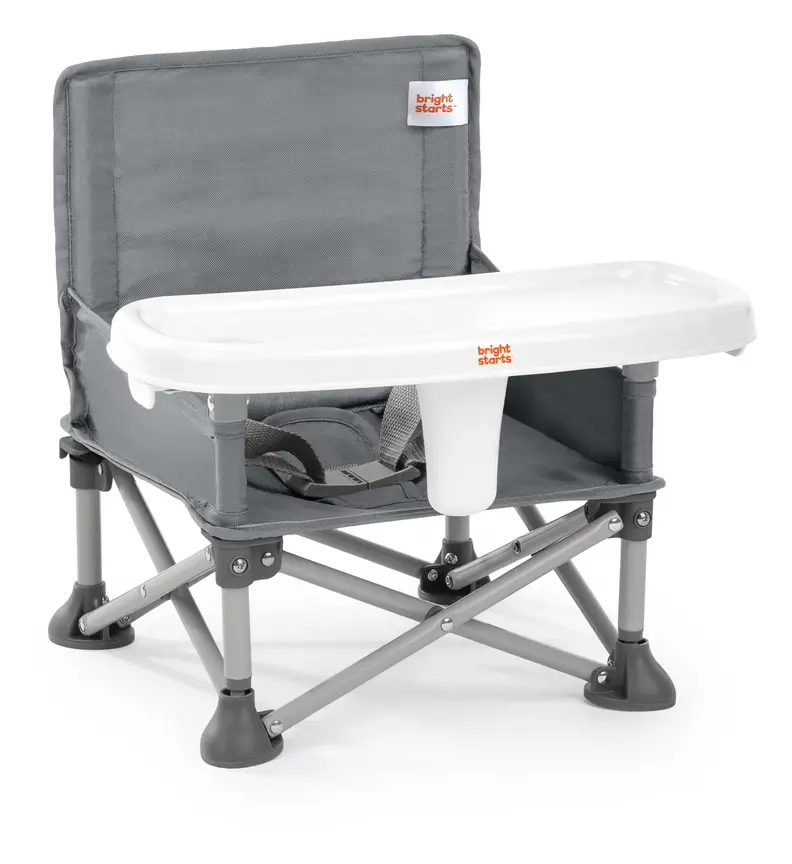
Bright Starts Pop 'N Sit Portable Booster
Booster seat for table
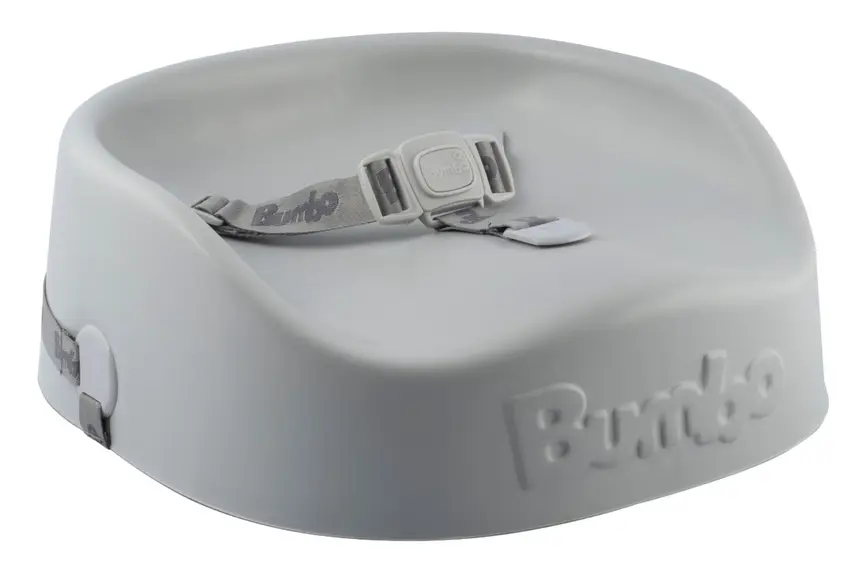
Bumbo Booster Seat
A soft booster that straps onto an adult chair, with a 3-point harness.

Dreambaby Grab 'N Go Kids Booster Seat
Booster seat for table

Ingenuity Baby Base 2-in-1 Booster Seat
Booster seat for table
Harnesses, leg holes, and posture
Product Safety Australia, the UK Office for Product Safety and Standards, the US Consumer Product Safety Commission and Health Canada all stress the same core rule for baby seats: use the restraint system every single time.
Waist belt and crotch strap
Never rely on the table edge to hold your baby in. A baby can easily slide down through a leg hole or stand up and topple out.
A safe clip-on chair must have a waist strap and a strap between the legs (a crotch strap or post). Better models use a five-point harness that goes over both shoulders, around the waist and between the legs. Shoulder straps stop an active baby from leaning out sideways or standing up.
Check that the straps sit snug against your baby's body. You should be able to fit one or two fingers under the strap, no more. Loose straps let a child wriggle free in seconds.
Why feet and legroom matter
When a baby sits in a clip-on chair, their legs hang down under the table. Look underneath before you sit down.
If there is a table crossbar, shelf or another chair within reach of your baby's feet, move it or pick another spot. A baby who plants their feet on a hard bar can push upwards with surprising strength. That upward push can unhook the clamp arms from the table or launch the baby backwards.
Check the leg holes as well. They should be snug enough that your baby cannot slip through, yet wide enough not to pinch chubby thighs.
Safety standards and rules in Australia, the UK, the US and Canada
Rules for high chairs and clip-on chairs differ slightly from country to country, even though the safety advice is very similar.
| Country | Key bodies | Standards and what to look for |
|---|---|---|
| Australia | Product Safety Australia (ACCC), Raising Children Network, Kidsafe | No mandatory national standard for high chairs. Follow ACCC and Raising Children Network guidance, and look for tested overseas marks such as BS EN 14988 or ASTM F404. |
| United Kingdom | Office for Product Safety and Standards (OPSS), NHS, RoSPA | High chairs follow BS EN 14988, and table-mounted chairs have their own European and UK safety standard. Buy from trusted sellers and check OPSS recall alerts. |
| United States | Consumer Product Safety Commission (CPSC), American Academy of Pediatrics (AAP) | Freestanding high chairs must meet ASTM F404. Hook-on chairs are covered by a separate US federal safety standard for hook-on chairs. Check CPSC recall lists. |
| Canada | Health Canada, HealthLink BC | Check Health Canada recall and safety alerts before buying new or second-hand. Look for products tested to recognised North American standards and follow HealthLink BC sitting advice. |
Be careful when buying cheap unbranded clip-on chairs online from unknown overseas sellers. Independent safety checks in all four countries often find unbranded imports with weak clamps, missing crotch straps or fabric that tears under load. Stick to known brands that list clear weight limits, test compliance and safety warnings on the box.
Before using a second-hand chair, search your national recall site. Product Safety Australia, the UK OPSS, the US CPSC and Health Canada all keep free online recall lists.
Step-by-step setup and safety check at every meal
Make this quick check a habit before you lift your baby into the seat, both at home and when eating out.
- Pick the right spot: Choose a heavy, flat, solid table with four legs. Keep away from hot stoves, kettle cords, sharp knives and tablecloth edges your baby could grab.
- Clear the surface: Pull back any tablecloth, runner or placemat so the clamp touches bare table.
- Check underneath: Feel under the edge for table lips, screws, crossbars or rough wood. Make sure the bottom jaw will sit flat.
- Slide the arms on: Push the chair arms all the way onto the table until the frame rests against the edge.
- Tighten both clamps: Turn or lock both clamps evenly until firm. Do not over-tighten or force them.
- Do the tug test: Pull back and push down hard on the seat with your hand. The chair must not slide, twist or tilt. The table must stay steady on all four legs.
- Seat your baby and buckle up: Place your baby in the seat with legs through the holes. Fasten the waist, crotch and shoulder straps snugly.
- Check foot space: Look under the table to make sure your baby's feet cannot reach a crossbar or nearby chair.
- Re-check during the meal: If anyone bumps the table or chair, feel the clamps again to make sure they are still tight.
Cleaning, travel packing, and wear checks
Babies drop food everywhere, and clip-on chairs get messy fast. Choosing a chair that is easy to clean makes daily life much simpler.
Look for a chair with a zip-off or snap-off fabric cover that can go in the washing machine. Wipe the metal frame and clamp pads after every meal so sticky food does not build up on the threads or rubber.
Let all fabric parts dry completely before you fold the chair into its travel bag. Packing a damp seat into a closed bag leads to mould and bad smells.
Every few weeks, inspect the moving parts:
- Check the rubber grip pads on the clamps. If they are cracked, hardened, peeling or missing, stop using the chair until you replace them.
- Check the screw threads and locking levers for cracks, bends or loose pins.
- Check the fabric seams around the arms and leg holes for any fraying or pulling.
- Check the harness buckles to make sure they click shut firmly and do not slip when tugged.
Common mistakes parents make
Most accidents with clip-on chairs happen because of the table or a missed step, not a broken chair. Watch out for these common mistakes:
- Clamping over a tablecloth: Fabric looks neat, but it acts like a slide between the rubber pad and the wood.
- Trusting a cafe pedestal table: Small round tables with one central post look sturdy until a baby sits on the edge and tips the whole table over.
- Skipping the tug test: Assuming a clamp is tight just because you turned the knob. Always pull and press the seat before putting your baby in.
- Leaving the harness unbuckled: Even a calm eater can lunge for a spoon or slide down through a leg hole in a second.
- Walking away to grab a wipe: Never leave a baby alone in any high chair or clip-on seat, even for a moment.
- Placing the chair near hot drinks or food: Babies in clip-on chairs sit right at table height and can reach plates, mugs and knives easily.
- Buying second-hand without a manual: Without the manual, you will not know the exact table thickness limits or the maximum child weight.
More options, from budget to premium
Real products from our catalogue. We don't show star ratings or review counts; check the current price, stock and reviews on Amazon before you buy.
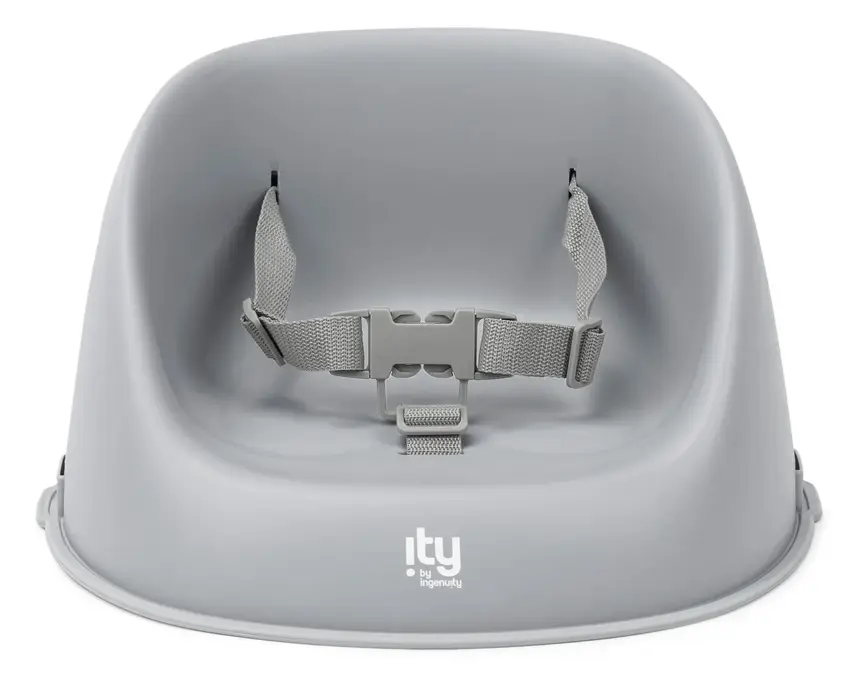
Ingenuity My Spot Easy-Clean Booster Seat
Booster seat for table

Ingenuity SmartClean Toddler Booster Seat
Booster seat for table
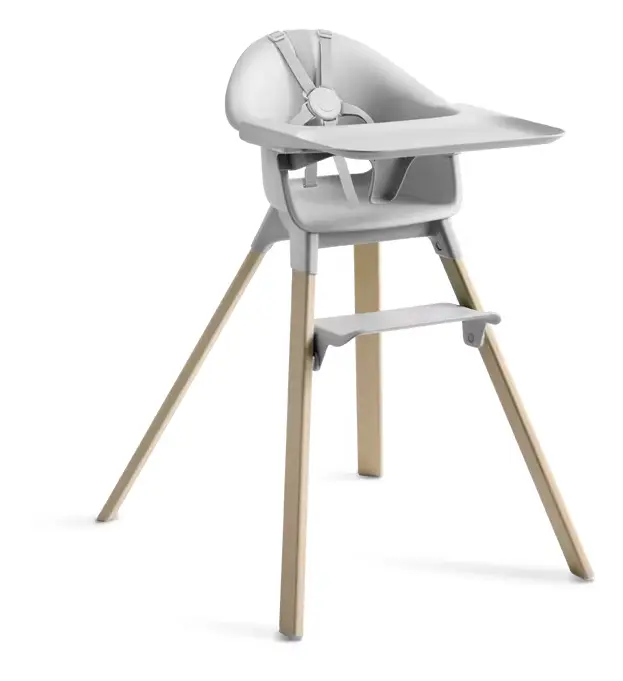
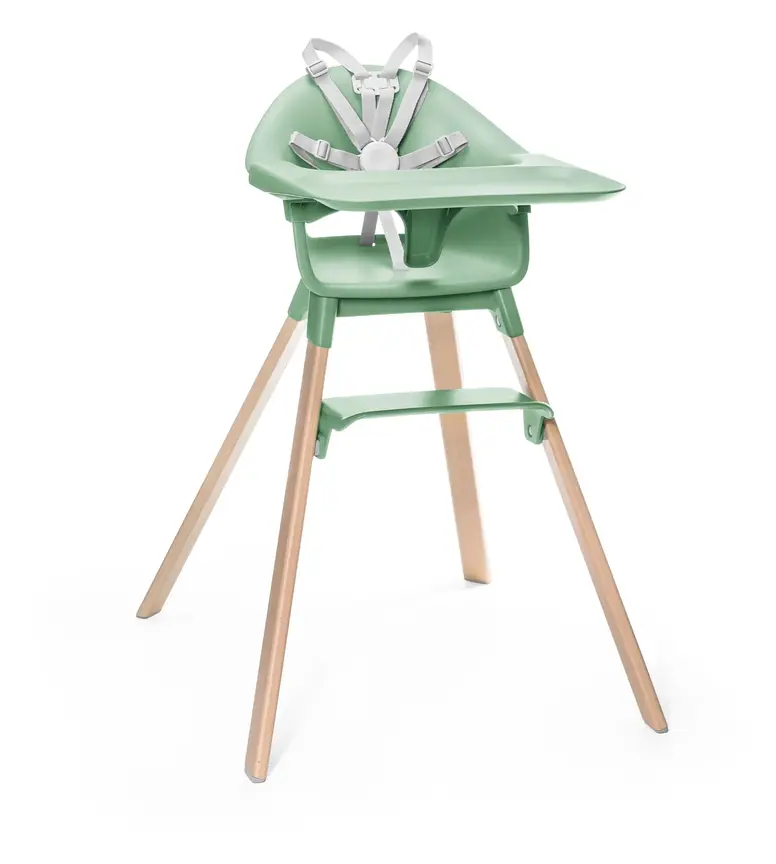
Stokke Clikk
Stokke's lighter, tool-free, fold-flat highchair with a built-in tray — the travel/rental-friendly sibling of the Tripp Trapp.
Frequently asked questions
Can I use a clip-on high chair on a glass table?
No. Never clamp a clip-on chair onto a glass tabletop. Glass can crack or shatter under the squeezing force of the clamp and the weight of your child.
How tight should the clamps be?
Tighten the clamps until the rubber pads press firmly against the table and the chair does not move when you tug it hard. Do not keep cranking past that point, as too much force can crush hollow wood or damage the clamp threads.
At what age can my baby start using a clip-on table chair?
Wait until your baby can sit up steady on their own without slumping, which is usually around 6 months old. Always check the minimum age and maximum weight listed on your chair's label.
Can a clip-on chair damage a wooden dining table?
Yes, it can leave marks or dents if you over-tighten the clamps, if dirt gets trapped under the pads, or if the table is hollow or soft wood. Keep the rubber pads clean and tighten only until the chair is firm and steady.
Are clip-on high chairs safe for restaurants and cafes?
They are safe only if the restaurant table is heavy, flat, solid and within the chair's thickness limits. Avoid small single-leg cafe tables, folding tables and tables with deep lips under the edge.
What if my baby's feet touch a bar under the table?
Move the chair to another spot on the table or use a different seat. If a baby can brace their feet against a crossbar or nearby chair, they can push upwards and unhook the chair or tip backwards.
Should I buy a clip-on chair with a five-point harness?
Yes, a five-point harness with shoulder, waist and crotch straps gives the best protection. It stops your baby from standing up, leaning too far sideways or slipping down through the seat.
Sources
- Product Safety Australia – High chairs guide
- Raising Children Network – Choosing safe baby furniture: highchairs and more
- NHS – Baby and toddler safety
- UK Office for Product Safety and Standards
- U.S. Consumer Product Safety Commission – New federal standard to improve safety of high chairs
- HealthLink BC (Canada) – Safe chairs for babies in the first year
- Health Canada – Recalls and safety alerts
Related guides
More Car Seats & Travel →
Dining Table Booster Seats: Chair Straps, Child Harnesses and Non-Slip Bases Explained

Portable Travel Bassinets and Pop-Up Infant Domes: Safe Sleep, Floor Insulation, Sun Canopies, and Packing

Smart WiFi Temperature and Humidity Sensors: Safe Nursery and Travel Guide
