














Wooden Push Walkers vs Stationary Activity Tables: How to Choose Safely
Compare wooden push walkers and stationary activity tables. Learn when each may suit your child, what to check, and how to reduce everyday risks.
On this page
- What these toys are
- What the old advice gets wrong
- Which one may suit your child?
- Push walker safety: wheels, handle and floor
- Stationary table safety: base, toys and height
- Side-by-side comparison
- Read labels and instructions before buying
- Age and development stages
- Choose for your room and routine
- Wheeled baby walkers are a different product
- Safety advice across four countries
- Common mistakes to avoid
- How to introduce a toy safely
- When to ask for help
- Frequently asked questions
- Sources
Short answer: A stationary activity table stays in one place. A child can stand or sit beside it and play. A wooden push walker has wheels and a handle. A child pushes it while standing. These are different toys, with different risks. Neither teaches a child to walk on its own. Choose by your child’s current skills, your space, and the maker’s instructions. Stay close whenever your child plays.
This guide covers push-along toys. It does not cover wheeled baby walkers with a seat or frame that holds a baby above the floor. Those let a child move while seated and can create serious hazards. Do not confuse the two products when shopping.
What these toys are
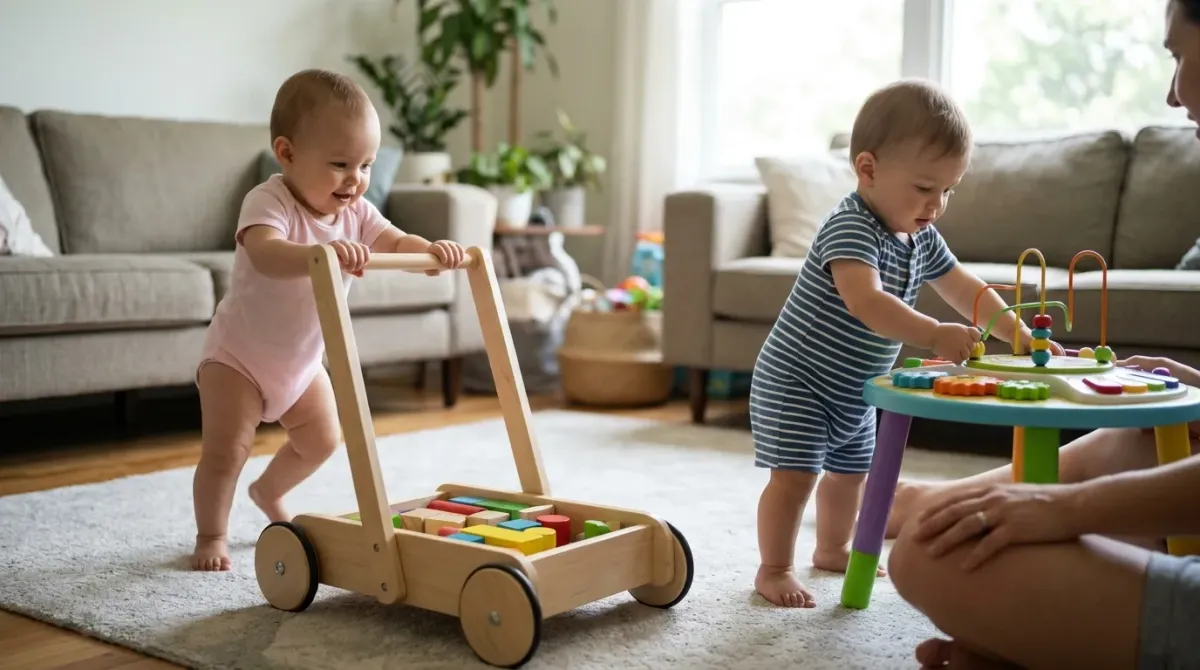
A wooden push walker is a toy with wheels and a handle. A child stands behind it and pushes it along the floor. Some have a small activity panel. Others have blocks or beads attached. The child’s hands hold the handle. The child’s feet remain on the floor.
A stationary activity table has a play surface and legs. It may have buttons, shapes, tracks, or simple toys. A child can play while sitting, kneeling, or standing. The table itself should stay put during play. It does not carry the child around the room.
Some products combine features. A table might have wheels or convert into a push toy. Read the instructions for each mode. Do not assume a toy is stable just because it feels heavy. Do not use a product in a mode the maker does not describe.
What the old advice gets wrong
The earlier draft made unsupported claims about Australian certification, materials, airflow, spinal support, and product testing. It also described standards that do not apply to these toys. This guide removes those claims. A badge or broad phrase such as “certified safe” is not proof by itself. Check the product details, instructions, recall notices, and rules in your country.
There is no sound basis here for saying a walker or table improves posture, prevents falls, or makes a child walk sooner. Toys can offer play and practice. Children develop at different speeds. A toy should not replace floor play, adult attention, or advice from a health professional when you have concerns.
Wood alone does not prove quality or safety. A wooden toy can still have loose screws, rough edges, trapped-finger gaps, or unstable wheels. A plastic toy can also be well made. Look at the whole product and its instructions. Do not choose by material or appearance alone.
Which one may suit your child?
A table can work for a child who enjoys play at one spot. It does not need a clear path across the room. It may suit a small play area, if the table fits without blocking exits or walkways. A child can return to the same toys without chasing them.
A push walker needs open floor space. The child must be ready to stand and move while holding the handle. A child who is still learning to pull up may find a wheeled toy moves away too quickly. This can lead to a loss of balance. A table with a wide, steady base may provide a fixed place to reach and play, but it is not a support rail. Watch how your child uses it.
Age labels are a starting point, not a skill check. Compare the child’s abilities with the instructions. If the toy has small parts, moving parts, cords, magnets, batteries, or a height limit, read those warnings before use.
Think about your child’s usual play. Some children like to repeat the same hand actions. Others want to move around. A table may offer repeated play in one place. A push walker may offer movement over a short route. Neither choice needs to entertain a child for a long time. Short play periods are fine.
Think about who will use the toy. A younger child may be near an older sibling’s toys. Small pieces from another toy can end up on the floor. A moving walker can reach those pieces. A table can also have small parts within reach. Check the whole play area before each session.
Push walker safety: wheels, handle and floor
Some push walkers have wheel friction settings or a brake. These may slow the wheels. They do not make the toy unable to move. Read how the maker says to adjust them. Do not add homemade brakes, weights, tape, or other changes. Changes can make the toy behave in an unsafe way.
Before each play session, look over the wheels and frame. Check that wheels turn as intended and do not wobble or fall off. Check the handle and any screws or fasteners. Stop using the toy if a part is loose, cracked, sharp, or missing. Follow the maker’s repair advice.
Use the walker on a level, dry floor. Keep it away from stairs, steps, balconies, pools, fireplaces, hot drinks, and glass doors. Use a safety gate where needed. Clear rugs that bunch, cables, toys, and other trip hazards from the route. Do not use it near a road or driveway.
A wide stance may help a walker feel less tippy, but no shape removes the risk of a fall. A child can push into furniture, tip the toy, or move faster than expected. Stay within reach. Do not pull the child along by the walker or leave them to play alone.
Check the floor where the child will play. A smooth floor may let wheels roll quickly. A thick rug may catch a wheel or bunch under the toy. A doorway lip can stop a wheel suddenly. Do not test the toy near stairs or a drop. Pick a clear, level area and remain close.
Do not use the walker to carry other items. A bag on the handle can change the balance. A toy tied to the handle can catch on furniture. Use only the parts supplied or allowed by the maker. Keep the route free from pets and other children who may cross in front.
Pay attention to the child’s grip and movement. If they lean heavily on the handle, fall, or seem unable to control the toy, pause play. The child may need more time before using it. A toy is not a way to train a child through discomfort or repeated falls.
Stationary table safety: base, toys and height
Put the table on a flat floor. Check that all legs are fitted and locked as the instructions show. Press gently on the play surface before use. If it rocks, shifts, or tips, stop and check the setup. Do not put heavy items on the table to hold it down.
Check the table’s height and edges. A child should be able to reach the play area without climbing on it. Keep stools, chairs, and other climbable objects away. A child may try to climb, lean over, or pull the table towards them. Supervise closely, especially when the child is standing.
Inspect attached toys and parts. Make sure nothing is broken or loose. Look for sharp edges, gaps that could trap fingers, and parts that could detach. Keep small pieces away from children who still put toys in their mouths. Follow the age label and warnings.
Place the table where an adult can see the child easily. Avoid spots beside windows, heaters, cooking areas, cords, or unstable furniture. Keep the table away from shelves that a child could pull. Do not put it on a raised platform or near steps.
Some tables use batteries or make sounds and lights. Check that battery covers close as the instructions show. Keep spare batteries away from children. Stop using the toy if a cover is missing or damaged. Follow the maker’s cleaning directions, especially around electrical parts.
A table should not be used as a highchair, climbing frame, or standing support unless the maker clearly designed it for that use. Do not strap a child to it. Do not leave the child standing on a chair to reach the toys. Keep play simple and supervised.
Side-by-side comparison
| Feature | Wooden push walker | Stationary activity table |
|---|---|---|
| Movement | Moves when pushed | Designed to stay in one place |
| Space needed | Needs a clear, level route | Needs a stable spot and clear space around it |
| Child’s position | Usually standing and holding the handle | Sitting, kneeling, or standing, depending on the child |
| Main concern | Rolling away, collisions, falls, and access to hazards | Climbing, tipping, trapped fingers, and loose parts |
| Wheel checks | Check wheels and any maker-provided speed setting | Check whether the table has wheels; follow instructions |
| Best setting | Open, level indoor floor, away from hazards | Flat area where the child can play with an adult nearby |
| What it cannot promise | It cannot guarantee safer steps or earlier walking | It cannot guarantee better balance or faster development |
| Before buying | Check age guidance, stability, handle, wheels, and recalls | Check stability, height, attached parts, and recalls |
| Cleaning | Wipe surfaces and check wheels for trapped dirt | Clean the top and toys as the maker directs |
| Storage | Keep it away from stairs and paths when not in use | Keep it from blocking doors or walkways |
| Good fit when | The child can stand and control the toy with help nearby | The child enjoys play beside a fixed surface |
This table compares common features. It does not rank all products. Designs differ, even within one type. Read the instructions for the exact model you are considering.
Read labels and instructions before buying
Look for the maker or importer’s name and contact details. Check the recommended age, weight or height limits, assembly steps, cleaning directions, and warnings. Ask the seller for the instructions if they are not easy to find. Keep the instructions for later checks.
Check that the product matches the description. A push walker should not have a seat that suspends a baby above the floor. If the product description is unclear, ask the seller what the child does while using it. Avoid products with missing instructions or unclear age guidance.
Second-hand toys need careful checks. Look for cracks, loose parts, worn wheels, missing screws, and changes made by a past owner. Find the exact model and check whether it has been recalled. If you cannot confirm the model or condition, do not use it.
Keep the receipt, model name, and instructions. These details help if you need a replacement part or need to check a recall. Take a clear photo of the product label before it wears away. Do not rely only on a seller’s product page, because listings can change.
When buying online, check who sells the item and where the seller is based. Confirm that you can contact the maker or importer. Read the return terms before purchase. If the seller cannot answer basic questions about age limits, setup, or parts, choose another product.
Inspect the item again after assembly. Follow each step in order. Use only the screws and tools supplied or named in the instructions. Do not guess if a part does not fit. Ask the maker or seller for help before letting a child use it.
Age and development stages
Before sitting steadily: These toys are usually not useful yet. Focus on safe floor play and toys suited to the child’s current skills. Never place a baby in a push walker or on a high surface to reach a toy.
When sitting and reaching: A low, stable table or floor toys may offer play. Stay close. A baby can lose balance while reaching, even when sitting. Use the table only as its instructions allow.
When pulling to stand: Children may pull on furniture or toys. A wheeled walker can move suddenly. Do not treat it as a steady support. If your child is unsteady, choose floor play and speak with a health professional if you have concerns.
When taking steps: A child may enjoy pushing a toy, but still needs close care. Keep the route clear and away from hazards. Stop if the child falls often, the toy tips, or the wheels move too quickly to control.
As skills change: Follow the maker’s age and size limits. Put the toy away when it is outgrown or damaged. A child may become more curious and climb on furniture, so keep supervising even when walking looks steady.
Children do not all reach movement skills on the same day. Avoid comparing your child with a sibling, friend, or online video. The toy should fit the child today. It should not be used to push them into a skill they are not ready to try.
If your child has a health condition or movement need, ask their health professional about play choices. A child health nurse, doctor, or paediatric physiotherapist can offer advice for that child. The product maker can answer questions about the toy’s intended use.
Choose for your room and routine
Measure the play space before buying. Leave room for an adult to sit or stand beside the child. A walker needs a route that does not cross a doorway, kitchen, or stair opening. A table needs space around it, so the child does not get trapped against furniture.
Think about where the toy will live when not in use. A walker left in a hall can become a trip hazard. A table left beside a shelf may help a child climb. Put toys away after play if your child might use them without an adult nearby.
Consider cleaning and upkeep. Wooden surfaces may need a dry or slightly damp cloth, based on the maker’s directions. Do not soak wood unless the instructions allow it. Check for splinters or finish that is peeling. Wipe plastic surfaces as directed, and let them dry before use.
Noise can matter in a shared home. Some toys make sounds or have parts that click. Try the toy in the store if possible, or read the description carefully. Do not assume extra sounds or lights help a child learn. Simple toys can still offer play.
Think about siblings and visitors. A toy that suits one child can still create risks for another. Put away small pieces before a baby enters the room. Teach older children not to push the walker near a younger child. Adults remain responsible for supervision.
Wheeled baby walkers are a different product
A wheeled baby walker has a seat or frame that holds a baby. The baby’s feet touch the floor, and the frame can roll. This is not the same as a push-along toy. The American Academy of Pediatrics warns that baby walkers can cause serious injuries. They can let a child reach hazards quickly, including stairs and hot items.
Do not buy or use a seated wheeled baby walker. If you already have one, keep the child out of it and check your local product safety advice for disposal or other steps. A push walker is not automatically safe either. It still needs the right child, safe space, correct setup, and adult supervision.
Product names can be confusing. Sellers may use the word “walker” for both types. Look at the picture and description. If a baby sits inside a frame that rolls, it is a seated baby walker. If a child stands behind a handle and pushes a toy, it is a push walker.
Safety advice across four countries
Rules for toys and child products differ by country. Check with the official body where you live. Australia’s Product Safety Australia is part of the Australian Competition and Consumer Commission (ACCC). The UK body is the Office for Product Safety and Standards (OPSS). In the US, the Consumer Product Safety Commission (CPSC) handles consumer product safety. In Canada, Health Canada shares product safety alerts and recalls.
| Country | Official body to check | Practical step |
|---|---|---|
| Australia | Product Safety Australia (ACCC) | Search recalls and read consumer product safety guidance. |
| United Kingdom | Office for Product Safety and Standards (OPSS) | Check current product safety advice and seller information. |
| United States | Consumer Product Safety Commission (CPSC) | Search the product name and model for recalls and alerts. |
| Canada | Health Canada | Search recalls and safety alerts for the product. |
Do not rely on a foreign safety mark alone. A product sold in one country may have different instructions or limits elsewhere. If you buy online from another country, check who is responsible for local support and recall notices.
In Australia, use Product Safety Australia to look for recalls and consumer advice. In the UK, check OPSS notices and the seller’s details. In the US, search CPSC recalls and alerts. In Canada, check Health Canada’s recall service. Search by the exact maker and model name when possible.
A recall check does not replace an inspection. A toy can become damaged after purchase. Check it before use, even if no recall appears. Stop using it if it breaks, has missing parts, or behaves differently from the instructions.
Common mistakes to avoid
- Mixing up product types: A seated baby walker is not a push-along walker. Read the listing carefully.
- Believing a brake makes play risk-free: A friction setting can slow wheels, but it cannot prevent every movement or fall.
- Using the toy on stairs or near a drop: Keep toys away from stairs, balconies, pools, and other hazards.
- Leaving a child alone: Stay close enough to act if the toy tips or moves.
- Ignoring loose parts: Stop use and repair or replace the toy as the maker directs.
- Assuming heavy means stable: Test stability on a flat floor and follow the instructions.
- Using a toy before the child is ready: Follow the age and skill guidance. Do not rush a child into standing play.
- Adding homemade changes: Do not attach weights, cords, or homemade brakes.
- Skipping recall checks: Search the exact brand and model before buying used.
- Leaving the toy in a doorway: Put it away after play so it does not block a path.
- Ignoring the room: Move cords, small objects, hot items, and unstable furniture out of reach.
- Assuming wood cannot break: Check for cracks, splinters, loose joints, and peeling finish.
How to introduce a toy safely
- Read the full instructions before assembly.
- Fit every part as shown. Ask the maker about missing pieces.
- Place the toy on a level floor, away from stairs and hazards.
- Check wheels, handles, legs, and attached toys for damage.
- Let the child explore while you stay close and watch.
- Put the toy away after play, especially if another child could climb on it.
For a first session, keep the play area simple. Remove other toys from the route. Sit or stand close enough to help. Let the child choose whether to touch or push the toy. Stop if the child becomes upset or tired.
For a push walker, watch how quickly it moves. Use only maker-approved wheel settings. Do not hold the child up by the handle. For a table, watch for climbing, leaning, and pulling. Move the toy if the child uses it in a way the maker does not allow.
After play, look for signs of damage. Check that small parts remain attached. Wipe away food or dirt as the instructions say. Store the toy where the child cannot reach it without supervision, if needed.
When to ask for help
Ask a child health nurse, doctor, or paediatric physiotherapist if you worry about your child’s movement, balance, or development. They can look at your child’s own needs. A toy maker or seller can answer questions about assembly, limits, and replacement parts. Contact your country’s product safety body if you think a product is unsafe.
Seek help promptly if a child is hurt. For an urgent injury or immediate danger, contact your local emergency service. Keep the product and its label if a serious fault or injury occurs. The maker or product safety body may need the model details.
Frequently asked questions
Do wooden push walkers help babies walk sooner?
There is no good reason to promise that they do. Children learn at different speeds. A push toy can be part of play for a child ready to stand and move. It does not replace floor play or adult care.
Are stationary activity tables safer than push walkers?
They have different risks. A table does not roll along a route, but a child may climb or pull it. A push walker can move and cause a fall or collision. Check the toy and supervise closely.
What does wheel friction mean?
It means the wheel setting adds resistance, so the wheels may turn more slowly. It does not lock every wheel or stop all movement. Use only a setting described by the maker.
Can I add weight to a push walker?
No. Added weight can change how the toy tips or moves. Do not make changes that the instructions do not allow.
Can my baby use a seated wheeled baby walker?
No. A seated wheeled baby walker is a different product and can expose a baby to serious hazards. Choose floor play or an age-suitable stationary toy instead.
What should I check when buying second-hand?
Find the exact model and instructions. Check for recalls, cracks, loose parts, worn wheels, and missing pieces. Do not use it if you cannot confirm it is complete and in safe condition.
Should I stop using the toy when my child can walk?
Follow the maker’s age and size limits. Stop if the toy is damaged or your child climbs on it. Keep supervising while the toy is out.
Where can I check a recall?
Use the official recall service in your country. Australia has Product Safety Australia, the UK has OPSS, the US has CPSC, and Canada has Health Canada alerts.
Is a wide base enough to prevent a walker tipping?
No. A wide base may affect how a toy feels, but it cannot prevent every tip or fall. Use it only as directed. Stay close and keep the route clear.
Can I use a push walker outdoors?
Follow the maker’s instructions. Many toys are intended for indoor floors. Uneven ground, slopes, steps, and outdoor hazards can make control harder. Do not use it near roads or driveways.
How often should I check the toy?
Look it over before each play session. Check for loose parts, cracks, sharp edges, and damage. Follow any extra checks in the instructions.
What if the table rocks slightly?
Stop play and check that it is assembled on a flat floor. Follow the maker’s setup steps. Do not use it if it still rocks or tips.
Disclaimer: This guide gives general information, not medical advice. Follow the product instructions and local safety advice. Ask a health professional about your child’s development or safety needs. Some links may be affiliate links. If you buy through them, BabyGearFinder may earn a commission at no extra cost to you.
Sources
- Raising Children Network – Choosing safe baby furniture: highchairs and more
- HealthyChildren.org (AAP) – Baby walkers: a dangerous choice
- Product Safety Australia – Recalls
- UK Office for Product Safety and Standards
- CPSC (US) – Safe sleep: cribs and infant products
- Health Canada – Recalls and safety alerts
Related guides
More Prams & Strollers →
Stroller Snack Trays and Bumper Bars: How to Choose and Use Them Safely

Smart Prams: Five Useful Features and How to Choose Safely

Portable Stroller Toys: How to Choose and Use Them Safely
