














Toddler Kitchen Helper Towers: Stability, Guardrails and Kitchen Safety
Learn how to choose and use a toddler kitchen helper tower, check its stability and guardrails, and keep your child safe near counters and cooking.
On this page
- What a kitchen helper tower does
- Decide whether your child is ready
- Check stability and anti-tip features
- Guardrails, openings and climbing
- Choose a tower that fits your home
- Side-by-side comparison of common designs
- Keep the counter and cooking area safe
- Supervision and safe use, step by step
- Age and skill stages
- Standards, recalls and guidance across four countries
- Common mistakes to avoid
- Cleaning, storage and second-hand towers
- Frequently asked questions
- Sources and further guidance
- Sources
Short answer: A kitchen helper tower lets a child stand near a counter while an adult works nearby. It is raised furniture, so a child can fall or tip it. Choose a model that fits your child and kitchen. Set it on a level floor, away from heat, water, sharp tools and dangling cords. Stay close enough to stop a fall. A guardrail or wide feet cannot make a tower safe without adult attention.
There is no single age that suits every child. Read the maker’s age, height and weight limits. Check that your child can climb in and out with control. If they cannot follow simple safety directions, or keep climbing and leaning, wait and try again later.
What a kitchen helper tower does
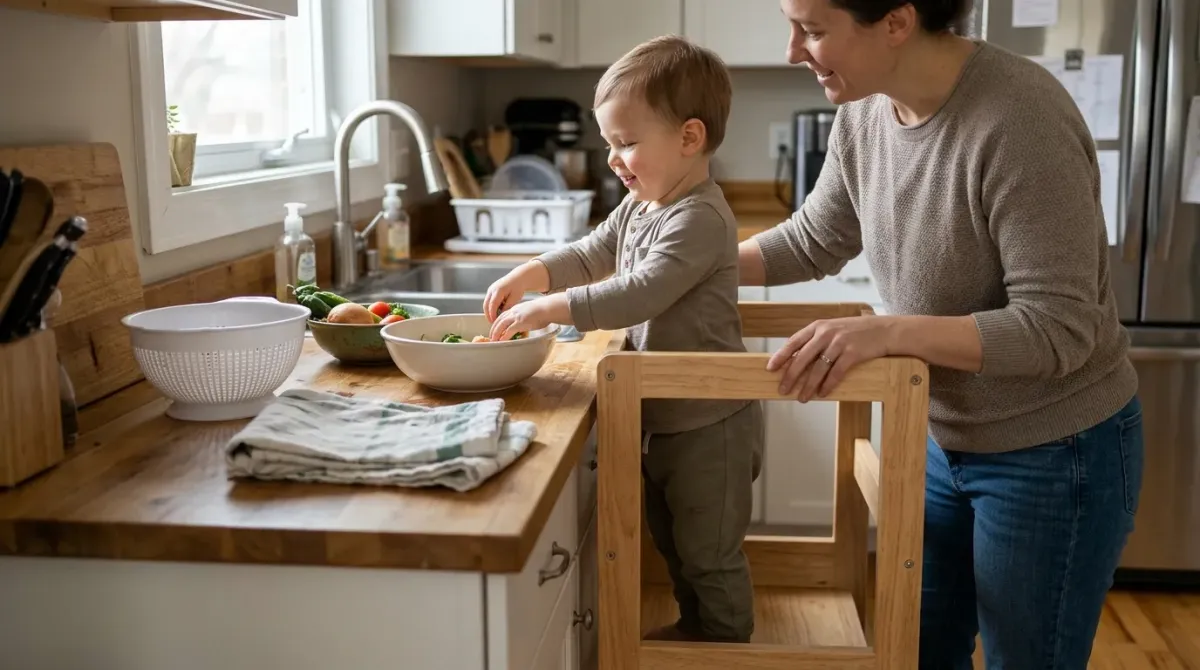
A kitchen helper tower is a raised platform with sides or rails. It brings a child closer to counter height. Some designs have an open side. Others have a gate or adjustable platform. The child usually stands inside while an adult prepares food or does another task.
It is not a high chair. It does not hold a child in a seated position. It is not a playpen, step stool, or place to leave a child alone. A child can climb, lean, reach, or try to get out. The tower only helps with access. It does not remove the risks around a busy kitchen.
Some families use one during simple tasks. A child might wash a vegetable in a cool bowl or stir a mixture away from heat. They can also watch an adult work. Keep hot, sharp and breakable items out of reach. The adult remains responsible for the child and the task.
Decide whether your child is ready
Age labels are a starting point. A child's actions matter more. Read the tower’s instructions before buying or using it. The instructions should state the child’s allowed age, height or weight, and how the child should enter and leave. Do not use a tower if those details are missing or unclear.
Look for steady standing, careful steps, and an ability to follow simple directions. Your child should understand “stay inside” and “hands away from the stove.” They may still need many reminders. If they keep climbing the sides, rocking the tower, or reaching for objects, stop the activity.
Do not put a baby who cannot stand steadily into a tower. Do not lift a child onto a platform that the maker says they can climb themselves. If the instructions require an adult to place the child inside, follow them. If the entry method seems hard to control, choose another activity at floor level.
Read the limits again as your child grows. A tower that once fit may become too small or too easy to climb out of. Stop using it once your child exceeds any stated limit. Stop sooner if a part is loose, damaged, missing or unstable.
Check stability and anti-tip features
Stability depends on the whole tower and the floor beneath it. Wide feet or outriggers can widen the base. Outriggers are parts that extend out from the legs. They may make tipping less likely, but they do not prevent every tip. A child can still fall from the platform or pull the tower over.
Before each use, place the tower on a flat, firm surface. Avoid rugs, soft mats, uneven tiles and floors that slope. Check that all feet touch the floor. If the tower rocks when empty, do not use it. Follow the maker’s directions for levelling or assembly. Do not add homemade weights, straps or braces.
Look at the base from the side and front. A broad base can help resist tipping when a child leans. It also needs room around it. Do not wedge the tower tightly between cabinets or against a counter. That can make it harder to notice movement and may trap fingers.
After assembly, check every screw, hinge, latch and joint. Tighten parts only as the maker directs. Recheck them at the interval in the instructions, and after moving the tower. Do not assume a heavier tower is automatically safer. Weight, shape, floor contact and the child’s actions all matter.
Do not use a tower with cracked wood, bent parts, sharp edges, loose rails or missing feet. Contact the maker for an approved replacement part. Do not repair a load-bearing part with tape, glue or a part from another model.
Guardrails, openings and climbing
Guardrails can help keep a child within the platform. They are not a harness. A child may climb over, push through, or lean across them. The rails should be secure, with no loose or broken sections. Follow the maker’s rules about gates and entry openings.
Check the spaces between rails and around the platform. A child’s head, neck, fingers or limbs could become trapped in an unsafe gap. It is not possible to judge safety from a photo or one measurement alone. Look for clear instructions and a product designed for this use. Do not modify the rails or add padding that could create new gaps.
Watch how your child uses the tower. If they stand on a rail, sit on the edge, climb the outside, or lean far over the counter, lift them down and end the activity. Do not rely on a high rail to stop climbing. Keep stools, chairs and other climbing aids away from the tower.
A gate can close the entry opening, but it needs to work as intended. Make sure it latches fully before use, if the instructions require it. Keep small fingers clear while closing it. Never leave the child inside while you leave the room.
Choose a tower that fits your home
Measure the space where the tower will stand. Check the counter height and the tower’s footprint. Leave room for an adult to stand beside the child and move away quickly. The tower should not block a walkway, doorway, oven, dishwasher or emergency exit.
Check the platform height and adjustment method. The child should stand with a stable footing and reach only the safe activity you have set up. The platform must lock into place as the instructions show. Do not adjust it while a child is inside.
Consider how the child enters. Some models have a fixed opening. Others use a movable step or gate. Choose a design you can supervise easily. If a child can climb in without help, they may also climb in when you are not ready. Store the tower out of reach or turn it away from the counter when not in use, if the maker allows.
Think about cleaning and storage. Food and liquid can collect in seams and corners. Check that the surfaces can be cleaned using the maker’s directions. A folding model can save space, but folding parts can create pinch points. Keep the child away while folding or unfolding it. Confirm it locks open before use.
Do not choose by promises such as “tip-proof” or “completely safe.” Ask for clear instructions, limits, assembly steps and care guidance. Check whether the product has been recalled in your country. Avoid second-hand towers if the model, instructions or parts cannot be confirmed.
Side-by-side comparison of common designs
Design names are not proof of safety. Use this table to decide what to inspect. The actual product instructions and condition matter most.
| Design feature | Possible benefit | What to check |
|---|---|---|
| Wide fixed base | May give the tower a broader footprint. | All feet sit flat. The base fits without blocking a walkway. |
| Outrigger feet | Extend the base beyond the upright sides. | Feet are firmly attached and do not catch on rugs or toes. |
| Full side rails | Can help keep a child within the standing area. | Rails are secure. The child cannot use them as climbing steps. |
| Entry gate | Can close an opening while the child stands inside. | It latches as directed and does not pinch fingers. |
| Adjustable platform | Can change height as the child grows. | It locks into each setting and is adjusted only when empty. |
| Folding frame | May take less space in storage. | It locks open. Folding parts stay away from children’s hands. |
| Open-sided design | May make entry and exit easier. | The child can leave or fall through the open side. |
Keep the counter and cooking area safe
Set the tower away from the stove, oven, hot pans, kettle, toaster and other heat sources. Keep it away from sinks and standing water. A child should not be able to touch a hot surface, pull a pan handle, or reach a knife.
Turn pan handles towards the back of the hob. Keep cords from kettles and other appliances out of reach. Put knives, scissors, skewers, cleaning products and medicines in a locked or high place. Do not leave a child beside an open dishwasher or a hot oven door.
Prepare the activity before bringing the child over. Use cool ingredients and a stable bowl. Give the child a safe utensil that suits their age. Avoid small foods or loose objects if they may put them in their mouth. Follow trusted choking guidance when offering food.
Keep the floor dry. Wipe spills at once. Do not place the tower over a floor mat that slips or folds. Keep pets and other children from bumping it. If someone needs to carry a hot pan through the space, take the child down first.
Use the tower for one child at a time unless the maker says otherwise. A sibling leaning on the frame can shift it. Do not let children push, rock or ride on it. Keep the activity short enough that the child can listen and stay engaged.
Supervision and safe use, step by step
- Read the instructions. Confirm age, size and weight limits, assembly and use directions.
- Inspect the tower. Check rails, fasteners, feet, gates and platform locks.
- Prepare the space. Clear the floor and move heat, sharp items and cords out of reach.
- Set it in place. Use a flat floor. Check that the tower does not rock.
- Bring your child over. Help them enter in the way the maker describes.
- Stay beside them. Keep your attention on the child. Do not use a phone or leave the room.
- End the activity early. Stop if the child climbs, leans, rocks the tower or stops following directions.
- Help them out. Take the child down before moving or adjusting the tower.
- Store it safely. Put it away or make it unavailable when it is not in use.
Being in the same room is not always enough. Stand close enough to steady the child or lift them down at once. Do not turn away to answer the door or collect something from another room. If you need to leave, take the child down first.
Age and skill stages
Children gain balance and judgement at different times. These stages are prompts for observation, not fixed age rules. The maker’s limits always apply.
| Stage | What to consider | Safer choice |
|---|---|---|
| Not standing steadily | The child may slump, reach suddenly or lose balance. | Do not use a standing tower. Choose a floor activity with an adult. |
| Learning to stand and climb | The child may not understand the edge or rails. | Wait until they meet the product instructions and can follow simple directions. |
| Steady standing with close help | The child may enjoy watching or doing a simple task. | Use only with an adult beside them and a prepared, cool activity. |
| Climbing or leaning often | The child may try to get over the rail or reach unsafe items. | Stop using it for now. Try again when they can stay within the safe area. |
| Above a product limit | The tower may no longer fit or support the child as intended. | Stop using it. Follow the maker’s maximum limits. |
Standards, recalls and guidance across four countries
A kitchen helper tower is a child-use product, but a listed standard may not cover every tower type. Do not assume that a tower meets a rule because a seller uses words like “certified” or “tested.” Ask what product and rule the claim refers to. Check the instructions and your local product safety advice.
| Country | Official bodies to check | Useful next step |
|---|---|---|
| Australia | Product Safety Australia and the Australian Competition and Consumer Commission (ACCC) | Check product recalls and general home safety guidance. |
| United Kingdom | Office for Product Safety and Standards (OPSS) and the NHS | Check product alerts and follow child safety advice. |
| United States | Consumer Product Safety Commission (CPSC) and the American Academy of Pediatrics (AAP) | Search for recalls and use childproofing guidance. |
| Canada | Health Canada and the Canadian Paediatric Society | Check recalls and product safety alerts. |
For general fall prevention, Kidsafe Australia advises families to reduce hazards around children. The CPSC’s Anchor It! campaign covers furniture tip-over prevention. These sources do not certify a kitchen tower. They can help you think about climbing, falls and stable furniture at home.
Check the model name and maker before buying or using a second-hand tower. Search your country’s official recall pages. If a recall applies, follow the instructions. Stop use if the tower is damaged or if you cannot confirm that a missing part is safe to replace.
Common mistakes to avoid
- Assuming outriggers make it tip-proof. They may widen the base, but a child can still tip or fall.
- Using it before the child is ready. Wait until the child meets the maker’s limits and can stand with control.
- Leaving the child alone. Stay close and keep watching for the whole activity.
- Placing it by heat or water. Keep the tower away from stoves, hot appliances and sinks.
- Using it on a rug or uneven floor. Choose a flat, firm surface and check for rocking.
- Letting the child climb on the rails. End the activity if they climb, lean or rock the frame.
- Adjusting it with the child inside. Take the child down before changing the platform or moving the tower.
- Adding homemade parts. Do not add straps, weights, cushions or braces that the maker has not approved.
- Ignoring wear. Stop using it if a rail, foot, latch or joint is loose or broken.
- Trusting broad safety claims. Look for clear instructions and check current recalls.
Cleaning, storage and second-hand towers
Follow the maker’s cleaning directions. Use only products that suit the tower’s finish. Dry it fully before use. Check seams and corners for food, moisture or damage. Do not soak wooden parts unless the instructions allow it.
Store the tower where a child cannot climb it without an adult. If it folds, keep it folded only as the maker directs. Check that it cannot fall over in storage. Keep small screws and removable parts away from children.
For a second-hand tower, ask for the model name, instructions and all original parts. Check the frame, rails, feet and platform closely. Search official recall pages. Avoid it if parts are missing, repairs are unclear, or you cannot confirm the limits. Do not guess whether a different screw or foot will fit.
Frequently asked questions
At what age can a child use a kitchen helper tower?
There is no single age for every child or tower. Follow the maker’s minimum age and size limits. Your child should stand steadily and follow simple directions. Wait if they still fall often or climb without control.
Are anti-tip outrigger feet enough to stop a tower tipping?
No. Outriggers extend the base and may help with stability. They cannot stop every tip or prevent a child falling from the platform. Use a flat floor, inspect the tower and stay close.
How high should the guardrail be?
There is no single height that makes every tower safe. Follow the product instructions and check that the rails are secure. A child may climb or lean over any rail. Do not rely on rail height instead of supervision.
Can I use the tower on a kitchen mat?
Use a flat, firm surface unless the maker says otherwise. Mats can slip, bunch up or leave a foot unsupported. If the tower rocks or shifts, stop and move it to a suitable floor.
Can I leave my toddler in the tower while I cook?
No. Stay close enough to act at once. Cooking needs attention, so choose a cool task away from the stove. Take your child down if you need to handle a hot pan or leave the room.
Can a kitchen helper tower replace a high chair?
No. A tower is for standing at a counter. It does not provide the same seated position or restraint as a high chair. Use the product only for the purpose stated by its maker.
What should I do if the tower wobbles?
Do not put your child in it. Check assembly and floor contact using the instructions. If it still wobbles, contact the maker or stop using it. Do not add a homemade brace or weight.
Can two children use it together?
Only if the maker clearly allows that use. Otherwise, use it for one child at a time. Another child can bump, pull or shift the tower while someone stands inside.
What should I do if my child climbs the rails?
Take them down and end the activity. Move the tower out of reach when it is not being used. Try again later only if your child can stay inside and follow directions.
Sources and further guidance
- Kidsafe Australia – Falls
- Product Safety Australia – Toppling furniture and televisions guide
- UK Office for Product Safety and Standards
- RoSPA – Child safety at home
- CPSC – Anchor It! furniture tip-over prevention
- American Academy of Pediatrics – Childproofing your home
- Health Canada – Recalls and safety alerts
This guide gives general information, not medical or product-specific advice. Follow the product maker’s instructions and check current safety alerts. Affiliate links may earn BabyGearFinder a commission. This does not change the price you pay.
Sources
- Kidsafe Australia – Falls
- Product Safety Australia – Toppling furniture and televisions guide
- UK Office for Product Safety and Standards
- RoSPA – Child safety at home
- CPSC (US) – Anchor It! furniture tip-over prevention
- HealthyChildren.org (AAP) – Childproofing your home
- Health Canada – Recalls and safety alerts
Related guides
More Toys & Play →
Toddler Rain Suits and Muddy Buddy Overalls: Fit, Seams and Puddle Play

Toddler Aprons and Waterproof Art Smocks: How to Choose and Use Them

How to Organise a Shared Closet for a Baby and Toddler
