














How to Trim a Newborn’s Nails Safely: Clippers, Scissors and Electric Buffers
Learn when and how to trim a baby’s nails with clippers, scissors or an electric buffer, plus simple steps to lower the risk of nicks and infection.
On this page
- Why newborn nails need gentle care
- Choose a tool you can control
- Tool comparison
- Set up before you start
- Step-by-step: trimming with clippers or scissors
- Step-by-step: using an electric buffer
- How to make nail care easier
- Care by age and stage
- If you nick the skin
- Cleaning and storing nail tools
- Official guidance in four countries
- Common mistakes to avoid
- Frequently asked questions
- Simple checklist
- Sources
Short answer: Baby nails can be sharp, and they grow quickly. Trim them when they need it, using a tool you can control. Baby nail clippers, rounded-tip scissors and electric buffers are all options. There is no single best tool for every family. Choose one that feels steady in your hand, follow its instructions, and work in good light. If your baby moves, stop and try again later.
Newborn nails may look soft, but the skin underneath is delicate. Take your time. You do not need to cut every nail in one sitting. You can smooth a sharp edge with a baby file. Ask a health professional for help if you are unsure or notice signs of infection.
Why newborn nails need gentle care
Newborn fingernails are small and can be hard to see. They may also be soft and close to the skin. A rushed cut can nick the fingertip. A baby may scratch their face while waving their hands. A smooth edge can help reduce sharp points.
Nails do not need to be cut on a fixed schedule. Check them when you dress or bathe your baby. Trim or file them if they are long or sharp. Fingernails often need attention more often than toenails. Each baby is different, so let the nail tell you when it needs care.
Do not pull or bite a nail to shorten it. Pulling can tear the skin. Biting can bring germs from your mouth to the baby’s finger. Use a clean tool made for nails, or a fine baby nail file.
Choose a tool you can control
You can choose baby nail clippers, rounded-tip scissors or an electric nail buffer. A small emery board is another option. Each tool works in a different way. The safest choice is the one you can hold steadily and use without rushing.
Baby clippers cut the nail with a small blade. They are compact and do not need batteries. Their small size can make it easier to see the fingertip. But the blade still needs careful placement. Do not press the clipper into the skin.
Rounded-tip scissors cut with two blades. Some parents prefer the open view and the familiar motion. The rounded ends reduce the chance of a sharp tip poking the skin. They do not remove the need for care. Keep the blades away from the fingertip and use small cuts.
An electric buffer files the nail with a rotating pad. It does not cut with a blade. The pad wears down the nail edge. It can be useful if cutting tools make you nervous. Check the device instructions for age, pad type, speed and cleaning. Keep the spinning pad on the nail only.
A baby file gently smooths an edge. It can be a good choice for a very young newborn whose nails still feel soft. Filing can take longer. Stop if the finger becomes red or sore.
Tool comparison
| Tool | How it works | Possible benefits | Points to watch |
|---|---|---|---|
| Baby nail clippers | A small blade clips the nail edge. | Small, portable and no batteries needed. | Place the blade carefully. Avoid cutting too close. |
| Rounded-tip baby scissors | Two blades cut the nail in small snips. | Rounded ends and a clear view of the cutting line. | Keep the blades steady and away from the skin. |
| Electric nail buffer | A rotating pad files the nail edge. | No cutting blade touches the nail. | Follow the age and pad instructions. Keep the pad on the nail. |
| Baby nail file | A fine surface smooths the nail edge. | Gentle and simple. Useful for small sharp points. | It may take longer. Use a clean file made for babies. |
There is no need to buy several tools before you begin. If one tool feels difficult, try another suitable option. Ask a midwife, nurse, doctor or pharmacist to show you how to hold it if you need help.
Set up before you start
Choose a calm moment when your baby is settled. Some parents find it easier after a feed or bath. Others prefer a time when the baby is asleep. You know your baby’s routine best. Do not begin while you feel rushed or distracted.
- Wash and dry your hands.
- Use a clean, undamaged tool intended for baby nails.
- Sit somewhere with good light.
- Keep your baby on a stable surface, such as a cot or changing mat.
- Keep one hand free to steady your baby and support the finger.
- Put the tool away as soon as you finish.
Never leave your baby alone on a raised surface. If you need to move, put the tool down and take your baby with you. Do not try to trim nails while walking, driving or carrying your baby.
Step-by-step: trimming with clippers or scissors
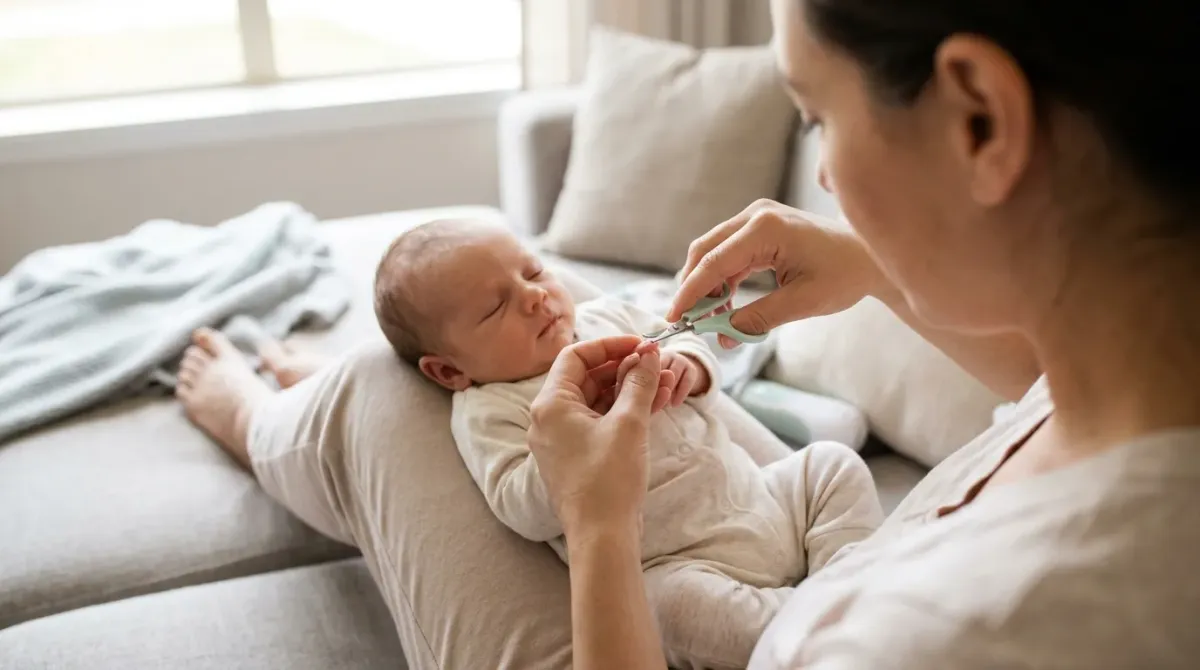
- Hold your baby’s hand gently. Support the finger you are trimming. Keep the other fingers tucked away from the tool.
- Press the fingertip pad back slightly. This helps you see where the nail ends. Use gentle pressure. Do not squeeze the finger.
- Look at the nail edge. Identify the white free edge beyond the skin. If you cannot see it clearly, wait or use a file.
- Make small cuts. Follow the natural curve of the fingernail. Do not cut down the sides or dig into the corners.
- Leave a small white edge. Cutting too close can hurt the skin. You can smooth the edge afterwards.
- Check each finger. Look for a sharp point or rough edge. File it gently if needed.
- Stop when your baby moves. Let the hand relax before you continue. You can finish the rest later.
For toenails, make small, straight cuts across the top. Do not cut deeply into the corners. This helps avoid irritating the skin at the sides. If a toenail looks unusual or painful, ask a health professional before trying to correct it.
Step-by-step: using an electric buffer
Electric buffers vary. Read the instructions for your exact device. Check which pad is meant for a newborn or young baby. Do not use a pad or speed that the maker says is for older children.
- Check the device. Make sure the housing is intact and the pad is secure. Do not use it if it is damaged.
- Set up in good light. Support your baby’s hand and keep the fingertip steady.
- Turn the device on as instructed. Start with the setting recommended for your baby’s age.
- Touch only the nail edge. Move the pad gently across the sharp part. Do not press hard or hold it in one spot.
- Check the nail often. Stop when the edge feels smooth. You do not need to shorten the nail a lot.
- Turn the device off. Clean or replace the pad as the maker directs. Store the device out of your child’s reach.
Do not assume that a buffer cannot irritate skin because it has no blade. A fast or rough pad can still rub the fingertip. Keep the pad on the nail and stop if the skin looks red or sore. If the device warms up, smells unusual or makes a new noise, switch it off and check the instructions.
How to make nail care easier
Small steps can make the task feel less stressful. You can trim one or two nails at a time. There is no rule that says you must finish both hands together.
- Try during a calm feed or while another adult gently holds your baby.
- Use natural light or a bright lamp aimed at the hand.
- Keep your own hands relaxed. A tense grip can make small movements harder.
- Talk softly or pause for a cuddle if your baby becomes unsettled.
- Use a file for a sharp corner after cutting.
- Ask another trusted adult to help steady your baby if that makes you feel safer.
Some babies sleep through nail care. Others wake as soon as you touch a hand. Neither response means you are doing anything wrong. Pause, comfort your baby and try again later.
Care by age and stage
| Stage | What you may notice | Care approach |
|---|---|---|
| Newborn | Nails can be soft and close to the skin. | Check the edge. Use a fine file or a baby tool with a clear view. |
| Young baby | Hands move often, and nails may grow quickly. | Choose a calm moment. Trim a few nails at a time if needed. |
| Older baby | Your baby may reach for the tool or pull away. | Keep the tool out of reach. Ask another adult to help steady the hand. |
| Toddler | Your child may want to watch or hold the tool. | Explain simply. Let them choose a calm time, but keep control of the tool. |
Age alone does not decide which tool is right. Follow the device maker’s age guidance. Choose a method that lets you see the nail and keep your child still enough for safe care.
If you nick the skin
A small nick can happen. Stay calm and stop trimming. Wash your hands. Hold a clean cloth or gauze gently against the spot until bleeding stops. Do not put a bandage where your baby could suck it off or swallow it.
Ask a doctor, nurse or health advice service for help if bleeding does not stop, the cut is deep, or you are worried. Seek medical advice if the finger becomes more red, warm, swollen or painful, or if you see pus. These can be signs of infection.
Do not use nail glue, household glue or strong antiseptic products on a baby’s finger. If you are unsure what to put on the skin, ask a health professional.
Cleaning and storing nail tools
Follow the cleaning directions supplied with your tool. Wash removable parts only if the instructions say they can be washed. Keep electrical parts dry. Do not share nail tools between children unless they have been cleaned as directed.
Check clippers and scissors before each use. The blades should be clean and free from rust or damage. Replace a tool that no longer cuts smoothly. A blunt blade can pull at the nail and make control harder.
For an electric buffer, check how the pads should be cleaned or replaced. Do not keep using a worn, dirty or loose pad. Keep batteries and small parts away from children. If a device uses a small button battery, keep the battery compartment closed and store spare batteries safely.
Official guidance in four countries
Baby nail care is a simple home task. There is no nail-trimming standard listed for these tools in the source library. Product rules for cots, prams and car seats do not apply to nail clippers or buffers. Do not treat a safety mark for another product as proof that a nail tool is safe.
For wider baby health questions, use trusted health services. In Australia, Healthdirect Australia and Pregnancy, Birth and Baby provide health information. In the UK, the NHS gives public health advice. In the US, the American Academy of Pediatrics shares parent guidance through HealthyChildren.org. In Canada, the Canadian Paediatric Society shares family health advice through Caring for Kids.
| Country | Official or peak body | How it can help |
|---|---|---|
| Australia | Healthdirect Australia; Pregnancy, Birth and Baby | General health advice and ways to find care. |
| United Kingdom | National Health Service (NHS) | Public health advice and routes to local care. |
| United States | American Academy of Pediatrics (AAP) | Parent information through HealthyChildren.org. |
| Canada | Canadian Paediatric Society (CPS) | Family health information through Caring for Kids. |
These bodies may not offer specific advice about nail tools. For a cut, rash or nail problem, contact a health professional in your country. Use urgent care if your baby seems very unwell or the injury needs prompt attention.
Common mistakes to avoid
- Cutting too close: leave a small white edge. Do not cut into the skin or nail corners.
- Working in poor light: wait until you can see the nail clearly.
- Trying to finish while your baby moves: pause and start again later.
- Using adult tools without checking: use a baby tool that you can control and that suits the nail.
- Sharing or storing dirty tools: clean them as directed and put them away safely.
- Assuming an electric tool has no risks: the pad can still rub the skin if used carelessly.
- Using teeth: biting can tear the skin and bring mouth germs to the finger.
- Following a fixed schedule: trim when the nails need it, not because a calendar says so.
Frequently asked questions
When can I trim my newborn’s nails?
You can care for nails when they need it. Some parents use a fine file at first, when the nails are soft and close to the skin. There is no need to wait for a certain age if a nail is sharp. Use a gentle method you can control.
Are electric nail buffers safer than clippers?
Not for every family. A buffer has no cutting blade, but its pad can still rub the skin. Clippers can work well when you see the nail edge and make small cuts. Choose the tool that feels easiest to control. Follow its instructions.
Should I cut fingernails straight or round?
Follow the natural curve of fingernails, but do not cut deeply into the corners. For toenails, trim straight across and avoid digging into the sides. Smooth rough edges with a fine file.
How often should I trim my baby’s nails?
Check them often and trim when they become long or sharp. Fingernails may need attention more often than toenails. There is no fixed schedule that suits every baby.
Can I use adult nail clippers?
A baby-sized tool is often easier to see and control on a tiny finger. If you use another tool, make sure it is clean, sharp enough to work smoothly and small enough for careful handling. Do not use it if you cannot see the cutting edge clearly.
What if my baby will not stay still?
Stop and try later. You can do one nail at a time. Another adult may help by holding your baby gently. Never force your baby’s hand or keep cutting while they are moving.
Can I bite my baby’s nails?
No. Biting can tear the skin and may bring germs from your mouth to the finger. Use a clean file or a baby nail tool instead.
What should I do if the nail looks ingrown?
Do not dig into the side or try to cut out a corner. Ask a health professional to check it, especially if the skin is red, swollen, warm, sore or has discharge.
Do I need to trim a baby’s toenails?
Trim them if they are long or sharp. Toenails often grow more slowly than fingernails. Cut across the top and leave the corners alone.
Simple checklist
- Use a clean tool made for baby nail care.
- Choose a calm time and good light.
- Support one finger gently.
- Make small cuts or light filing strokes.
- Leave a small white edge.
- Stop if your baby moves or the skin becomes sore.
- Ask a health professional if you are worried about a cut or nail problem.
Baby nail care takes practice. Go slowly and stop when you need to. A few nails at a time is enough. If you cannot see the nail edge or feel unsure, use a file or ask someone trained to show you.
Disclaimer: This article provides general information only. It is not a substitute for advice from a doctor, nurse or other qualified health professional. Always seek medical advice for concerns about your baby’s health or an injury. Some links may be affiliate links. BabyGearFinder may earn a commission if you buy through them, at no extra cost to you.
Sources
Related guides
More Parental Tips →
How to Treat Cradle Cap Safely: Oil Loosening, Silicone Brushes, and Wash Routines

Crawling and Baby Development: How to Encourage Floor Play Safely
How to Store, Thaw and Warm Expressed Breast Milk Safely
