














How to Thaw, Warm and Mix Pumped Breast Milk Safely
How to thaw frozen breast milk, warm it safely without a microwave, follow the 24-hour thawed rule, and mix same-temperature batches.

On this page
- Key points
- Why safe milk handling matters
- How to thaw frozen breast milk safely
- The 24-hour thawed milk rule explained
- Side-by-side comparison: thawing and warming methods
- How to warm breast milk safely
- How to combine pumped breast milk batches safely
- Storage times and official guidance: Australia, UK, US and Canada
- What to do with leftover milk after a feed
- Common mistakes to avoid
- Frequently asked questions
- Sources
Short answer: Thaw frozen breast milk in the fridge overnight, or in a bowl of cool then warm water. Once it is fully thawed, use it within 24 hours. Never refreeze thawed milk. Never use a microwave or boiling water to thaw or warm milk. If you want to mix two batches of pumped milk, chill the fresh milk in the fridge first. Only mix batches when they are at the same cold temperature.
This guide follows official advice from Australia (Australian Breastfeeding Association and NHMRC), the UK (NHS Start for Life), the US (CDC and American Academy of Pediatrics) and Canada (Health Canada and the Canadian Paediatric Society).
Key points
- Best way to thaw: Put frozen milk at the back of the fridge overnight.
- Quick way to thaw: Hold the sealed bag or bottle under cool, then warm, tap water.
- The 24-hour rule: Count 24 hours from when the milk has no ice left.
- No refreezing: Never put thawed breast milk back into the freezer.
- Warming: Swirl the bottle in a bowl of warm water. Never microwave it.
- Mixing batches: Chill fresh milk first. Mix only when both batches are cold.
- Leftovers: Throw away milk left in a bottle after a feed within 1 to 2 hours.
Why safe milk handling matters
Breast milk is a living food. It holds natural germ-fighting cells, healthy fats, proteins and vitamins. These parts help protect your baby from illness and help them grow.
Wrong temperatures can harm your milk in two ways. First, high heat breaks down those helpful cells and vitamins. Second, sitting at warm room temperatures lets germs grow fast. A newborn's immune system is still growing, so germs in milk can make a baby very sick.
Good habits are simple once you learn them. You do not need fancy gadgets. Clean hands, clean bottles, a fridge and a bowl of warm water are enough.
How to thaw frozen breast milk safely
You can thaw frozen breast milk in three safe ways. Always pick the slowest method you have time for. Slow thawing keeps more of the good nutrients intact.
Method 1: Thaw in the fridge (best choice)
Fridge thawing is the safest and gentlest method. Frozen milk usually takes about 12 hours to thaw in a fridge. Putting a bag or bottle in the fridge the night before works well for most families.
- Check the date on your storage bag or bottle. Use the oldest frozen milk first.
- Place the frozen bag or bottle inside a clean bowl or cup. This catches any drips if a bag has a tiny pinhole.
- Put the bowl at the back of the fridge, not in the door. The back stays coldest.
- Leave it until all the ice crystals have melted.
- Use the thawed milk within 24 hours.
Method 2: Thaw in a bowl of warm water
Sometimes you need milk right away. You can thaw it faster in water.
- Make sure the lid is tight or the storage bag zip is sealed.
- Place the container in a bowl of cool or lukewarm water first.
- As the water gets cold, pour it out and add fresh warm water.
- Keep the top of the bottle or bag above the water line so tap water cannot leak in.
- Gently swirl the milk now and then to help it melt evenly.
- Once it is thawed, dry the outside of the bottle with a clean towel.
- Use it straight away, or within 2 hours if kept at room temperature.
Method 3: Thaw under running tap water
This works well for flat milk storage bags, because they melt quickly.
- Hold the sealed bag or bottle under cool running tap water.
- Slowly turn the tap a little warmer until the milk melts.
- Never use hot or steaming water.
- Keep the seal or cap out of the water stream.
- Use the milk right away after thawing it this way.
Ways you must never thaw breast milk
- Never use a microwave: Microwaves heat unevenly. They leave boiling hot spots inside the milk that can burn your baby's mouth and throat. They also destroy antibodies (the germ-fighting parts of your milk).
- Never use boiling water: Boiling water is too hot. It damages the milk and can warp or crack plastic bags and bottles.
- Never thaw on the kitchen bench: The outside of the milk warms up long before the middle melts. Germs can grow in the warm outer layer while the core is still icy.
The 24-hour thawed milk rule explained
Health bodies in Australia, the UK, the US and Canada all share the same rule for thawed milk. Once frozen breast milk is completely thawed in the fridge, you must use it within 24 hours.
When does the 24-hour clock start?
This is a common point of confusion. The 24-hour clock does not start when you take the milk out of the freezer. It starts when the milk is completely thawed and no ice crystals remain.
For example, suppose you move a frozen bag from the freezer to the fridge at 8:00 pm on Monday. By 8:00 am on Tuesday, all the ice has melted. Your 24-hour window runs from 8:00 am Tuesday until 8:00 am Wednesday.
Tip: write the time it finished thawing on a piece of masking tape and stick it on the bottle. That way, anyone feeding your baby knows when it must be used.
Why does thawed milk have a shorter shelf life than fresh milk?
Freshly pumped milk can stay in the fridge for several days because its live cells actively fight bacteria. Freezing slows down bacteria while the milk is frozen, but it also breaks down some of those protective cell walls. Once the milk melts, germs can grow faster than they do in fresh milk. Using thawed milk within 24 hours keeps your baby safe.
Why you must never refreeze thawed breast milk
Once breast milk has thawed completely, never put it back in the freezer. Refreezing lowers the quality of the milk. More importantly, any bacteria that started growing while the milk was liquid will still be there when you thaw it a second time. If a bag is still mostly frozen with plenty of ice crystals left, some guides note it may be safe to put back in the freezer, though it is always safer to keep it in the fridge and use it within 24 hours.
Side-by-side comparison: thawing and warming methods
Use this table to compare the most common ways parents thaw and warm breast milk at home.
| Method | Safe? | Rough time | Best for | Key rule |
|---|---|---|---|---|
| Fridge (back shelf) | Yes (best) | About 12 hours | Planning ahead for the next day | Use within 24 hours once fully thawed |
| Bowl of warm water | Yes | 10 to 20 minutes | Quick feeds at home | Use warm water, never hot or boiling |
| Running tap water | Yes | 5 to 15 minutes | Flat storage bags needed soon | Start cool, then warm; keep seal dry |
| Electric bottle warmer | Yes (check heat) | 3 to 8 minutes | Warming chilled or thawed bottles | Test milk on wrist; do not overheat |
| Kitchen bench | No | Several hours | Not safe | Bacteria grow in the warm outer layer |
| Microwave | No | Seconds | Never use | Creates scalding hot spots; harms milk |
How to warm breast milk safely
First, remember a helpful secret: you do not have to warm breast milk at all. Healthy, full-term babies can safely drink breast milk cold from the fridge or at room temperature. Many babies do not mind cold milk. Some babies prefer it warm because it feels closer to feeding from the breast.
How to warm a bottle in a bowl of water
- Fill a jug, mug or bowl with warm tap water. It should feel comfortably warm on your hand, not hot.
- Stand the sealed bottle or bag in the water for a few minutes.
- Make sure the water stays below the bottle cap or bag zip.
- Take the bottle out and dry the outside.
Using an electric bottle warmer
If you use a bottle warmer, follow the maker's instructions closely. Some warmers use steam, which can get very hot fast. Always take the bottle out as soon as it is lukewarm. Never leave breast milk sitting in a warmer for long periods, as warmth lets germs multiply.
Swirl, do not shake
When breast milk sits in the fridge or freezer, the creamy fat rises to the top. The milk underneath looks watery or bluish. This is completely normal. It does not mean the milk has gone bad.
To mix the cream back in, swirl the bottle gently in circles. Avoid shaking the bottle hard. Rough shaking can damage delicate proteins in the milk and whip in air bubbles that may give your baby wind.
Always test the temperature first
Before you offer the bottle to your baby, drip one or two drops of milk onto the inside of your wrist. It should feel lukewarm or neutral, close to your own body temperature. If it feels hot on your wrist, let it cool down before feeding your baby.
How to combine pumped breast milk batches safely
Many parents pump small amounts several times a day. Putting two small sessions together into one bottle or storage bag saves space and cuts down on washing up. You can safely combine breast milk, as long as you follow the temperature and dating rules.
Why temperature matters when mixing
Never pour warm, freshly pumped breast milk directly into a bottle of cold or frozen milk. When warm milk hits cold milk, it raises the temperature of the older batch. That warm jump gives bacteria a chance to grow.
Instead, always bring both batches to the same temperature first.
Step-by-step: combining milk from the same day
- Pump your fresh milk into a clean bottle or cup. Put a lid on it.
- Write the date and time on the container.
- Place it at the back of the fridge until it is completely cold. This usually takes at least 1 to 2 hours.
- Once the new batch is just as cold as your earlier batch, pour them together into one clean bottle or bag.
- Gently swirl to mix.
Which date do you write on combined milk?
Always label the combined container with the date and time of the oldest milk in the mix. For example, if you mix cold milk pumped on Monday morning with cold milk pumped on Tuesday morning, the whole bottle counts as Monday morning milk. Throw it out or freeze it based on Monday's clock.
Combining fresh milk with frozen milk
Can you add chilled milk to a half-full bag of frozen milk in the freezer? It is safer not to, unless you only add a small amount that has been chilled in the fridge first. If you pour warm or large amounts of liquid milk onto frozen milk, it can partly melt the frozen block. That partial thaw is unsafe.
A much easier habit is to freeze small portions in separate bags, such as 60 ml to 120 ml (2 to 4 ounces) per bag. Small bags also thaw much faster and reduce waste.
Mixing fresh milk with thawed milk
Avoid mixing fresh milk with thawed milk for storage. If you need to combine them right before a feed to make a full bottle, use the whole bottle within the shorter 24-hour thawed window—or straight away if it has been warmed.
Storage times and official guidance: Australia, UK, US and Canada
Official health bodies in all four countries agree on the main safety rules, though exact fridge and freezer hour limits vary slightly. The table below shows standard advice for healthy, full-term babies. If your baby was born early (premature), is in hospital, or has a weak immune system, ask your doctor or hospital team for stricter rules.
| Storage place | Australia (ABA / NHMRC) | UK (NHS Start for Life) | US (CDC / AAP) | Canada (Health Canada / CPS) |
|---|---|---|---|---|
| Fresh milk at room temperature | Up to 4 hours (cool room) | Up to 6 hours (cool room) | Up to 4 hours (up to 25°C) | Up to 4 hours (up to 25°C) |
| Fresh milk in fridge (4°C or colder) | 3 to 4 days (NHMRC); up to 72 hours (ABA) | Up to 8 days at 4°C or lower | Up to 4 days | Up to 4 days (some guides say 3 to 5 days) |
| Fresh milk in freezer | Up to 3 months (fridge freezer); 6 to 12 months (deep freezer) | Up to 6 months | Best within 6 months; up to 12 months | Up to 6 months (fridge freezer); 6 to 12 months (deep freezer) |
| Thawed milk in fridge | Use within 24 hours | Use within 24 hours | Use within 24 hours | Use within 24 hours |
| Leftover milk after baby drinks | Discard at end of feed or within 1 to 2 hours | Discard after feed | Use within 2 hours, then discard | Discard after feed or within 2 hours |
Notice that the 24-hour rule for thawed milk in the fridge is identical in Australia, the UK, the US and Canada. So is the rule against microwaving and refreezing.
Cleanliness and safe containers
Safe storage starts before the milk even hits the fridge. Always wash your hands with soap and water before pumping or handling milk. Wash all pump parts, bottles and teats in hot, soapy water, rinse well and air-dry on a clean rack. If your baby is under 3 months old, or was born early, check your local health advice on sterilising bottles and pump parts.
Store milk in clean, food-grade glass bottles, BPA-free hard plastic bottles, or strong bags made for breast milk. Do not use ordinary plastic sandwich bags or disposable bottle liners, as they can tear or leak. Leave about 2 centimetres (nearly an inch) of empty space at the top of any container you freeze, because breast milk expands when it freezes.
Keep milk at the back of the fridge or freezer, never in the door. Every time you open the door, warm room air hits the door shelves first.
What to do with leftover milk after a feed
Once your baby starts drinking from a bottle, saliva and mouth bacteria enter the milk. Even if you put that bottle back in the fridge, those germs can grow.
Most health bodies advise throwing away any leftover breast milk within 1 to 2 hours after a feed ends. Never save a half-drunk bottle in the fridge for the next feed, and never re-warm it.
How to waste less breast milk
Throwing out pumped milk feels awful, especially when you worked hard to express it. These simple steps cut down on waste:
- Store small portions: Freeze milk in 60 ml to 90 ml (2 to 3 ounce) bags.
- Warm a little at a time: Start by warming a small bottle. If your baby wants more, warm a second small amount.
- Use older milk first: Put newer bags at the back of the freezer and older bags at the front.
- Know your baby's usual intake: If your baby normally drinks 100 ml per feed, do not thaw 180 ml in one bottle.
Common mistakes to avoid
Even careful parents slip up when they are tired at 2:00 am. Watch out for these common traps:
- Microwaving for 'just 10 seconds': Even a short burst can create scalding pockets inside the liquid.
- Pouring fresh milk straight into a cold bottle: Always chill the fresh batch first so both are cold before mixing.
- Storing milk in the fridge door: The door is the warmest spot in the fridge.
- Counting 24 hours from the wrong time: Start the 24-hour thawed clock when the ice has fully melted, not when you moved the bag out of the freezer.
- Forgetting the oldest date: When mixing two days of chilled milk, label the bottle with the older date.
- Filling freezer bags to the brim: Milk expands as it freezes and can split a full bag.
- Thawing on the bench: Room-temperature thawing lets germs grow on the warm outside while the centre stays frozen.
- Saving half-finished bottles: Once baby's lips touch the teat, finish the bottle within 1 to 2 hours or tip it out.
Frequently asked questions
Why does my thawed breast milk smell soapy or metallic?
A soapy or slightly metallic smell is very common in thawed breast milk. It comes from a natural enzyme called lipase. Lipase helps your baby digest milk fats, and in some parents it keeps breaking down fats during storage. This changes the smell and taste, but the milk is still completely safe and healthy. If your baby refuses the taste, try mixing half thawed milk with half fresh chilled milk. If the milk smells sour, rotten or like spoiled cow's milk, throw it away.
Can my baby drink cold breast milk straight from the fridge?
Yes. Healthy, full-term babies can safely drink cold breast milk or room-temperature breast milk. Warming is only for your baby's comfort. If your baby drinks cold milk happily, you can skip the warming step altogether. That saves a lot of time during night feeds.
Can I refreeze breast milk if it only thawed a little bit?
If the milk is completely liquid, never refreeze it. If it only started to melt around the edges and still has solid ice crystals inside, some health services say you can put it straight back in the freezer. However, the safest choice is to keep it in the fridge, let it finish thawing, and use it within 24 hours.
How long can thawed breast milk stay at room temperature?
Do not leave thawed breast milk sitting out for hours. Once you take thawed milk out of the fridge and warm it, offer it right away. Any milk left after a feed starts should be used within 1 to 2 hours, then thrown away.
Can I mix breast milk pumped on different days?
Yes, as long as both batches have been chilled to the same fridge temperature first, and both are still within the safe fridge window. Always label the combined bottle with the date and time of the oldest milk inside it. Never mix fresh milk with milk that is close to its 4-day fridge limit unless you plan to use it right away.
What should I do if the power goes out and freezer milk starts to thaw?
Keep the freezer door closed so the cold air stays inside. When power returns, check your milk bags. If a bag still has ice crystals in it, it is safe to refreeze or keep in the fridge to use soon. If a bag has melted completely with no ice left, move it to the fridge (if cold) and use it within 24 hours. If the milk has gone warm, throw it out.
Sources
- Australian Breastfeeding Association – Preparing expressed breastmilk
- NHMRC – Infant Feeding Guidelines
- Pregnancy, Birth and Baby – Food preparation and safety
- Food Safety Information Council (Australia) – Infants and young children
- NHS Start for Life (UK) – Storing breast milk
- Caring for Kids, Canadian Paediatric Society – Feeding your baby in the first year
- FoodSafety.gov (US) – Food safety for children under five
- U.S. FDA – Bisphenol A (BPA): use in food contact application
Related guides
More Parental Tips →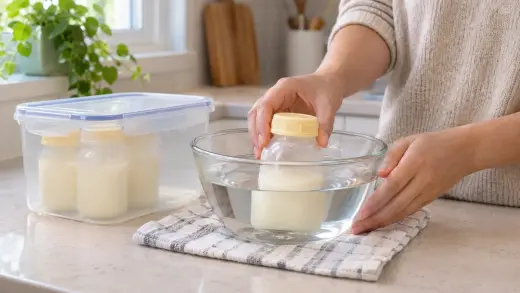
How to Store, Thaw and Warm Expressed Breast Milk Safely

Moving from Breast Milk or Formula to Cow’s Milk at 12 Months

Combo Feeding Breast Milk and Formula: Paced Bottle Schedules That Protect Your Supply
