How to Dress Your Baby for Sleep in Every Season: Room Temperature and TOG Guide
How to dress your baby for sleep in every season: room temperature guide, TOG layering chart, safe sleeping bags, and overheating checks.
On this page
- Key points
- Why sleepwear and room temperature matter
- What TOG means and how it works
- Room temperature and TOG layering chart
- How to check if your baby is too hot or too cold
- Dressing your baby by season
- Dressing your baby by age stage
- Sleeping bags, wraps, or blankets: what to use
- Official guidance in Australia, the UK, the US and Canada
- Common mistakes to avoid
- Frequently asked questions
- Sources
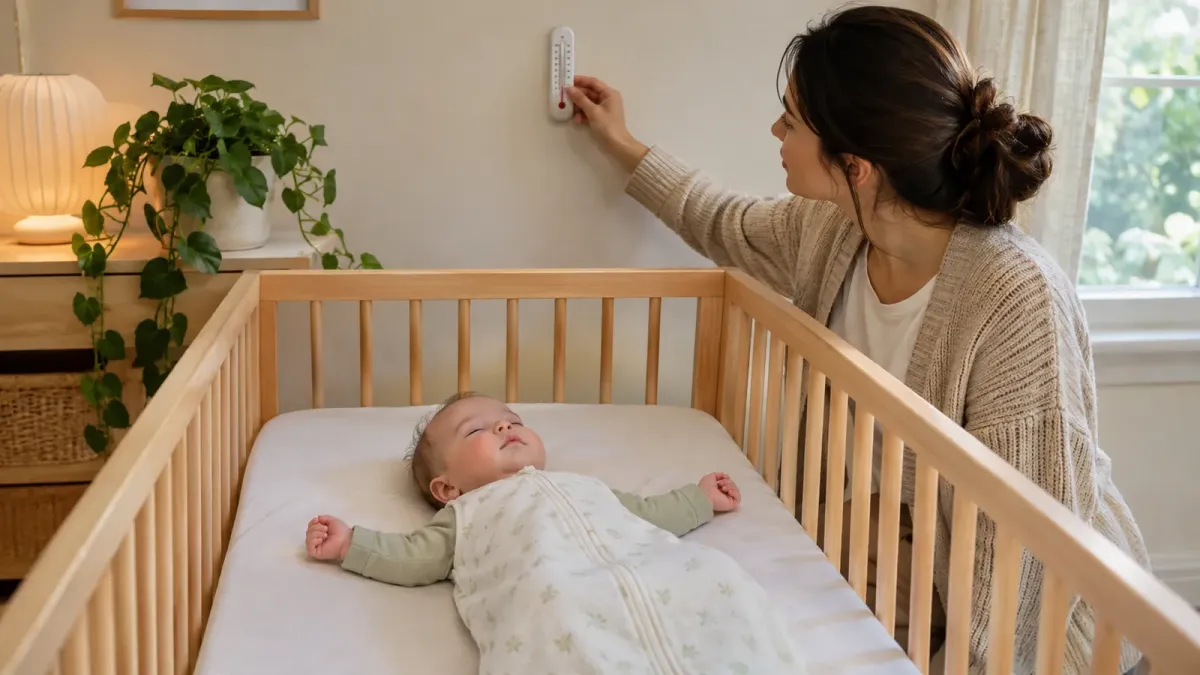
Short answer: Dress your baby for the temperature of their room, not the weather outside. Use light, breathable cotton layers and a fitted baby sleeping bag instead of loose blankets. Keep your baby's head and face uncovered at all times. To check if your baby is comfortable, feel their chest or the back of their neck. It should feel warm, not sweaty or cold.
This advice matches safe sleep guidance from Red Nose and Pregnancy, Birth and Baby in Australia, The Lullaby Trust and the NHS in the UK, the American Academy of Pediatrics (AAP) in the US, and Health Canada and the Canadian Paediatric Society in Canada.
Key points
- Skip loose blankets: Use a safe baby sleeping bag with a fitted neck and armholes, or a light cotton wrap for newborns who cannot roll yet.
- No hats indoors: Never put a beanie, bonnet, or hood on your baby for sleep. Babies lose extra heat through their heads.
- Check the core, not the hands: Cold hands and feet are normal in babies. Feel their chest or the back of their neck instead.
- Use TOG as a guide: A low TOG (0.2 to 0.5) suits warm rooms. A higher TOG (2.5 to 3.5) suits cold rooms.
- Adjust for fever: If your baby is unwell or has a fever, use fewer layers, not more.
- Keep the cot clear: No pillows, doonas, quilts, cot bumpers, or soft toys.
Why sleepwear and room temperature matter
Newborn babies and young infants cannot control their body heat as well as older children or adults. They warm up quickly if they wear too many layers or sleep in a hot room.
Health bodies in Australia, the UK, the US, and Canada all warn that overheating raises the risk of sudden infant death syndrome (SIDS). A baby who is too hot may sleep too deeply or struggle to cool down.
Being too cold is uncomfortable and can wake your baby often. Still, overheating is the bigger safety risk. When you are unsure between two layers, choose the lighter option first and check your baby later.
Most heat leaves a baby's body through their head and face. That is why safe sleep rules say to keep the head and face uncovered. A hat, beanie, or hood traps heat fast and can also slip over a baby's nose or mouth.
What TOG means and how it works
TOG stands for Thermal Overall Grade. It is a simple number that tells you how warm a fabric is. You will see it on baby sleeping bags, swaddles, and sleep suits.
The rule is easy to remember. A lower TOG number means thinner, cooler fabric. A higher TOG number means thicker, warmer fabric.
- 0.2 to 0.5 TOG: Very thin cotton or muslin. Made for hot summer nights and warm bedrooms.
- 1.0 TOG: Light padding or medium cotton. Good for mild spring and autumn nights, or cool air-conditioned rooms.
- 2.5 TOG: Padded and cosy. Made for cool winter bedrooms.
- 3.5 TOG: Thick and very warm. Used only in cold rooms when heating is off or low.
Think of TOG as a starting point, not a strict rule. Two babies in the same room can need slightly different layers. Some babies run warm and sweat easily. Others feel the cold more.
Also remember that a sleeping bag only covers the body. Your baby's arms are usually outside the bag. In cool weather, long-sleeved pyjamas or a bodysuit underneath keep those arms warm.
Room temperature and TOG layering chart
What is the right room temperature? The Lullaby Trust and the NHS in the UK suggest a room temperature of about 16°C to 20°C for a sleeping baby. Many parents in the US and Canada aim for a similar range, around 20°C to 22°C.
Red Nose in Australia takes a slightly different approach. It notes that there is no single proven "ideal" room temperature for preventing sudden infant death. Instead, Red Nose says you do not need to keep a heater or air conditioner running all night to hit one exact number. Dress your baby to match the room as it is.
Use the chart below as a practical guide for layering your baby in different room temperatures.
| Room temperature | Sleeping bag TOG | What to put underneath | Extra notes |
|---|---|---|---|
| 27°C and above | No bag, or 0.2 TOG | Nappy only, or nappy and thin singlet | Keep air moving with a fan, not pointed at baby. |
| 24°C to 26°C | 0.2 TOG or 0.5 TOG | Short-sleeve bodysuit or singlet | Skip socks and long sleeves. |
| 21°C to 23°C | 1.0 TOG | Short-sleeve bodysuit, or light cotton romper | Add light cotton pyjamas if baby feels cool. |
| 18°C to 20°C | 1.0 TOG or 2.5 TOG | Long-sleeve bodysuit or cotton pyjamas | With 1.0 TOG, use pyjamas. With 2.5 TOG, a light bodysuit is often enough. |
| 16°C to 17°C | 2.5 TOG | Long-sleeve bodysuit and footed cotton pyjamas | Make sure the neck and armholes still fit snugly. |
| Under 16°C | 2.5 TOG or 3.5 TOG | Singlet, long-sleeve bodysuit, and warm cotton pyjamas | Warm the room gently if very cold. Still no hats or loose blankets. |
If your baby is a newborn and still wrapped in a muslin or cotton swaddle, treat a single thin wrap like a 0.5 TOG layer. Never put a wrapped baby inside a thick sleeping bag. That doubles the layers and can cause overheating fast.
How to check if your baby is too hot or too cold
Many new parents touch their baby's hands or feet, feel that they are chilly, and rush to add another blanket. That is a common mistake. Babies have developing circulation, so their hands and feet often feel cool even when their body is warm.
Instead, slip two fingers gently inside their collar to feel their chest, tummy, or the back of their neck.
Signs your baby is too hot
- Sweaty or damp hair at the back of the head.
- Warm, damp, or clammy skin on the chest or neck.
- Red, flushed cheeks.
- Heat rash (tiny red bumps on the skin).
- Fast breathing or restlessness.
If you notice any of these signs, take off one layer right away. You can swap to a lighter sleeping bag or remove a bodysuit. Check their chest again after 15 to 20 minutes to make sure they have cooled down.
Signs your baby is too cold
- Cool skin on the chest, tummy, or back of the neck.
- Mottled or pale skin on the torso.
- Baby waking up often and struggling to settle back down.
If your baby's chest feels cool, add one light layer. A cotton singlet under their pyjamas, or a slightly warmer sleeping bag, usually fixes the problem.
Dressing your baby by season
Rooms change temperature from bedtime to early morning. The coldest part of the night is often just before dawn, around 4:00 AM to 6:00 AM. Dress your baby for how cool the room will be in the early morning, or check them before you go to bed.
Summer and hot nights
Hot nights can be stressful for parents. When the bedroom stays above 24°C or 26°C, less is more.
- Choose breathable fabric: 100% cotton, bamboo, or muslin lets air flow and pulls sweat away from the skin. Avoid fleece or polyester in summer.
- Drop the sleeping bag if needed: In very hot weather (27°C or higher), a nappy and a light singlet are enough.
- Cool the room before bed: Close curtains and blinds during the day to block out the sun. Open windows in the evening if the outside air is cooler.
- Use a fan safely: A ceiling fan or standing fan helps move air around the room. Keep cords out of reach and do not point the airflow straight at your baby's face.
- Watch for thirst: Pregnancy, Birth and Baby notes that breastfed babies may want more frequent feeds in hot weather, and formula-fed babies may also need extra feeds or small sips of cooled boiled water if they are over 6 months old.
Never drape a muslin cloth or wet towel over a cot or pram to block light or cool the air. It traps heat inside and stops air from moving.
Autumn and spring
Mild seasons bring big temperature swings. A room might feel warm at 7:00 PM and chilly by 4:00 AM.
A 1.0 TOG sleeping bag is your best friend in spring and autumn. Start the night with a short-sleeve bodysuit under the bag if the room is warm. If the room drops below 18°C overnight, use long-sleeve cotton pyjamas underneath instead.
Avoid heavy fleece sleep suits in mild weather. They do not breathe well and can trap heat if the room warms up.
Winter and cold nights
In winter, the goal is steady, breathable warmth without piling on loose blankets or overheating the bedroom.
- Layer thin cotton clothes: Start with a cotton singlet, add a long-sleeve footed sleepsuit, and zip your baby into a 2.5 TOG or 3.5 TOG sleeping bag.
- Watch the room heater: If you use a heater, set the thermostat to a mild level, around 18°C to 20°C. A hot, dry room is unsafe and uncomfortable. Never put a cot next to a radiator, wall heater, or sunny window.
- Never use hot water bottles or electric blankets: They can burn a baby's skin or cause dangerous overheating.
- Skip winter hats indoors: Even in a cold house, take off beanies and bonnets as soon as you come inside and before every sleep.
Dressing your baby by age stage
What your baby wears to sleep changes as they grow and learn new skills.
Newborns (0 to 3 months)
Newborns have a strong startle reflex, which can wake them up. Many parents wrap (swaddle) their newborn in a large, thin cotton or muslin square.
If you wrap your baby, keep the cloth below their shoulders and leave plenty of room around the hips and legs so their knees can bend up and out. Dress them lightly underneath—often just a nappy and singlet in warm weather, or a light cotton suit in cool weather.
If your baby dislikes being wrapped, you do not have to wrap them. You can use a newborn-sized sleeping bag with the arms out from day one, as long as the neck and armholes fit properly.
Rolling babies (around 3 to 6 months)
Once your baby shows any sign of starting to roll, stop wrapping them right away. Red Nose says to stop at the first signs of rolling or by 3 months, whichever comes first. The AAP says to stop when a baby starts trying to roll, which can happen as early as 2 months.
Move your baby into an arms-out sleeping bag. Free arms let your baby push up or roll back if they turn onto their tummy. Check that the bag matches your baby's current weight and length. A bag that is too big can let a small baby slip down inside the neck hole.
Older babies and toddlers (6 months and up)
Older babies move around the cot a lot. A sleeping bag stays on even when they kick, sit up, or crawl around the mattress. Loose blankets just get kicked off, which wakes them up cold.
Once your baby starts standing up or walking, look at sleep suits with built-in feet or grippy soles. These look like sleeping bags with legs. They keep your toddler warm at night without tripping them up when they stand in the cot or walk to your room in the morning.
Keep pillows, doonas, and heavy quilts out of the cot for babies under 12 months. Many safe sleep experts suggest waiting until your child moves to a toddler bed before introducing a duvet or pillow.
Sleeping bags, wraps, or blankets: what to use
Parents often wonder whether to buy sleeping bags, wraps, or cellular blankets. Each option works differently and comes with its own safety rules.
| Option | Best age | Pros | Safety rules to watch |
|---|---|---|---|
| Baby sleeping bag (arms out) | Birth to toddlerhood | Cannot be kicked off; keeps face clear; easy TOG guide | Must have fitted neck and armholes, no hood, and right size for weight. |
| Thin cotton or muslin wrap | Birth until first signs of rolling | Helps calm newborn startle reflex | Keep below shoulders, loose at hips, always on the back; stop at rolling signs. |
| Lightweight cellular blanket | Birth and up (if tucked safely) | Easy to add or remove a layer | Must be tucked firmly at the mattress sides and kept chest-high only, with baby's feet at the foot of the cot. |
In the UK and Europe, safe sleeping bags follow standard BS EN 16781 (or EN 16781), which tests neck opening size, warmth ratings, and fastenings. Wherever you live, check these four things before using any sleeping bag:
- Neck fit: When zipped up, your baby's head must not be able to pass through the neck hole.
- Armholes: Armholes should fit snugly so your baby cannot pull their arms inside the bag.
- No hood: Never use a sleeping bag or sleep suit with a hood for sleep.
- Right weight and length: Follow the weight range on the label, not just the age printed on the tag.
Official guidance in Australia, the UK, the US and Canada
Safe sleep rules are remarkably similar across English-speaking countries. Every peak health body agrees that babies must sleep on their back, on a firm, flat mattress, in a clear cot with their head and face uncovered.
| Country | Main health and safety bodies | Key advice on sleepwear and temperature |
|---|---|---|
| Australia | Red Nose, ACCC (Product Safety Australia), Pregnancy, Birth and Baby | Dress baby to suit the room; no fixed "ideal" number needed. Keep head and face uncovered. Use a safe sleeping bag with fitted neck and armholes, or tuck light blankets firmly at chest level. |
| United Kingdom | The Lullaby Trust, NHS, Office for Product Safety and Standards (OPSS) | Aim for a room around 16°C to 20°C. Use a well-fitting baby sleeping bag (BS EN 16781) or light sheets tucked below shoulder level. No hats indoors. |
| United States | American Academy of Pediatrics (AAP), NICHD Safe to Sleep, CPSC | Keep the sleep space bare—no loose blankets at all. Dress baby in at most one more layer than an adult would wear comfortably. Avoid weighted swaddles and weighted sleep sacks. |
| Canada | Health Canada, Canadian Paediatric Society (Caring for Kids) | Dress baby in a light, fitted sleeper or sleep sack. Avoid overheating; keep the room comfortable for a lightly dressed adult. No loose blankets, quilts, or hats. |
Notice the small difference with blankets. In Australia and the UK, guidelines allow a light cellular blanket if it is tucked firmly under the mattress and reaches no higher than the baby's chest, with the baby placed feet-to-foot. In the US and Canada, guidelines advise skipping all loose blankets in the crib and using wearable blankets (sleeping bags) instead. Using a properly fitted sleeping bag meets the strictest rule in all four countries.
Common mistakes to avoid
Even careful parents can slip into habits that make a sleeping baby too warm or unsafe. Watch out for these common mistakes:
- Leaving a beanie on in bed: Babies do not need hats indoors, even if they were born in winter. Hospitals only use hats briefly right after birth. Once home, take hats off for sleep.
- Adding layers when baby has a fever: A baby with a temperature needs fewer layers, not extra blankets. Dress them lightly and speak to a doctor if a baby under 3 months has a fever.
- Using weighted sleep sacks or swaddles: Both the US CPSC and the AAP warn against weighted infant sleep products. They put extra weight on a baby's chest and make it harder to breathe or roll safely.
- Putting a sheepskin or padded liner in the cot: Soft pads trap heat underneath your baby and create a suffocation risk. Stick to one fitted cotton sheet on a firm mattress.
- Overdressing under a wrap: A wrap already counts as a layer. Putting thick fleece pyjamas under a swaddle can quickly overheat a newborn.
- Buying a bag "to grow into": A sleeping bag that is too big can ride up over your baby's face or let them slide down inside. Always buy the size that fits today.
Frequently asked questions
What is the best room temperature for a sleeping baby?
The Lullaby Trust and the NHS suggest 16°C to 20°C as a comfortable range. Red Nose Australia says there is no single proven number you must hit, as long as you dress your baby to match the room. A simple rule from the AAP is to dress your baby in the same number of layers you would wear to sleep comfortably, plus one light layer (such as a sleeping bag).
Why are my baby's hands and feet cold at night?
Cold hands and feet are completely normal in babies. Their blood flow focuses on keeping their core warm first. Feel your baby's chest or the back of their neck instead. If their chest feels warm and dry, they do not need extra clothes or mittens.
Can my baby wear a beanie or hat to bed in winter?
No. Never put a hat, beanie, or hooded sleepsuit on your baby for sleep indoors. Babies release extra heat through their heads. A hat can make them overheat fast, and it can slip down over their face.
How should I dress my baby if they have a fever?
Dress your baby in light, single-layer cotton clothes, or just a nappy and singlet if the room is warm. Do not bundle them up to "sweat out" a fever, and do not try to chill them with cold water. If your baby is under 3 months old and has a fever, seek medical care straight away.
What TOG sleeping bag should I buy if I only want one or two?
Most families do well with two weights: a 1.0 TOG bag for mild nights and a 2.5 TOG bag for cool nights. You can adjust warmth by changing what your baby wears underneath—for example, a singlet under a 1.0 TOG bag on warmer evenings, or long pyjamas on cooler nights. If you live somewhere with very hot summers, add a 0.2 or 0.5 TOG bag.
Are weighted sleeping bags or swaddles safe?
No. Safety experts in the US, including the AAP and the CPSC, advise parents not to use weighted swaddles, blankets, or sleep sacks. The added weight can press on a baby's chest and restrict breathing.
Should I use a fan or heater in my baby's room?
You can use either if you place it safely. Keep a fan pointed away from your baby's face so it gently moves air around the room. Keep heaters set to a mild, comfortable temperature, never hot, and place the cot well away from any heater, radiator, or power cord.
Sources
- The Lullaby Trust – How to dress your baby for sleep
- The Lullaby Trust – Room temperature
- Red Nose Australia – How to choose a safe sleeping bag
- Red Nose Australia – Six safe sleep recommendations
- Pregnancy, Birth and Baby – Babies in hot weather
- American Academy of Pediatrics (US) – A parent's guide to safe sleep
- Caring for Kids (Canadian Paediatric Society) – Safe sleep for babies
- NHS (UK) – Reduce the risk of sudden infant death syndrome
Related guides
More Parental Tips →
How to Use a Baby Sleep Sack Safely: Sizes, Tog Ratings, Room Temperature and Common Mistakes

Helping Your Baby Sleep Through the Night: A Simple, Safe Guide

How to Set Up a Safe Hotel or Airbnb Sleep Space for Your Baby