













Air Purifiers for New Parents: Do They Help Your Baby Breathe and Sleep Better?
Do air purifiers help babies and new parents? What HEPA filters can and can't do, how to pick the right size, ozone warnings and safe nursery setup.
On this page
- What does an air purifier do?
- Can an air purifier help a baby?
- Clean air comes first: things that matter more than a purifier
- How to choose the right air purifier
- Purifier types side by side
- Safe setup in the nursery
- Smoke events: bushfires and wildfires
- Allergies and asthma in the family
- Care and maintenance
- Working out the real cost
- Age stages
- Common mistakes
- FAQ
- Sources
Short answer: A good air purifier with a true HEPA filter can take dust, pollen, pet dander and smoke particles out of the air in one room. That may help if your home is near busy roads, has bushfire or wildfire smoke, or if someone in the family has allergies or asthma. But it is not a must-have for a healthy baby. It does not prevent SIDS, it can't fix damp or mould, and some types (ozone makers and ionisers) can make the air worse. Keeping the home smoke-free and well aired matters more.
This guide explains what air purifiers can and can't do, how to choose the right size, and how to use one safely in a nursery.
What does an air purifier do?
An air purifier is a box with a fan and one or more filters. The fan pulls room air through the filters, which catch tiny bits floating in the air, then blows the cleaner air back out.
The main filter types
- HEPA filter. HEPA stands for "high-efficiency particulate air". It is a thick paper-like filter that traps very small particles, like dust, pollen, pet hair and dander, mould spores and smoke. This is the part that does most of the useful work.
- Pre-filter. A coarse mesh in front of the HEPA filter. It catches hair and big dust so the HEPA filter lasts longer.
- Activated carbon filter. Carbon soaks up some smells and gases, like cooking smells or some smoke gases. A thin carbon sheet does little. A thick bed of carbon does more.
Types to avoid
- Ozone generators. These make ozone on purpose and claim it "cleans" the air. Ozone irritates the lungs. Health Canada advises against using ozone generators indoors. The US Environmental Protection Agency (EPA) says to avoid devices that make ozone on purpose.
- Ionisers and some "plasma" or UV add-ons. Some of these can give off small amounts of ozone. NSW Health says negative ion generators do not remove fine bushfire smoke particles. If a purifier has an ioniser, choose one where you can turn it off, or pick a model without one.
Can an air purifier help a baby?
Babies breathe faster than adults and their lungs are still growing. So clean air matters. But a purifier is just one small part of keeping the air clean.
Where it may help
- Smoke from bushfires or wildfires. Health bodies in Australia and Canada say a portable HEPA air cleaner can lower smoke particles inside a closed room during smoke events.
- Allergies in the family. If a parent or older child has hay fever, a purifier may cut down pollen and dust in the bedroom.
- Pets. It can reduce floating pet dander.
- Busy roads or city pollution. It can lower fine particles that come in from outside.
What the evidence says
The EPA says studies show air cleaners give small, sometimes hard-to-notice benefits for allergy and asthma symptoms. A purifier can lower particles in the air. That doesn't always mean fewer symptoms, because many allergens, like dust mites, sit in bedding and carpet rather than floating in the air.
What it can't do
- It can't prevent SIDS. No air purifier lowers the risk of sudden infant death. Safe sleep habits do that.
- It can't fix mould. The EPA says mould problems need the damp source fixed.
- It can't undo smoking. If anyone smokes or vapes in the home or car, the purifier won't make it safe. Keeping your baby smoke-free is one of the six Red Nose safe sleep recommendations.
- It can't remove most gases well. Fumes from gas cooktops, paint or new furniture need fresh air and good ventilation.
Clean air comes first: things that matter more than a purifier
- Smoke-free home and car. No smoking or vaping inside or near your baby. Smoke clings to clothes, hair and furniture too.
- Fresh air. Open windows when outdoor air is clean. Use the range hood when cooking, especially with gas.
- Control damp. Dry clothes outside or in a vented dryer. Fix leaks. Wipe away condensation. Use the bathroom fan.
- Cut dust. Damp-dust surfaces, vacuum with a HEPA-filter vacuum, and wash bedding in hot water.
- Keep it simple. Skip air fresheners, scented candles, incense and strong cleaning sprays in the nursery.
- Check outdoor air. On smoky or high-pollution days, keep windows and doors shut. Check your local air quality website or app.
After these, a purifier can add a bit more help.
How to choose the right air purifier
1. Size: match it to the room
The most useful number on the box is the CADR, or "clean air delivery rate". It tells you how much clean air the machine puts out. A bigger number means it cleans a room faster.
The EPA gives a simple rule for smoke and fine dust. For a room with standard 2.4 m (8 ft) ceilings, you need roughly:
| Room size | Smoke CADR needed (about) |
|---|---|
| 9 m² (100 sq ft) | 65 cfm (cubic feet per minute) |
| 19 m² (200 sq ft) | 130 cfm |
| 37 m² (400 sq ft) | 260 cfm |
If your ceilings are higher, you need a higher CADR. To find your room size, multiply the length by the width. Many brands also list a "maximum room size". Pick a model rated for a room bigger than yours, so it can run on a quiet low setting and still do the job.
2. True HEPA, not "HEPA-type"
Words like "HEPA-like", "HEPA-style" or "99% effective" are not the same as a true HEPA filter. Canadian health experts warn that these may miss the smallest smoke particles. Look for "true HEPA" or a stated filter grade such as H13.
3. Noise
A nursery purifier needs to be quiet on its low setting. Check the decibel rating (dB) for the lowest speed. Lower numbers are quieter. Many models have a "sleep mode" that dims the lights and runs slowly.
4. Filter cost and how often to change it
The filter is the ongoing cost. Before you buy, check:
- How much a new filter costs.
- How often the maker says to change it (often every 6 to 12 months).
- That replacement filters are easy to buy where you live.
5. No ozone
Choose a model that doesn't make ozone. The EPA notes that no US federal agency has approved ozone generators for use in rooms where people are. If the box says "ozone", "activated oxygen" or "super oxygen", skip it.
6. Electrical safety
Buy from a trusted shop. Look for your country's electrical safety mark: the RCM tick in Australia and New Zealand, UKCA or CE in the UK, and a UL, ETL or CSA listing in the US and Canada.
7. Smart features (nice, not needed)
Some purifiers have an air quality sensor, an app, or auto mode that speeds up when the air gets dusty. These are handy but not needed. A simple machine on a steady low setting works well. If you buy a Wi-Fi model, set a strong password and keep it updated, like any smart device.
Purifier types side by side
| Type | What it removes | Good points | Weak points |
|---|---|---|---|
| True HEPA purifier | Dust, pollen, dander, mould spores, smoke particles | Proven to lower airborne particles; no ozone | Filters cost money; must be sized right |
| HEPA + thick carbon | Particles plus some smells and gases | Better for cooking smells and some smoke gases | Carbon wears out; heavier and dearer |
| Ioniser / plasma | Claims to clump particles | No filter to replace on some models | May make ozone; doesn't remove fine smoke well |
| Ozone generator | Claims to "kill" smells and germs | None for a home with a baby | Irritates lungs; health bodies say don't use indoors |
| DIY box-fan filter | Particles, during smoke events | Low cost; used in some wildfire programs | Must be built and used safely; noisy; not for unattended use near a baby |
Safe setup in the nursery
Where to put it
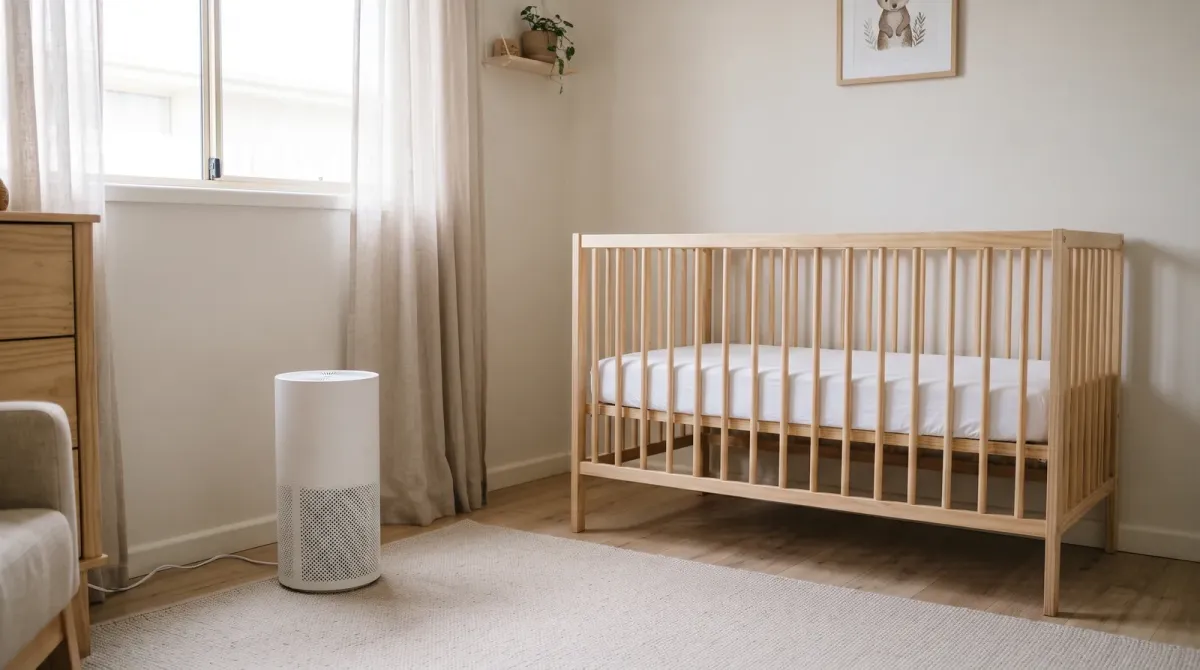
- Put it on the floor or a low, stable surface, where it can't tip over.
- Keep it well away from the cot. Your baby should not be able to reach it, its cord or its vents.
- Leave space around it, as the instructions say, so air can flow freely.
- Don't point the airflow straight at your baby.
Cords
Health Canada says to keep cords from lamps, monitors, sound machines and other electronics out of reach of your baby's cot. The same goes for an air purifier cord. Run it along the wall behind furniture. Re-check when your baby starts to pull up and crawl.
Keep the room closed while it runs
A purifier works best in a closed room. Asthma Australia notes that if the room is open to the outside, the air cleaner won't work well. NSW Health also says your air purifier or air conditioner should not pull in air from outside during smoke events. In normal weather, it's fine to open windows for fresh air and run the purifier at other times.
Temperature still matters
A purifier is not a fan or a cooler. Dress your baby for the room. Keep their head and face uncovered. Check if they are too hot by feeling their back of neck or tummy.
Smoke events: bushfires and wildfires
Smoke is when a purifier is most useful. Australia, the US and Canada all have regular fire seasons, and smoke can drift a long way.
- Make a "cleaner air room". Pick one room, often the main bedroom where your baby sleeps. Shut windows and doors. Run a well-sized HEPA purifier there.
- Turn air conditioners to recirculate. Close fresh-air intakes.
- Don't add smoke indoors. Avoid candles, frying, gas heaters or vacuuming without a HEPA filter on smoky days.
- Check official advice. In Australia, follow your state air quality site. In Canada, check Environment and Climate Change Canada's Air Quality Health Index. In the US, check AirNow. In the UK, check the Daily Air Quality Index.
- Watch for signs your baby is unwell. Fast breathing, coughing, wheezing or trouble feeding need medical advice. Call emergency services if your baby is struggling to breathe.
Allergies and asthma in the family
Babies can't be diagnosed with asthma easily. Wheezing in babies has many causes, often colds. But if a parent has asthma or allergies, a baby is more likely to have them too.
Common triggers listed by Asthma + Lung UK and healthdirect include house dust mites, pollen, pets, mould, smoke and air pollution. A purifier helps most with things that float in the air, like pollen, smoke and pet dander. For dust mites, washing bedding hot, reducing soft toys and carpets in the bedroom and keeping humidity in check do more.
If your baby or child often wheezes, coughs at night or has trouble breathing, see your GP or family doctor. Don't rely on a purifier instead of medical care.
Care and maintenance
- Change the filter on time. A clogged filter cleans less and can smell. Mark the date on the filter.
- Clean the pre-filter every few weeks, as the instructions say. Many can be vacuumed or rinsed.
- Wipe the outside and vents with a damp cloth. Unplug it first.
- Change filters more often in smoke season. Heavy smoke fills filters fast.
- Handle used filters carefully. Bag them outside to avoid shaking dust back into the room.
- Never wash a HEPA filter unless the maker says it is washable.
Working out the real cost
The price on the shelf is only part of the cost. Before you buy, add up what you will spend in the first two years. That way you can compare models fairly.
- The machine. The upfront price.
- Filters. Multiply the price of one new filter by how many you will need. If the maker says every 6 months, that is four filters in two years. In smoke season you may need more.
- Power. Look at the wattage on the low setting, where it will run most of the time. Lower wattage means lower power bills. An energy rating label, where your country has one, can help, but it only tells you about power use, not how well it cleans.
- Extra parts. Some carbon filters or pre-filters are sold separately.
A cheap machine with expensive filters can cost more over time than a dearer machine with cheap filters. Also check that the brand has been around for a while, so you can still buy filters in a few years.
Quick checklist for the shop
- Does it say "true HEPA" or give a filter grade like H13?
- Is the smoke CADR high enough for my room?
- Is it quiet on the lowest setting?
- Does it make ozone, or have an ioniser I can't turn off?
- How much do filters cost, and how often do I need one?
- Does it have my country's electrical safety mark?
- Can it stand where my baby can't reach it or its cord?
- Does it have a child lock on the buttons?
Age stages
Newborn to 6 months
Your baby should sleep in your room for at least six months. If you use a purifier, it will likely be in your bedroom. Keep it quiet and away from the bassinet or cot. Focus on a smoke-free home and good airflow.
6 to 12 months
Babies start to crawl and pull up. Purifiers on the floor can become a toy. Choose one with a child lock on the buttons, and make sure it can't tip. Keep cords tidy and out of reach.
Toddlers
Toddlers poke fingers into vents and pull things over. Put the purifier behind furniture or in a corner they can't reach. Teach them it is "not a toy".
Common mistakes
- Buying one too small. A tiny desk unit can't clean a whole bedroom.
- Buying an ozone or ioniser model. These can irritate lungs.
- Thinking it replaces fresh air. It doesn't remove most gases.
- Using it instead of fixing damp. Mould needs the moisture fixed.
- Leaving windows open while it runs on smoky days.
- Forgetting the filter. Old filters work poorly.
- Placing it near the cot with the cord within reach.
- Adding scented oils to purifiers or diffusers in the nursery.
FAQ
Do I need an air purifier for a newborn?
No. Most healthy babies don't need one. It can help in smoky seasons, in polluted areas or if family members have allergies.
Is it safe to run an air purifier all night in the nursery?
Yes, if it's a true HEPA model with no ozone, placed safely away from the cot with the cord out of reach, and running on a quiet setting.
Can an air purifier help prevent SIDS?
No. There is no evidence it does. Follow safe sleep advice: back to sleep, a bare cot, face uncovered, smoke-free home, and your baby in your room for at least six months.
What's the difference between a purifier and a humidifier?
A purifier cleans particles out of the air. A humidifier adds moisture. They do different jobs. NSW Health notes that humidifiers do not remove bushfire smoke particles.
How often should I change the filter?
Follow the maker's guide, often every 6 to 12 months. Change it sooner if you've had a lot of smoke, or if it looks grey and clogged.
Are cheap air purifiers any good?
Some are. Look at the CADR, the filter type and the filter cost, not just the price. A cheap unit with a low CADR or a "HEPA-type" filter may do very little.
Will a purifier help with my baby's blocked nose?
Probably not much. Blocked noses in babies are usually from colds. Saline drops and gentle suction, as your nurse or pharmacist shows you, help more. See a doctor if your baby struggles to feed or breathe.
Sources
- U.S. Environmental Protection Agency – Guide to air cleaners in the home
- Health Canada – Using a portable air cleaner to improve indoor air
- NSW Government – Bushfire smoke health advice
- NSW Health – Smoke from hazard reduction burns (2025)
- Asthma + Lung UK – Asthma triggers
- healthdirect Australia – Asthma
- Asthma Australia – Bushfire smoke factsheet
- Red Nose Australia – Six safe sleep recommendations
- Health Canada – Is Your Child Safe? Sleep Time
Related guides
More Health & Safety Gear →
Audio Baby Monitors: How Sound-Only Monitors Help Parents Sleep Safely

Baby Sleep Trackers: Do They Help, Are They Safe, and How to Choose One

Baby Nasal Aspirators: When They Help and How to Use Them Safely