













Baby Finger Toothbrushes: How to Use One and What to Choose
Learn what a baby finger toothbrush does, how to use and clean one, and when a small baby toothbrush may be a better choice.
On this page
- What a baby finger toothbrush is
- Five reasons some parents choose one
- When to start cleaning gums and teeth
- How to choose a finger toothbrush
- Finger toothbrush or baby toothbrush?
- How to use a finger toothbrush gently
- Toothpaste and dental advice
- How to clean and store the brush
- How mouth care may change as your baby grows
- Safety points for parents
- Common mistakes to avoid
- Guidance in Australia, the UK, the US, and Canada
- Frequently asked questions
- A simple routine to remember
- Sources
Short answer: A baby finger toothbrush fits over an adult finger. It can help clean a baby's gums or first teeth. It is optional. A small, soft baby toothbrush is another choice. Use either tool gently, while your baby is awake and supervised. Never leave a finger brush with your baby as a toy or teether.
Baby teeth need care, even though they later fall out. A finger brush cannot prevent every dental problem. Regular brushing and advice from a dental professional matter more than the brush shape. Ask a dentist or local health service what to use for your baby's age.
What a baby finger toothbrush is
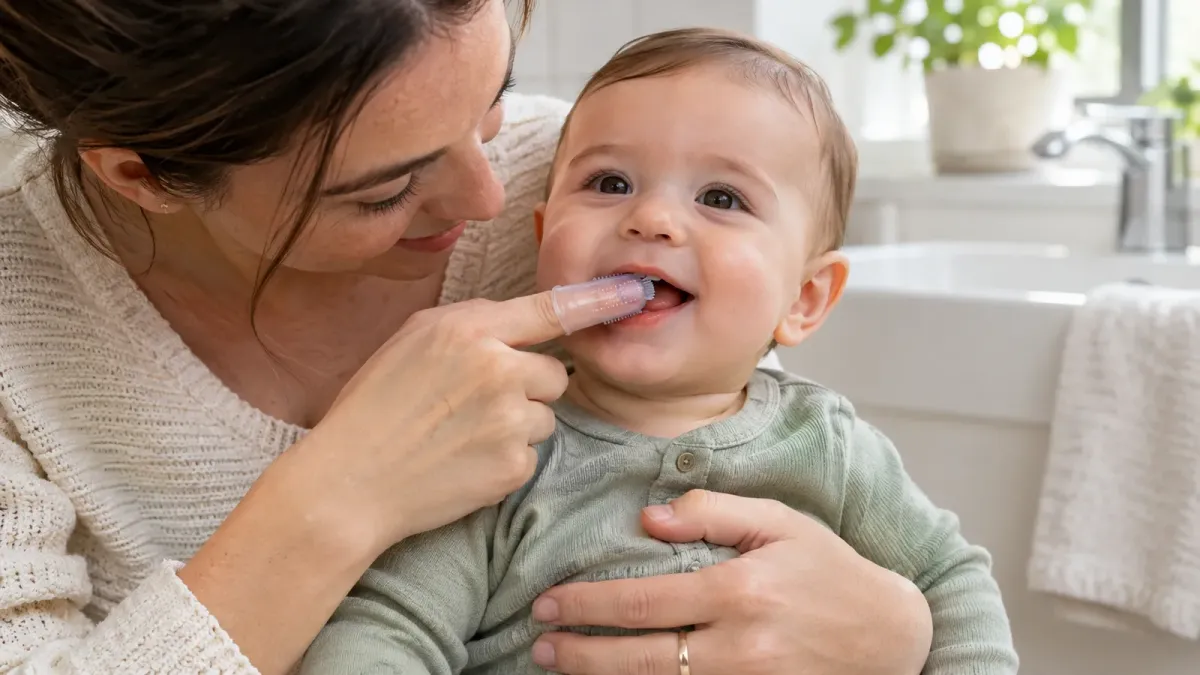
A baby finger toothbrush is a small cover for an adult finger. Its tip may have short bristles, soft bumps, or a smooth surface. The adult wears it and gently cleans the baby's mouth.
It is different from a teething toy. A teething toy is made for a baby to hold or chew. A finger toothbrush is a cleaning tool. Keep it in your hand during use. Put it away when brushing ends.
Finger brushes come in different shapes and materials. Read the maker's instructions for age, cleaning, and care. Do not use a brush that is torn, cracked, sharp, or misshapen. Do not assume a label such as “natural” proves that a product is right for your child.
There is no need to buy one just because a product calls it essential. Some parents prefer a clean, damp cloth before teeth appear. Others choose a small baby toothbrush. Ask your dentist what suits your baby.
Five reasons some parents choose one
1. It can help you practise a mouth-care routine
Some parents like to get used to gentle mouth care before the first tooth appears. A finger brush can help them learn how to touch the gums gently. A clean, damp cloth is another simple option. Ask a dental professional whether cleaning the gums is useful for your baby.
Once a tooth appears, ask how to brush it. Gum cleaning alone is not the same as brushing teeth. Your dentist can advise on the brush and toothpaste to use.
2. Your finger can feel where the brush is
A finger brush places the cleaning surface close to your hand. Some parents find this makes it easier to feel where they are brushing. Use only light pressure. A baby's mouth is small and sensitive.
Keep the brush near the gums and teeth. Do not push your finger or the brush towards the back of the mouth. Stop if your baby coughs, gags, pulls away strongly, or seems distressed. Try again later, when your baby is calm.
3. Some babies accept it more easily
Some babies may prefer a caregiver's hand to a toothbrush handle. Others dislike a finger brush. Your baby may bite down, turn away, or push it out. Each response is possible.
Start gently and keep the first attempts brief. Let your baby see the brush before you begin. Do not force it into a closed mouth. A calm routine is more useful than a struggle.
4. It is small to pack
A finger brush takes up little space in a wash bag. This can make it easy to pack for a visit or trip. It still needs proper care and safe storage.
Follow the maker's cleaning instructions. Let it dry as directed. Keep it away from dirty items, and store it where your baby cannot reach it. A small size does not make it safe to leave with a baby.
5. It is one possible tool in a changing routine
Some families use a finger brush for a short time, then switch to a handled brush. Other families start with a baby toothbrush. The choice depends on your baby and advice from your dental professional.
You do not need several brushes to begin. Choose a tool that you can use gently and clean properly. Check it before each use. Replace it when damaged or as the maker directs.
When to start cleaning gums and teeth
Advice about mouth care can vary by country and by child. Ask a dentist, doctor, or child health nurse what is right for your baby. Many families begin a brushing routine when the first tooth appears. Ask what brush and toothpaste to use.
There is no need to wait until all the baby teeth have come through. A dentist can show you how to clean the teeth that are present. They can also advise when to book your baby's first dental visit.
Baby teeth help children chew and speak. They also hold space for adult teeth. Tooth decay can cause pain and may need treatment. Ask a dentist how to care for your baby's teeth and gums.
A finger brush does not treat tooth decay, gum problems, mouth ulcers, or bleeding. Ask a health professional about white patches, swelling, pain, or bleeding. Seek prompt advice if your baby has trouble feeding or seems unwell.
How to choose a finger toothbrush
Check the product and its instructions before you buy. The brush should be simple to inspect and clean. Avoid one with loose parts, rough edges, or a damaged surface.
- Check the fit. It should stay on your adult finger while you clean. It must not slip off easily.
- Feel the tip. Bristles or raised bumps should feel soft and smooth. Avoid rough or sharp edges.
- Read the directions. Check the maker's age advice, use instructions, and cleaning steps.
- Look for damage. Do not use a brush with cracks, tears, loose pieces, or a changed shape.
- Keep it simple. Extra parts are not needed for basic cleaning. Choose a design you can check and wash.
- Think about biting. If your baby has teeth and bites your finger, stop. Ask whether a handled brush may suit you better.
- Check product details. Look for a named maker and clear directions. Ask the seller or maker if key information is missing.
Be careful with claims that a brush prevents cavities or kills germs. A brush cannot replace brushing, toothpaste advice, or dental care. Do not assume one material is always better than another.
Finger toothbrush or baby toothbrush?
Both tools can help an adult clean a baby's mouth. A finger brush sits close to your hand. A handled brush keeps your finger farther from your baby's teeth. A clean, damp cloth may help wipe gums before teeth appear.
| Choice | What it is | Possible use | Point to consider |
|---|---|---|---|
| Finger toothbrush | A cover worn on an adult finger | Gentle cleaning of gums or teeth, if advised | A baby may bite the adult's finger. The adult must hold it throughout. |
| Baby toothbrush | A small brush head on a handle | Brushing teeth with adult help | A baby may resist the handle. An adult should guide the brush. |
| Clean, damp cloth | A soft cloth wrapped around an adult finger | Wiping gums before teeth appear, if advised | Use a clean cloth. Keep it near the front of the mouth. |
This is a general guide, not a ranking. Ask a dental professional which option suits your baby. Once teeth appear, ask about a toothbrush and toothpaste for your child's age.
How to use a finger toothbrush gently
- Wash your hands. Use soap and water before handling the brush or touching your baby's mouth.
- Check the brush. Look for dirt, cracks, tears, or loose material. Do not use a damaged brush.
- Follow the care label. Clean the brush before use if the maker says to do so.
- Choose a calm position. Support your baby and make sure you can see their mouth.
- Fit the brush. Place it on your own finger, as the directions show. Check that it feels secure.
- Use a light touch. Clean only the gums or teeth you can see. Do not push towards the back of the mouth.
- Keep it brief. Stop if your baby is upset, keeps gagging, or bites your finger.
- Clean it after use. Follow the maker's directions. Let it dry as directed.
- Put it away. Store it where your baby cannot reach it.
Do not use a finger brush to scrape the tongue or gums. Do not add medicine, oil, or home remedies unless a health professional advises it. Do not share the brush between children.
Toothpaste and dental advice
Advice about toothpaste and fluoride can differ between countries. It can also depend on your child's age and dental health. Ask a dentist or local health service which toothpaste to use and how much to put on the brush.
Follow the advice you receive. An adult should put toothpaste on the brush and help with brushing. Keep the toothpaste tube out of your baby's reach. Do not let your baby suck or chew it.
A finger brush may not hold toothpaste as well as a small toothbrush. Ask your dentist if a handled brush would work better once teeth appear. The best choice is one you can use gently and well.
Ask a dentist when to arrange your baby's first visit. You can ask even when your baby has no tooth problems. A visit can help you learn how to care for new teeth.
How to clean and store the brush
Follow the maker's care directions. Rinse off any residue after use if the instructions say to do so. Store the brush in a clean place. Let it dry as directed.
Do not boil, microwave, or put it in a dishwasher unless the maker says that method is safe. Heat can damage some materials. Do not use bleach or strong cleaners unless the instructions allow them.
Replace the brush if it tears, cracks, becomes sticky, changes shape, or cannot be cleaned. Follow any replacement advice from the maker. If it falls somewhere dirty, clean it as directed. Replace it if you cannot clean it well.
Give each child their own brush. Do not share it between children or adults. Keep it separate from other bathroom items that may be dirty.
How mouth care may change as your baby grows
| Stage | What may be happening | What you can do |
|---|---|---|
| Before the first tooth | Your baby has gums but no visible teeth. | Ask whether a clean, damp cloth or finger brush is useful. Keep any touch gentle. |
| First tooth appears | A tooth starts to show through the gum. | Ask a dentist about the right brush and toothpaste. Start care as advised. |
| More teeth appear | Your baby may move, bite, or resist brushing. | Keep your baby supported. Use a calm, steady approach. Ask a dentist for help. |
| Toddler years | Your child may want to hold the brush or copy you. | Let your child practise with you nearby. Ask how long an adult should help. |
These are broad stages. Teeth do not appear on the same schedule for every child. Ask a dentist if you worry about timing, pain, or a tooth that looks damaged.
Safety points for parents
- Stay with your baby. Hold the finger brush throughout each use.
- Keep it out of reach. Put it away after cleaning. Do not leave it in a cot, pram, or play space.
- Do not use it as a teether. It is a cleaning tool, not a toy.
- Watch for biting. Stop if your baby bites your finger or the brush slips.
- Keep it near the front. Do not push the brush towards the throat.
- Check it each time. A cracked or torn brush may be hard to clean.
- Use the right tool. A finger brush cannot treat tooth decay or other mouth problems.
- Ask for help. Speak with a dentist if your baby has pain, swelling, bleeding, or feeding trouble.
Small items can cause choking if a child puts them in their mouth. A finger toothbrush should remain in an adult's hand during use. Learn where to find local first-aid advice. If a child is choking, contact emergency services and follow trained first-aid guidance.
Common mistakes to avoid
Thinking every baby needs one
A finger toothbrush is optional. A cloth or baby toothbrush may suit your family better. You do not need one just because an advert calls it a must-have.
Using it instead of brushing teeth
Once a tooth appears, ask about a suitable toothbrush and toothpaste. A finger brush may not reach every tooth surface well. A dentist can help you choose.
Letting your baby hold it alone
A baby can put a small item too far into the mouth. Keep control of the brush. Put it away as soon as brushing ends.
Pressing too hard
Strong pressure can make brushing unpleasant or sore. Use gentle movements. Stop if your baby seems hurt or distressed.
Ignoring the cleaning directions
Different products may need different care. Follow the instructions. Do not use heat or cleaning chemicals unless the maker allows them.
Believing every health claim
A brush does not prevent every dental problem. It does not replace toothpaste advice or dental visits. Be wary of promises that sound certain or claim to cure a problem.
Guidance in Australia, the UK, the US, and Canada
Families can ask a local dentist about brushing and toothpaste. Health services in each country can also offer general advice. The relevant official and professional bodies differ by country.
| Country | Bodies to know | How to use their guidance |
|---|---|---|
| Australia | Healthdirect Australia, the Australian Dental Association, and state and territory dental services | Ask a local dental service about your baby's brush, toothpaste, and first visit. |
| United Kingdom | NHS and the British Society of Paediatric Dentistry | Check NHS guidance and ask a dental practice about care for your baby's age. |
| United States | American Academy of Pediatric Dentistry and American Academy of Pediatrics | Ask a paediatric dentist or child health provider about brushing and toothpaste. |
| Canada | Canadian Dental Association, provincial dental services, and Canadian Paediatric Society | Follow local dental advice. Services and guidance can vary by province. |
The sources linked with this article give general health and feeding advice. They do not make a finger toothbrush a requirement. Ask a dental professional for advice about teeth and toothpaste. Local guidance may change as your baby grows.
Frequently asked questions
Do I need a finger toothbrush before my baby has teeth?
No. It is optional. Some parents gently wipe gums with a clean, damp cloth. Others ask about a finger brush. Follow advice from your dentist or health service.
When should I start brushing my baby's teeth?
Ask your local dental service when to begin and what to use. Many families start when the first tooth appears. Guidance on toothpaste can differ by country and age.
Can my baby chew on a finger toothbrush?
Do not leave it with your baby to chew. It is a cleaning tool, not a teether. Hold it during use and put it away afterwards.
Can a finger toothbrush hurt my baby's gums?
It may hurt if you press hard, use a damaged brush, or push too far into the mouth. Use gentle movements. Stop if your baby seems sore or upset.
Is silicone always better than a baby toothbrush?
No. The material alone does not show whether a brush suits your baby. Check the directions and condition. Ask a dentist which type to use.
Can I use toothpaste with a finger brush?
Ask a dentist or local health service about the right toothpaste and amount. A finger brush may not hold toothpaste well. Keep toothpaste out of your baby's reach.
How often should I replace a finger toothbrush?
Follow the maker's directions. Replace it sooner if it tears, cracks, changes shape, or cannot be cleaned. Do not share it with another person.
Should I sterilise the brush?
Only use a sterilising method if the maker says it is safe. Heat may damage some brushes. Follow the cleaning instructions and let it dry as directed.
What if my baby refuses brushing?
Keep the attempt brief and calm. Try another time or ask about a different brush. Do not force it. Ask a dentist for ideas if brushing remains difficult.
When should I contact a dentist?
Ask for advice if your baby has tooth pain, swelling, bleeding, visible damage, or trouble feeding. You can also ask when to book a first visit and how to brush.
A simple routine to remember
A finger toothbrush can suit some families, but it is not essential. Choose a clean, undamaged tool with clear instructions. Use a gentle touch. Keep your baby supervised and store the brush safely afterwards.
When teeth appear, ask a dental professional about brushing and toothpaste. A small, soft baby toothbrush may suit you better. Daily care and good advice matter more than the brush design.
This article gives general information. It does not replace advice from a dentist or health professional. Check current product instructions before use. BabyGearFinder may earn a commission from qualifying purchases. This does not change the price you pay.
Sources
Related guides
More Health & Safety Gear →
Baby Toothbrushes: How to Clean Your Baby’s Teeth and Choose a Brush

Baby Gear Safety Apps: What Helps, What Does Not, and How to Choose

Silicone U-Shaped Toothbrushes for Babies: What Parents Should Know
