Budgeting for Baby: How to Prioritise Spending on Essential Gear
How to budget for baby gear by spending first on safe sleep, car seats and feeding, saving on nice-to-have items, and checking secondhand gear safely.
On this page
- Key points
- What you actually need before your baby comes home
- How to split your baby budget into three tiers
- Where to spend: items you should buy new if you can
- Where to save: items that work well secondhand or borrowed
- Items you can skip to save money and space
- Spending by age stage: birth to two years
- Safety standards and official rules by country
- Common budgeting mistakes parents make
- A simple step-by-step plan to build your budget
- Frequently asked questions
- Sources
Short answer: Put your money into safe sleep, a safe car seat, and feeding gear first. Buy a new car seat and a new, firm cot mattress if you can. Save money by borrowing or buying secondhand cots, prams, clothes, and highchairs after a safety check. Skip extras like cot bumpers, wipe warmers, and baby walkers.
This guide follows advice from official safety and health groups in Australia (ACCC, Product Safety Australia, Red Nose, and Pregnancy, Birth and Baby), the UK (Office for Product Safety and Standards, NHS, and The Lullaby Trust), the US (Consumer Product Safety Commission and American Academy of Pediatrics), and Canada (Health Canada and the Canadian Paediatric Society).
Key points
- Safety comes first: A cheap item that meets safety rules is better than a costly item that does not.
- Buy new when history matters: Car seats and cot mattresses are the top items to buy new.
- Wait to buy extras: Many items can wait until after your baby arrives.
- Skip unsafe trends: Some popular baby products are unsafe and waste your money.
- Check recalls: Always check national recall lists before you use secondhand gear.
- Spread out your spending: Your baby will not need toddler gear for many months.
What you actually need before your baby comes home
Baby shops make very long checklists. Many of those lists try to sell you things you will barely use. A newborn has very simple needs in the first weeks. They mostly eat, sleep, and need clean nappies.
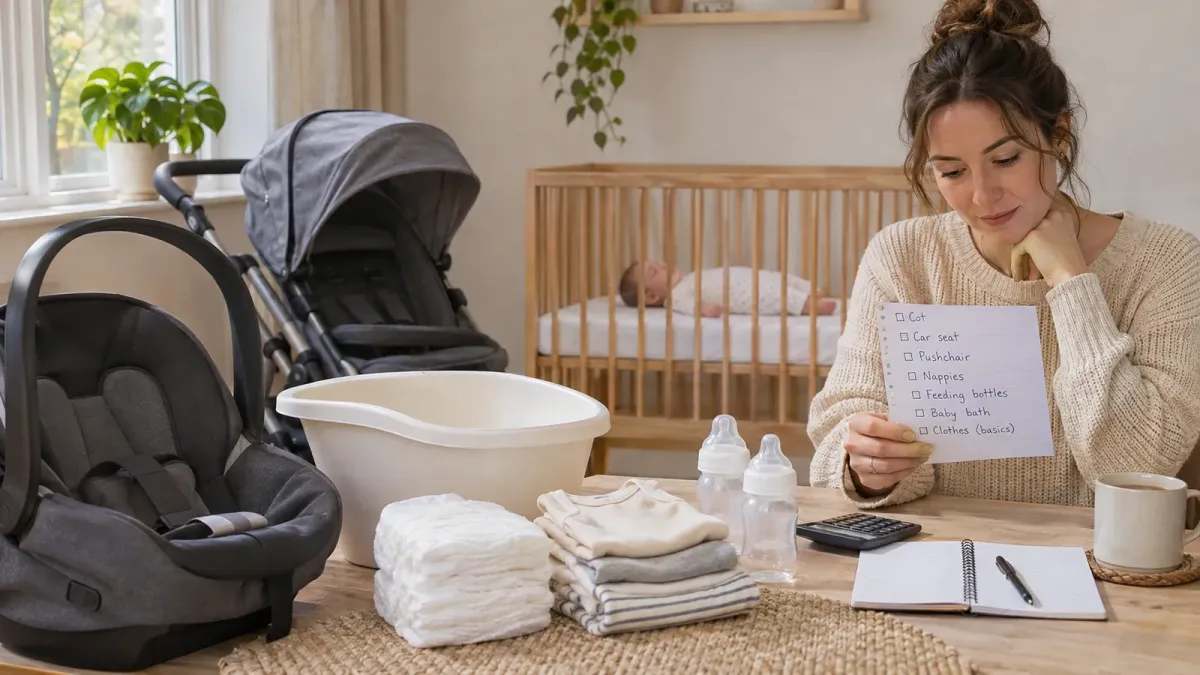
Your baby needs four basic things from day one:
- A safe place to sleep: A cot or bassinet with a firm, flat mattress and a tight fitted sheet.
- A safe way to travel: A car seat that fits your car and meets your country's rules.
- A way to feed: Breastfeeding supplies or bottles, teats, sterilising gear, and infant formula.
- Everyday basics: Nappies, wipes or soft cloths, simple cotton clothes, and a baby bath or clean sink.
Almost everything else can wait. You do not need a full nursery set up before the birth. Many babies sleep in a bassinet or cot in the parents' room for the first six months anyway. Safe sleep groups in all four countries recommend room-sharing for at least the first six months.
You also do not need months of clothes or toys ready on day one. Babies grow fast in the first twelve weeks. Friends and family often bring gifts after the birth too. Waiting lets you see what your baby actually likes and needs.
How to split your baby budget into three tiers
Splitting your shopping list into three tiers stops panic buying. It helps you see where money protects your baby. It also shows where extra spending only buys looks or convenience.
Tier 1 (Must-haves from day one): These items keep your baby safe, fed, and warm. Spend your main budget here first. Never cut corners on safety for these items.
Tier 2 (Helpful gear you can borrow or buy later): These items make daily life easier. You can buy them secondhand, borrow them, or wait until your baby is older.
Tier 3 (Nice-to-have extras): These items are optional. Many parents never miss them. Some popular ones are even unsafe for babies.
| Gear item | Budget tier | New or secondhand? | Why |
|---|---|---|---|
| Car seat or baby capsule | Tier 1: Must-have | Buy new if possible | Past crashes or hidden cracks can make a seat unsafe. |
| Cot or bassinet | Tier 1: Must-have | New or checked secondhand | Frame can be secondhand if it meets current safety rules. |
| Cot mattress | Tier 1: Must-have | Buy new if possible | Must be firm, flat, clean, and fit the cot with no gaps. |
| Bottles and teats | Tier 1: Must-have | New teats; bottles new or clean | Old teats can tear, perish, or become a choking risk. |
| Nappies and cloths | Tier 1: Must-have | New or washed cloth nappies | Used every day from birth; buy small packs at first. |
| Pram or stroller | Tier 2: Helpful | New or checked secondhand | Check brakes, harnesses, and folding locks before buying. |
| Baby carrier or sling | Tier 2: Helpful | New or secondhand | Check seams and buckles; learn safe carrying rules. |
| Highchair | Tier 2: Helpful | New or secondhand | You do not need this until about 6 months. |
| Change table | Tier 2: Helpful | Secondhand or skip | A firm mat on the floor is free and cannot tip over. |
| Baby clothes | Tier 2: Helpful | Secondhand or borrowed | Babies outgrow early sizes in just a few weeks. |
| Baby bath | Tier 2: Helpful | Secondhand or use a clean sink | Always stay within arm's reach of your baby in water. |
| Wipe warmer | Tier 3: Skip | Skip | Warm water and a soft cloth work well and cost nothing. |
| Cot bumpers or pillows | Tier 3: Skip | Never buy | Safety groups warn they raise suffocation risk. |
| Baby walker | Tier 3: Skip | Never buy | Doctors and safety groups warn they cause serious falls. |
Where to spend: items you should buy new if you can
Some items protect your baby in a crash or while they sleep. For these items, knowing the full history matters more than saving a bit of cash. If your budget is tight, spend your money here first and save everywhere else.
1. Car seats and infant capsules
A car seat is the top item to buy brand new. You cannot see inside the plastic shell of a used seat. A seat that was in a car crash may have hairline cracks inside. Even a minor bump can weaken the frame or foam.
Car seats also have expiry dates. Plastic gets brittle over time from heat and sunlight in a parked car. Labels wear off, and small parts go missing. Transport Canada, the American Academy of Pediatrics (AAP), and Australian road safety groups all warn against using expired or unknown secondhand seats.
An expensive car seat is not automatically safer than a basic one. All seats sold legally in your country must pass the same core crash rules. Pick a seat that fits your car, fits your baby, and is easy for you to install tightly every time.
A convertible car seat often saves money over time. It starts rear-facing for a newborn and later turns forward-facing for a toddler. A newborn capsule is handy because it clicks into a pram, but your baby will outgrow it in months. If you want to save money, a rear-facing convertible seat from day one means buying one seat instead of two.
Check independent crash ratings where available, such as Child Car Seats in Australia. Also check if your local council, hospital, or road safety group offers free or low-cost fitting checks.
2. Cot and bassinet mattresses
Safe sleep groups in Australia (Red Nose), the UK (The Lullaby Trust), the US (AAP), and Canada (Health Canada) all agree on mattresses. A baby mattress must be firm, flat, and clean. It must fit the cot or bassinet snugly with no wide gaps at the sides.
The Lullaby Trust notes that a brand-new mattress is safest. Used mattresses can sag in the middle or lose their firmness. A soft or sagging spot can trap a baby's face or let them roll into a risky spot. Never use a mattress with tears, peeling cover, or damp smells.
If you already have a cot frame, measure the inside carefully before you buy a new mattress. Check the cot's manual or safety label for the exact mattress size it needs. Do not add soft mattress toppers, sheepskins, or padded protectors on top.
3. Bottle teats, dummies, and breast pump parts
Soft silicone and rubber parts wear out with daily washing and heat. They get tiny cracks and can become cloudy or sticky. Old teats can split and break off in a baby's mouth, which is a choking hazard.
Always buy new bottle teats and new dummies (pacifiers). Check them for wear before each use and throw out any damaged ones right away. If you borrow or buy a used electric breast pump, buy new tubing, valves, and shields. Only share a pump motor if the maker says it is a closed system designed for more than one user.
4. Room thermometer and basic first aid items
You do not need expensive smart nursery gadgets. A simple digital room thermometer helps you dress your baby for sleep. A basic baby thermometer for checking a fever is also worth buying new. Keep a simple first aid kit with infant pain relief advice from your doctor or pharmacist.
Where to save: items that work well secondhand or borrowed
Babies use most gear for a very short time. A bassinet may last four months. A newborn sleepsuit may fit for three weeks. Buying these items secondhand or borrowing from trusted friends can cut your costs in half.
1. Cots and bassinets
A sturdy wooden cot can safely serve more than one child if it meets current rules. Older cots, however, can be dangerous. Traditional drop-side cots have caused serious injuries and deaths when hardware broke or came loose. The US and Canada have banned traditional drop-side cribs.
Before you take a used cot or bassinet, check every part carefully:
- Safety label: Look for a current standard label on the frame. Avoid very old family heirlooms made before modern safety rules.
- No missing parts: Check every bolt, screw, bracket, and slat. Nothing should wobble or rattle.
- Bar spacing: Gaps between bars must be narrow so a baby's head or limbs cannot get stuck.
- No corner posts or cutouts: Tall corner posts or decorative cutouts can snag clothing around a baby's neck.
- Fixed sides: Choose a cot with fixed sides rather than a drop side.
- Check recalls: Search the brand and model on your national recall site before you use it.
2. Prams and strollers
Prams are one of the biggest costs for new parents. A secondhand pram from a known brand often lasts for years. Before you pay, test the pram in person on a flat floor and a kerb if possible.
- Brakes: Lock the brakes and push hard. The pram should not roll or slip.
- Folding lock: Open and fold the frame a few times. The safety lock must click firmly so it cannot fold on your baby.
- Harness: Check the five-point harness straps and buckles for fraying, tears, or stiff clasps.
- Flat recline: For a newborn, the seat must lie flat, or you need a flat bassinet attachment.
- Wheels and frame: Check for bent metal, rust, cracked tyres, or wobbly front wheels.
- Car boot check: Fold the pram and test if it fits easily into your car boot before you buy.
3. Highchairs
You will not need a highchair until your baby starts solid foods, around 6 months. A basic, easy-to-wipe highchair works just as well as a pricey wooden one. Smooth plastic seats with no fabric crevices are much faster to clean after messy meals.
When checking a used highchair, look for a wide, stable base that cannot tip over. Make sure it has a working five-point harness and a rigid crotch post or strap so your baby cannot slide down under the tray. Always test the tray locks and leg joints.
4. Baby clothes, wraps, and sleeping bags
Newborns grow fast and spit up often. Fancy outfits are hard to wash and uncomfortable for sleep. Secondhand cotton onesies, singlets, and muslin wraps are cheap and already soft from washing.
Zip-up onesies are often much easier for middle-of-the-night nappy changes than outfits with dozens of tiny snaps. When checking used clothes and sleeping bags, pull gently on buttons or snaps to make sure they are tight. Skip any sleepwear with hoods, loose ribbons, or drawstrings. Check that any used sleeping bag has a fitted neck and armholes so your baby cannot slip inside.
5. Change tables and baby baths
You do not need a special change table at all. Changing your baby on a waterproof mat on the floor is free. It also removes the risk of your baby rolling off a high surface. Keep nappies, wipes, and a spare onesie in a small basket next to the mat.
If you have back pain or had a caesarean birth and want a raised surface, a sturdy secondhand chest of drawers with a secured change mat works well. Just anchor heavy furniture to the wall with proper straps so it cannot tip over as your baby grows. Never leave your baby alone on a raised surface, even for one second.
For bath time, a simple plastic baby tub or a clean kitchen sink works fine. Put a clean folded towel at the bottom of the sink so it is not slippery. Always stay within arm's reach and keep your eyes on your baby in water.
6. Play mats, books, and simple toys
Babies learn best through simple floor play and talking with you. A clean folded blanket on the floor works well for tummy time. Secondhand board books, wooden blocks, and washable plastic rattles cost very little. Wipe hard toys with warm soapy water and check for loose parts, sharp edges, or small button batteries before giving them to your baby.
Items you can skip to save money and space
Skipping gear does two good things. It saves your money, and it keeps clutter out of your home. More importantly, some popular products go against safe sleep and injury rules.
- Inclined sleepers, baby nests, and pods: Product Safety Australia, the CPSC, Health Canada, and The Lullaby Trust warn against letting babies sleep on soft, padded, or tilted surfaces. Babies must sleep flat on their back on a firm surface.
- Cot bumpers, pillows, quilts, and soft toys: Keep the cot completely clear. Loose bedding and padded bumpers can block a baby's airway or cause overheating.
- Weighted swaddles and weighted sleep sacks: The AAP and CPSC warn parents not to use weighted sleep products on babies.
- Baby walkers (wheeled frames): The AAP and Health Canada warn against baby walkers. Babies in walkers can tip down stairs, reach hot drinks, or grab hazards fast. Floor play is free and better for muscle and motor skills.
- Wipe warmers: They dry out wipes, grow mould if not cleaned often, and use power for no health benefit. Warm water and a soft cloth work better for sensitive skin.
- Specialised baby food makers: A normal pot, steamer basket, and fork or stick blender make healthy baby food for free. You can use tools you already own in your kitchen.
- Expensive nappy bins with special refill cassettes: Ongoing refill bags cost a lot over two years. A normal lidded bin lined with a standard bag works fine if you empty it often.
- Hard-soled baby shoes: Babies do not need shoes until they are walking outside. Soft socks or bare feet are better for balance and growing feet.
- Expensive breathing or heart-rate sleep socks: Health groups like Red Nose, The Lullaby Trust, and the AAP say home breathing monitors do not prevent sudden infant death in healthy babies. False alarms can also add stress.
Spending by age stage: birth to two years
You do not have to buy two years of gear before your baby is born. Spreading out your spending helps your cash flow. It also stops you buying things your baby ends up hating, like a certain brand of bottle, dummy, or carrier.
| Age stage | What you need now | What can wait | How to save |
|---|---|---|---|
| Birth to 3 months | Cot or bassinet, firm mattress, car seat, nappies, basic clothes, feeding gear. | Highchair, toys, playpen, solid food bowls, forward-facing seats. | Ask for gift vouchers or bigger-size clothes instead of newborn outfits. |
| 3 to 6 months | Larger clothes, sleeping bags (arms out when rolling starts), play mat for tummy time. | Sippy cups, toddler beds, booster seats, stair gates. | Use a clean blanket on the floor for tummy time instead of pricey gyms. |
| 6 to 12 months | Highchair, open cup or free-flow cup, baby spoons, stair gates, cabinet locks, furniture anchors. | Toddler bike or helmet, potty, big-kid bed. | Borrow or buy secondhand highchairs and playpens after safety checks. |
| 1 to 2 years | Next-stage car seat (if outgrown), toddler shoes for walking, sun hat, basic toys. | Bunk beds (not safe for under-9s), big bikes. | Sell or pass on outgrown baby gear to fund toddler items. |
This staged approach also matches your baby's development. At 6 months, for example, your baby starts moving and pulling up. That is the right time to spend a little on safety gates, wall straps for tall drawers, and outlet covers. You do not need those items on day one, and buying them later spreads out your bills.
Safety standards and official rules by country
When you budget, never buy unbranded gear from unknown online sellers if you cannot check its safety rules. Products sold through informal marketplaces or overseas drop-shippers may skip national testing. A low price is not a bargain if the straps break or the bars are too wide.
Here is how official bodies and standards compare across Australia, the UK, the US, and Canada.
| Country | Safety and health bodies | Key gear rules to look for |
|---|---|---|
| Australia | ACCC (Product Safety Australia), Red Nose, Kidsafe, NHMRC | Mandatory rules for cots (AS/NZS 2172), prams (AS/NZS 2088), car seats (AS/NZS 1754), and mattress firmness testing (AS/NZS 8811.1). Strict button-battery rules. |
| United Kingdom | Office for Product Safety and Standards (OPSS), NHS, The Lullaby Trust, RoSPA | Look for UKCA or CE marks and British/European rules: cots (BS EN 716), cribs (BS EN 1130), mattresses (BS EN 16890), prams (BS EN 1888), highchairs (BS EN 14988), car seats (R129). |
| United States | Consumer Product Safety Commission (CPSC), American Academy of Pediatrics (AAP) | Federal rules cover cribs (ASTM F1169), bassinets (ASTM F2194), play yards (ASTM F406), strollers (ASTM F833), highchairs (ASTM F404), and car seats (FMVSS 213). |
| Canada | Health Canada, Canadian Paediatric Society (CPS), Transport Canada | Strict rules under federal law for cribs, playpens, strollers, and car seats (CMVSS 213). Traditional drop-side cribs and baby walkers are banned. |
Always check the label before you pay. In Australia, look for the Australian Standards mark on car seats and cots. In the UK, check for UKCA or CE marks and follow Buy Safe advice from the government. In the US, check for CPSC and ASTM compliance labels. In Canada, look for the National Safety Mark on car seats and check Health Canada's recall list.
Common budgeting mistakes parents make
Most overspending happens when parents shop out of fear, stress, or tiredness before the birth. Knowing these common traps helps you keep your money for what matters.
Buying everything at once before the birth
Shops stay open after your baby arrives. Buying a highchair, a baby monitor, and six months of clothes before birth ties up cash you might need for nappies, medical bills, or time off work. Buy only the Tier 1 basics before the due date.
Paying for looks instead of function
Matching nursery furniture sets and designer prams cost a lot more than plain ones. Yet a plain wooden cot and a simple pram pass the exact same safety tests. Your baby does not care about matching colours or trendy fabrics.
Stocking up on one brand too early
Parents often buy giant boxes of newborn nappies or a full set of one bottle brand. Your baby might grow out of newborn nappies in two weeks. Or they might prefer a different bottle teat shape. Buy small packs at first until you know what works.
Ignoring hidden ongoing costs
A big pram might not fit in your car boot, forcing you to buy a second travel pram later. A cheap bottle set might need pricey replacement teats. A nappy bin might lock you into costly refill bags. Think about size, weight, and ongoing parts before you buy.
Buying unsafe sleep gadgets when tired
Exhausted parents are easy targets for ads promising "full night sleep" from fancy wedges, nests, or monitors. Red Nose, The Lullaby Trust, and the AAP all warn that soft sleep positioners and wedges are unsafe. Consumer baby monitors also do not prevent sudden infant death.
Forgetting about laundry and easy cleaning
Gear with hand-wash-only covers or tricky fabric folds quickly becomes frustrating. Look for machine-washable covers on prams and car seats, and wipe-clean surfaces on highchairs. Gear that is easy to clean lasts longer and holds better resale value too.
A simple step-by-step plan to build your budget
You can set up a calm, realistic baby budget in under an hour. Follow these six steps:
- List what you already have or can borrow. Ask trusted friends or family before you shop. Many parents are happy to lend a bassinet, baby bath, carrier, or newborn clothes.
- Price your Tier 1 items first. Look up a safe, mid-range car seat, a compliant cot, and a new firm mattress. Subtract that cost from your total budget first so safety is covered.
- Plan for ongoing weekly costs. Set aside money each week for nappies, wipes, and formula or breastfeeding supplies. These repeat costs add up faster than one-off gear.
- Make a useful gift list. When family ask what to buy, ask for practical things. Good ideas are fitted cot sheets, sleeping bags, nappies in size 2 or 3, or contributions towards a car seat.
- Check recalls on every secondhand item. Write down the brand and model number. Search your national recall site (Product Safety Australia, OPSS, CPSC, or Health Canada) before you hand over money.
- Keep a small buffer for after the birth. Hold back some cash for surprises. You may need different feeding gear, extra muslins, or a different baby carrier once you meet your baby.
Frequently asked questions
What is the single most important thing to spend money on for a baby?
A safe car seat and a safe place to sleep are the top two priorities. Every baby needs a firm, flat mattress in a safe cot or bassinet from day one. If you travel by car, a properly fitted car seat that meets your country's rules is required by law and protects your baby's life.
Is it safe to buy a secondhand cot or pram?
Yes, as long as you check it carefully. Make sure the cot meets current safety standards, has fixed sides, has no missing bolts, and has not been recalled. For a pram, test the brakes, harness, and folding lock. Even with a secondhand cot, try to buy a brand-new, firm mattress that fits tightly.
Should I ever buy a secondhand car seat?
Safety groups advise against buying a secondhand car seat if you do not know its full history. A seat that has been in a crash can have hidden damage. It may also be expired or missing parts and instructions. Only consider a used seat if it comes from someone you trust completely, is well within its expiry date, has never been in any crash, and has all parts and manuals.
How can I tell if cheap baby gear is safe?
Check for official safety marks and buy from trusted local shops. Look for AS/NZS labels in Australia, UKCA or CE marks in the UK, ASTM or CPSC labels in the US, or the National Safety Mark in Canada. Avoid unbranded gear from unknown overseas websites that do not list local safety standards. Always check national recall lists before buying.
What baby gear can I wait to buy until after my baby is born?
You can wait to buy a highchair, baby spoons and bowls, play gyms, baby carriers (if you want to try one on with your baby), stair gates, and clothes larger than 0 to 3 months. You can also wait on breast pumps or large stashes of bottles until you see how feeding goes.
Are expensive baby products safer than cheaper ones?
No. All cots, prams, and car seats sold legally in Australia, the UK, the US, and Canada must meet the same core safety rules. A higher price usually pays for lighter frames, nicer fabrics, brand names, or extra features. A budget-friendly product that carries the proper safety label and fits your home and car is just as safe.
How do I check if secondhand baby gear has been recalled?
Find the brand name, model name, and manufacture date on the product label. Then type those details into your country's official recall website. Use Product Safety Australia in Australia, the Office for Product Safety and Standards in the UK, the CPSC recall site in the US, or Health Canada's recalls database in Canada. If the label is missing or unreadable, skip the item.
Sources
- Pregnancy, Birth and Baby – Preparing your home for when your baby arrives
- Red Nose Australia – Product safety: how do I know what is safe
- Product Safety Australia – Household cots guide
- UK Government – Buy safe, be safe
- The Lullaby Trust (UK) – Sleeping products
- HealthyChildren.org (American Academy of Pediatrics) – Home safety: tips for families with young children
- CPSC (US) – Safe sleep: cribs and infant products
- Health Canada – Recalls and safety alerts