














How to Choose and Use a Baby Hair Brush and Comb
Learn how to choose, clean and use a baby hair brush or comb gently, with simple advice for cradle cap, different hair types and every age.
On this page
- What a baby brush and comb can do
- Do babies need a brush?
- How to choose a brush or comb
- Brush, comb, or fingers?
- How to brush or comb gently
- Different hair needs different care
- Cradle cap and flaky skin
- Age stages and changing hair
- Cleaning and storing the tool
- Keep grooming tools safe
- Advice from official bodies in four countries
- Common mistakes to avoid
- When to seek advice
- Frequently asked questions
- Simple takeaway
- Sources
Short answer: A baby hair brush or comb can help smooth hair and remove loose flakes. Choose a tool with smooth edges and a handle you can hold comfortably. Use light strokes. You do not need to brush a baby’s hair every day. Stop if your baby seems uncomfortable or the scalp looks sore.
There is no special brush that every baby needs. Some babies have little hair. Some have thick curls. Some have a flaky scalp for a while. A soft brush, a wide-tooth comb, or your fingers may be enough. Choose what works gently for your child.
What a baby brush and comb can do
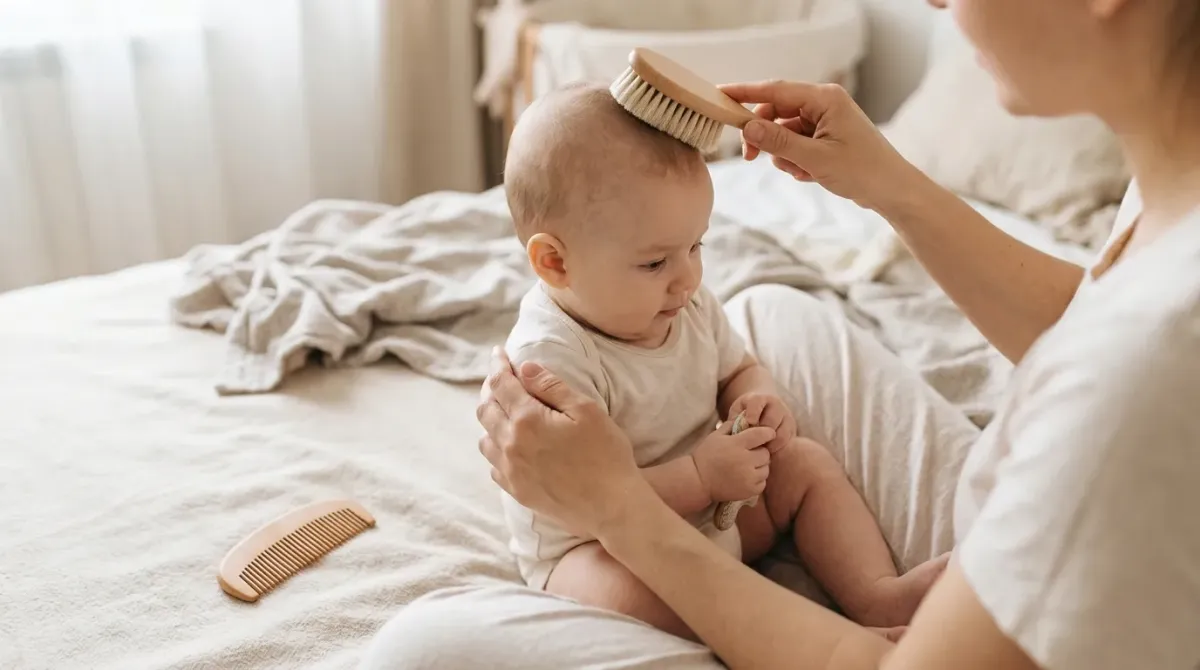
A brush moves over the hair and scalp. It can smooth fine hair and lift away loose flakes. A comb has teeth that pass between strands. It can help separate tangles, especially in longer hair.
Neither tool makes hair grow faster or thicker. Brushing does not change a child’s hair type. Hair length and texture vary from child to child. They also change as children grow.
Gentle grooming can be a calm part of getting dressed or bathing. But it is not a medical treatment. A brush cannot cure a skin condition or remove stuck-on scales safely by force.
Hair care is also a chance to notice changes. You may see a new patch of dryness or a small scratch. A quick look can help you decide whether to brush, pause, or ask for advice. It does not need to become a long routine.
Some babies enjoy the feeling of gentle strokes. Others dislike having their head touched. Both responses are normal. Your baby’s comfort matters more than keeping hair in a certain shape.
Do babies need a brush?
No. Many babies do not need a brush or comb. You can smooth short hair with your hand. If your baby has little hair, there may be nothing to comb.
A tool may help when hair is longer or tangles easily. It can also lift loose flakes from the scalp. Use it only when helpful. There is no need to follow a strict routine.
Hair care should not hurt. If your baby cries, pulls away, or has redness after brushing, stop. Try a softer touch or a different tool. Ask a health professional if the scalp remains sore or irritated.
Some parents feel pressure to buy a full set of grooming products. In most homes, a simple brush or comb is enough. You can wait and see what your child’s hair needs. This avoids buying tools that may never be used.
A brush is not a way to keep a baby warm. It does not protect the scalp from sun or cold. Use clothing and shade that suit the weather. Do not put a loose hat or item in a baby’s sleep space.
How to choose a brush or comb
Look at the tool before you buy it. Run your fingers over its surface. It should feel smooth, without sharp points, cracks, or rough seams. Teeth should not bend into sharp shapes or have rough ends.
For a young baby, a soft brush may feel gentle on fine hair. A comb with wide, smooth teeth may suit thicker or curly hair. There is no need to buy both if one tool works well.
- Check the handle. It should be easy for an adult to hold, even with wet hands.
- Check the teeth or bristles. They should be smooth and firmly attached.
- Check the whole tool. Avoid cracks, loose parts, sharp edges, or damage.
- Choose a washable tool. Follow its care instructions and let it dry fully.
- Skip add-ons. A simple brush or comb is enough for ordinary grooming.
Products labelled “baby” are not automatically better. Read the materials and care directions. Be cautious with claims that promise hair growth, a cure for cradle cap, or a special health benefit. A brush is a grooming tool, not a treatment.
Consider where you will keep the tool. A small brush may be easy to pack, but it can be easier for a baby to pick up. A larger handle may be easier for an adult to hold. The best size is one you can control safely.
Natural bristles, plastic bristles, and wooden handles are all sold for baby grooming. A material name alone does not prove that a tool is safer or gentler. Check the finish, construction, cleaning directions, and your child’s comfort.
If a tool has a cover, detachable parts, or a decorative piece, check that these parts cannot come loose during use. Do not give a baby a brush or comb to chew. No grooming tool should be used as a toy.
Brush, comb, or fingers?
Use the gentlest option that works. Fingers can separate a small tangle. A soft brush can smooth short, fine hair. A wide-tooth comb may work better for curls or longer strands.
| Tool | May suit | How to use it | What to check |
|---|---|---|---|
| Fingers | Very short hair or one small tangle | Separate hair gently, without pulling | Keep nails smooth and clean |
| Soft brush | Fine hair or loose flakes | Use light strokes in the direction of growth | Bristles feel soft and stay attached |
| Wide-tooth comb | Longer, thicker, or curly hair | Start at the ends and work upwards | Teeth are smooth and spaced apart |
| Fine-tooth comb | Some short, straight hair | Use only if it moves without tugging | Teeth do not scratch or pull |
A fine-tooth comb is not needed to scrape flakes from the scalp. If it catches, stop. Pulling can hurt the skin and break hair.
There is no single right choice for every head of hair. You might use your fingers after a bath, then a comb on a dry day. If a tool pulls or makes grooming difficult, put it aside. Try a different option later.
Some families find that a comb is easier to clean. Others prefer a brush for smoothing short hair. Ease of cleaning can matter if several family members help with care. Keep each child’s personal tool separate.
How to brush or comb gently
Pick a calm time when your child is settled. Sit your baby securely on your lap or another safe surface. Keep one hand close to them. Do not leave a baby alone on a raised surface.
- Check the scalp. Look for redness, cuts, swelling, or wet patches. Do not brush over sore skin.
- Hold the hair near the roots. This can reduce pulling when you work through a tangle.
- Start at the ends. If hair is long, loosen the lowest part first. Then move a little higher.
- Use short, gentle strokes. Let the brush or comb move through the hair. Do not press hard against the scalp.
- Pause when it catches. Use your fingers to loosen the knot. Do not yank the tool through.
- Stop when your baby is upset. Try again later if needed.
For a short-haired baby, a few strokes may be enough. You can also leave the hair alone. Grooming should be quick and comfortable.
Use a steady hand and keep the tool away from the eyes and ears. Move slowly if your baby turns their head. Do not try to hold the head still by force. Pause until your child is calm and safe.
If your baby has just had a bath, dry the scalp gently with a towel first. Wet hair can be easier to stretch and break. You do not need to brush immediately after washing. Wait until your child is settled.
For a toddler, explain what you are doing in simple words. Let them choose whether to start at the front or back. A small choice can make grooming feel less stressful. Keep the session short.
Different hair needs different care
Babies can have straight, wavy, curly, or tightly curled hair. Hair may also change in thickness and texture over time. Avoid judging what hair “should” look like. Choose care based on how it feels and behaves.
Fine or short hair
Fine hair can flatten or tangle easily. A soft brush or your fingers may be enough. Use light strokes. Frequent brushing is not needed.
Short hair may not need combing at all. If you brush, use a soft touch and stop if the bristles catch. Do not keep brushing to make the hair lie in a certain direction.
Curly or coiled hair
Curly hair can knot when dry or when handled roughly. A wide-tooth comb may help when hair is damp. Work from the ends upward and hold hair near the roots. Do not pull a comb through a tight knot.
Some families use a small amount of hair conditioner for older babies or toddlers. Choose only a product suitable for your child’s age and skin. Keep it away from the eyes and mouth. Stop using it if a rash appears. A health professional can advise if your child has sensitive skin or a scalp condition.
Hair can be easier to manage when you work in small sections. Separate one section with your fingers. Comb the ends first. Move higher only when the lower part is free. Stop if the comb keeps catching.
Longer hair
Long hair can tangle at the ends. Separate it into small sections if that helps. Comb each section slowly. Avoid tight styles that pull on the hair or scalp.
Take care with bands, clips, and small hair decorations. Keep them away from babies who may mouth or swallow small objects. Remove them before sleep. Stop using a band if it leaves a mark or pulls hair tightly.
Hair that is changing
A baby’s first hair may fall out or change colour and texture. New hair may look different from the hair at birth. These changes do not mean that brushing needs to change. Keep the scalp clean in the usual gentle way.
If you notice a clear patch of hair loss, sores, or a change that worries you, ask a health professional. A brush cannot explain why a change has happened. It is better to get advice than to try strong products on your own.
Cradle cap and flaky skin
Cradle cap is a common name for greasy or dry scales on a baby’s scalp. The skin may look flaky, yellowish, or crusty. It often improves over time. It is not a sign that a parent has failed to wash the baby.
Do not pick, scrape, or scratch scales. This can break the skin and cause soreness. A soft brush may lift loose flakes during gentle washing. If a flake does not come away easily, leave it alone.
Ask a doctor or nurse if the scalp is very red, swollen, bleeding, smells unusual, or seems painful. Also ask if the problem spreads beyond the scalp or does not improve. These signs may need a closer look.
Do not use medicated creams, oils, or adult dandruff products unless a health professional recommends them. A product that suits an adult may irritate a baby’s skin.
Some parents worry that flakes mean the scalp is dirty. Scrubbing harder is not the answer. Gentle washing and patience are usually safer than force. If you are unsure what you see, show the scalp to a health professional.
A brush cannot remove every scale. It should only touch loose flakes without pain. If the brush catches in a crust, stop. Do not try to lift the crust with a comb, fingernail, or pointed tool.
Age stages and changing hair
Hair care can change as your child grows. There is no age when every child needs a brush. Follow your child’s hair and comfort.
| Stage | What you may notice | Simple care |
|---|---|---|
| Newborn | Little hair, fine hair, or a flaky scalp | Use your hand or a soft brush only if useful |
| Older baby | More movement and changing hair length | Keep the tool out of reach; groom while holding your baby securely |
| Toddler | Longer hair or more tangles | Offer simple choices and use short, gentle sessions |
| Preschool age | Your child may want to help | Let them hold a safe comb while you supervise |
Babies can lose some hair or grow new hair with a different texture. This can happen naturally. Brushing does not control these changes.
In the newborn stage, keep grooming simple. Your baby may have very little hair. There is no need to create a daily routine just for the sake of it. Check the scalp while washing and leave it alone if it looks comfortable.
Older babies may wriggle, grab, or turn their heads. Choose a time when they are calm and keep one hand near them. Store the brush or comb straight after use. Do not leave it where your baby can reach it.
Toddlers may want more control. You can let your child choose a tool, then guide their hand. Stay close. A child should not walk around with a comb or brush.
As children grow, they can learn simple care habits. They can help put a brush away or sit still for a short turn. They still need an adult to check the scalp and handle tangles gently.
Cleaning and storing the tool
Hair, skin flakes, and product can collect on a brush or comb. Clean it as the maker directs. If there are no clear directions, remove trapped hair and wash the tool with mild soap and water when suitable for its material.
Rinse away soap and let the tool dry fully. Do not store a damp brush in a closed bag. Moisture can make it smell or grow mould. Do not share a brush between children when one has a scalp infection or lice.
Check the tool from time to time. Replace it if bristles fall out, teeth crack, edges become rough, or parts loosen. A damaged tool can scratch skin or break hair.
Use a clean cloth or your fingers to remove hair from the brush. Do not use a sharp object that could damage the bristles or hurt your hand. If the tool cannot be cleaned well, replace it.
Keep the brush away from the bath and sink when it is not being used. A wet tool may become slippery. Put it in a clean, dry place that an adult can reach and a baby cannot.
Do not boil, microwave, or soak a tool unless the maker says it is safe. Heat or long soaking may damage some materials. Follow the care label when one is available.
Keep grooming tools safe
A brush or comb is small and may have parts that break. Keep it away from a baby’s mouth. Do not leave it in the cot or sleep space. Store it where a baby cannot reach it.
Use grooming tools only while an adult is present. Do not let a child walk or run with a comb in their hand. Put the tool away after use.
Do not use a sharp-ended comb, scissors, or other sharp tool on a moving baby. If hair needs trimming, choose a calm moment and keep the child still. A trained hairdresser or health worker can help if you are unsure.
Check the tool before each use. Look for a broken tooth, a loose handle, or a bristle that has come free. Put damaged tools aside. Do not try to fix a cracked comb with tape or glue.
Keep grooming products and tools away from other small children too. A toddler may copy an adult and put a comb in their mouth. Teach them to sit down during grooming and hand the tool back afterwards.
If a tool falls onto a dirty floor, wash it before using it again. If it has touched a sore or infected area, clean it well and keep it separate. Ask a health professional how to manage a known scalp infection.
Advice from official bodies in four countries
There is no special national safety standard for an ordinary baby hair brush or comb in the sources used here. General product safety advice still matters. Check that a tool is intact, suitable for its use, and free from sharp or loose parts.
| Country | Official bodies to know | Useful role for this topic |
|---|---|---|
| Australia | Product Safety Australia and the ACCC; Healthdirect Australia | Product Safety Australia shares consumer product safety and recall information. Healthdirect helps families find health advice. |
| United Kingdom | Office for Product Safety and Standards; NHS | The product safety office oversees consumer product safety. The NHS gives health advice for babies and children. |
| United States | Consumer Product Safety Commission; American Academy of Pediatrics | The commission handles consumer product safety. The paediatric academy gives child health guidance. |
| Canada | Health Canada; Canadian Paediatric Society | Health Canada shares product safety alerts. The society provides child health information for families. |
These bodies do not say every baby needs a brush. If a tool is recalled, stop using it and follow the recall notice. For a skin problem, contact a health professional in your area.
Product rules can vary between countries. A brush sold in one place may have different labels from a brush sold elsewhere. A label does not replace checking for damage or using the tool gently.
In Australia, families can check Product Safety Australia for recalls and consumer advice. Healthdirect can help people find health information and services. These are useful starting points when you have a product or skin question.
In the UK, the Office for Product Safety and Standards handles consumer product safety work. The NHS provides health information for families. Follow local advice if a product is recalled or your child’s scalp needs care.
In the US, the Consumer Product Safety Commission shares safety alerts and recall information. The American Academy of Pediatrics gives child health advice. In Canada, Health Canada shares product alerts, while the Canadian Paediatric Society offers family health information.
Do not assume that a brush needs a special certification for ordinary grooming. The sources listed for this article do not set out a brush-specific standard. Avoid claims that suggest a tool has official approval unless you can check that claim with the named body.
Common mistakes to avoid
- Brushing too hard. Light strokes are enough. Stop if the skin turns red or your child pulls away.
- Forcing a comb through a knot. Loosen it with your fingers. Start at the ends.
- Scraping cradle cap. Leave stuck flakes alone. A soft brush should never hurt.
- Buying many tools. One suitable brush or comb is often enough. Your fingers may work too.
- Trusting every claim. A brush cannot make hair grow faster or treat a skin condition.
- Using a damaged tool. Cracks, rough edges, and loose bristles can scratch or break hair.
- Leaving tools within reach. Store them away after use, especially when your child is mobile.
- Sharing during a scalp problem. Keep personal grooming tools separate if lice or infection is present.
Another common mistake is brushing because a baby’s hair looks untidy. Babies do not need a hairstyle. Hair can be left as it is if your child is comfortable.
Do not use a comb to remove a tight knot by pulling harder. This can hurt the scalp. Hold the hair near the roots and loosen the knot with your fingers first.
Do not treat every flake as cradle cap. A health professional can check a rash or sore patch. Avoid trying several products at once, since that can make it harder to tell what caused irritation.
Do not leave a brush beside the change area or bath. A baby may grab it while you look away. Keep one hand on your baby when they are on a raised surface, and put grooming tools away before moving them.
Finally, do not judge a product by its price or appearance. A costly tool is not automatically better. Check whether it is comfortable to use, easy to clean, and in good condition.
When to seek advice
Speak with a doctor, nurse, or pharmacist if your baby’s scalp seems painful, has open skin, or becomes very red. Seek advice if scales spread, smell unusual, or keep returning. A health professional can help tell ordinary cradle cap from another skin problem.
Ask for help if brushing causes repeated distress or hair loss. A clinician can check the scalp and suggest suitable care. Do not use strong treatments based on a social media tip.
For sudden swelling, trouble breathing, or a severe reaction after using a product, seek urgent medical help. Use your local emergency number.
Take a clear photo of a changing rash if you cannot get advice straight away. This may help you explain what has changed. Do not delay urgent care if your child seems very unwell.
If you are unsure whether a product is right for your baby, stop using it until you can check. Keep the packaging or product name. This can help a health professional give specific advice.
Frequently asked questions
Does every baby need a hair brush?
No. Many babies do well without one. Use a brush or comb only if it helps with hair or loose flakes. Your hand may be enough.
How often should I brush my baby’s hair?
There is no set schedule. Brush when needed, such as after washing or when hair is tangled. Stop if your baby seems uncomfortable.
Can brushing make my baby’s hair grow faster?
No. Brushing does not make hair grow faster or thicker. Hair growth changes with age and varies between children.
Which is better: a brush or a comb?
Neither is best for every child. A soft brush may suit fine hair. A wide-tooth comb may suit curls or longer hair. Choose the tool that moves gently.
Can I brush cradle cap away?
You can gently lift loose flakes with a soft brush. Do not pick or scrape stuck scales. Ask a health professional if the skin is sore or the flakes spread.
Should I use oil to remove flakes?
Do not assume oil is right for every baby. Some products can irritate skin or be hard to wash out. Ask a health professional what is suitable for your child.
Can my toddler use a comb alone?
A toddler can practise with an adult nearby. Choose a simple comb without sharp points. Put it away after grooming.
How do I clean a baby brush?
Follow the maker’s care directions. Remove trapped hair, wash when suitable, rinse well, and let it dry fully before storing.
When should I replace a brush or comb?
Replace it when it cracks, has rough edges, loses bristles, or develops loose parts. These can scratch the scalp or break hair.
Can I use an adult brush on my baby?
You can use a clean adult brush if it is smooth and gentle. Check that it does not scratch or pull. A baby label alone does not make a tool better.
Can a baby sleep with a brush nearby?
No. Keep brushes and combs out of the cot and sleep space. Put the tool away after grooming.
What if my baby has no hair?
You do not need to brush a bald or nearly bald scalp. Wash it gently as needed. Ask a health professional if you see a sore or worrying skin change.
Is a wooden comb better than a plastic one?
Neither material is always better. Choose a smooth tool that does not snag hair. Follow its cleaning directions and replace it if it becomes damaged.
Simple takeaway
A baby hair brush and comb are optional grooming tools. Choose a smooth, easy-to-clean tool that suits your child’s hair. Use gentle strokes, avoid scraping the scalp, and keep the tool out of reach. If the skin looks sore or the problem persists, ask a health professional.
Sources
- Product Safety Australia – Recalls
- UK Office for Product Safety and Standards
- CPSC (US) – Safe sleep: cribs and infant products
- Health Canada – Recalls and safety alerts
- Healthdirect Australia
- NHS – Washing and bathing your baby
- HealthyChildren.org (American Academy of Pediatrics) – Bathing your newborn
- Caring for Kids (Canadian Paediatric Society) – Diaper rash
Related guides
More Clothing & Accessories →
Baby Hair Ties for Thin Hair: How to Choose Safe, Gentle Ties

How to Choose a Baby Carrier: Wraps, Slings, Soft Carriers and Hiking Packs
How to Choose Baby Gear That Fits Your Family
