Baby Head Protector Backpacks: What Parents Need to Know
Learn what baby head protector backpacks can and cannot do, how to check fit and care, and safer ways to prevent falls at home.
On this page
- What is a baby head protector backpack?
- What it may and may not do
- Safer ways to reduce falls and bumps
- Choosing and checking a product
- Fit, comfort, and movement
- When not to use it
- Materials and cleaning
- Comparing ways to manage bumps and falls
- Safer play, room by room
- Help your baby practise new skills safely
- Age and changing skills
- What the four countries advise
- Common mistakes to avoid
- What to do after a head bump
- Frequently asked questions
- Sources and further guidance
- Sources
Short answer: A soft head protector backpack is a padded item worn by a baby or young child. It may cushion some small bumps during ordinary play. There is no source in this guide that proves it prevents head injuries or makes falls safe. It cannot replace close supervision, a safe play space, or medical care after a head injury. Keep it away during sleep, in a car seat, and whenever it could affect breathing or movement.
Australia's Product Safety Australia and Kidsafe Australia, the UK's Office for Product Safety and Standards and NHS, the US Consumer Product Safety Commission and American Academy of Pediatrics, and Canada's Health Canada and Canadian Paediatric Society offer broader product and child safety advice. The checked sources do not give specific approval for these backpacks. Check the maker's instructions and your local product safety alerts. Ask a health professional if you are unsure whether one suits your child.
What is a baby head protector backpack?
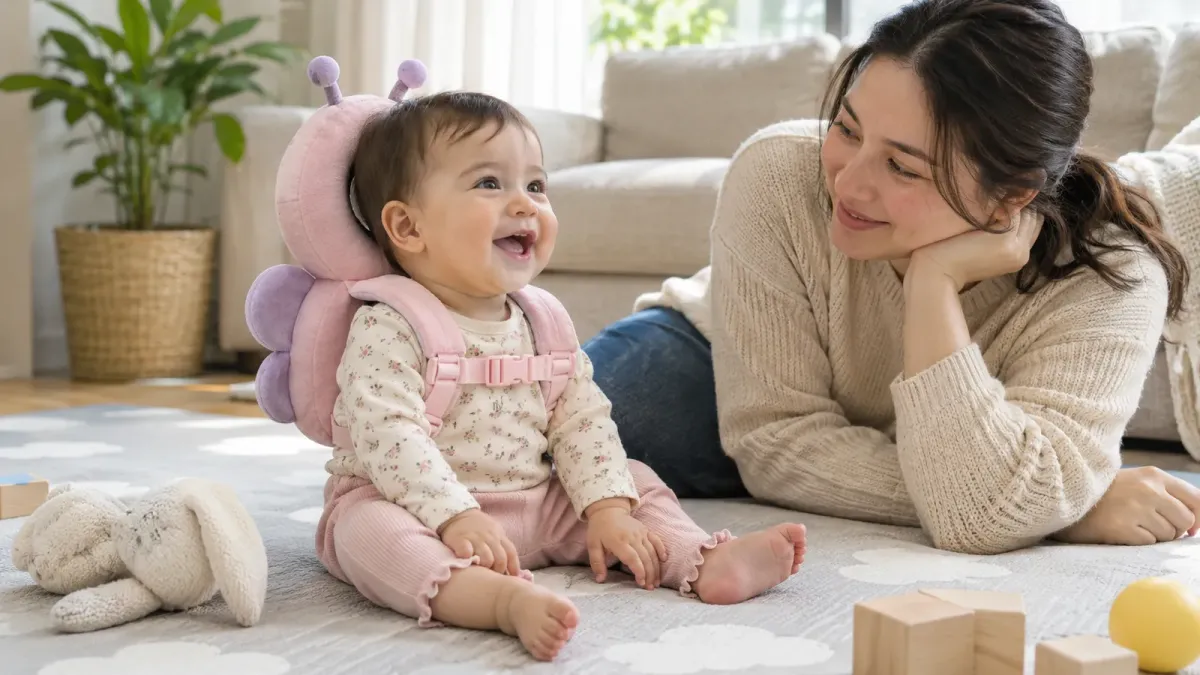
It is usually a small padded cushion shaped like a backpack. Straps hold it against a child's upper back. The padded part sits behind the head. Some designs have animal shapes, ears, or other decorations.
Parents may consider one when a baby starts sitting, crawling, pulling up, or walking. These are times when a child may topple while learning a new skill. A soft pad can look reassuring. But its shape, softness, and position do not show that it can prevent injury.
These items are different from bicycle helmets and other protective equipment made for a named activity. Do not treat a soft backpack as a helmet. Do not use it for cycling, scooters, skating, or any activity that calls for a helmet. Use a properly fitted helmet made for that activity.
The old article included broad claims about spinal support, hip position, special materials, and safety testing. It also gave a product number and a cleaning schedule. No evidence was supplied for those claims. They are left out here. A product's shape or shop description does not prove a health benefit.
What it may and may not do
The padding may soften contact with a surface during some minor backward falls. That is a limited possibility. It does not mean the product absorbs every impact. It does not mean a fall cannot cause harm.
There is not enough information in the checked source library to say that head protector backpacks reduce the chance or severity of head injury. The library also does not establish an ideal age, safe duration, or proven design. Be wary of claims that sound certain or promise protection from serious injury.
A child can still fall forward or sideways. A cushion may move out of place. Straps can loosen or twist. The child may catch the item on furniture. Padding can also make a child feel warm. These are reasons to supervise closely and stop use if the item shifts, restricts movement, or bothers the child.
Children need chances to practise movement. A padded backpack should not be used to encourage a child to climb or take risks. It should not be used instead of teaching safe play or removing hazards. Do not rely on it to protect a child near stairs, hard edges, water, roads, or furniture.
Safer ways to reduce falls and bumps
Make the space safer before relying on wearable gear. Stay close when your child is learning a new skill. Babies can move suddenly, even when they have not moved that way before.
- Use floor play. Let your child practise sitting, crawling, and standing on a clear floor area.
- Choose a safer surface. A firm play mat on the floor can make play more comfortable. It does not make a fall risk-free.
- Stay within reach. Keep a hand close during wobbly sitting or standing practice.
- Keep floors clear. Move toys, cords, bags, and other objects out of the play area.
- Block stairs. Use a suitable safety gate and keep your child away from steps.
- Secure furniture. Anchor furniture that could tip. Keep tempting objects off high shelves.
- Use changing areas carefully. Keep one hand on your baby on an elevated change surface. Do not leave them alone there.
- Use the right equipment. Follow instructions for high chairs, prams, carriers, and other products.
- Watch around water. Stay close and keep constant attention near baths, pools, and other water.
Kidsafe Australia's falls advice and the NHS baby and toddler safety guide cover common hazards. Raising Children Network also explains ways to prevent falls at home. These sources focus on the setting around a child, not on a padded backpack.
Choosing and checking a product
If you are considering one, begin with the product label and full instructions. Look for the maker's name, a clear age or size range, how to put it on, how to clean it, and any warnings. If these details are missing, unclear, or do not match the item, do not use it.
Do not assume that a product is safe because a shop sells it. Check Product Safety Australia's recalls page if you are in Australia. In Canada, check Health Canada's recalls and safety alerts. In the UK, check the Office for Product Safety and Standards. In the US, check the Consumer Product Safety Commission.
Before each use, look over the item. Stop using it if you see a split seam, loose strap, broken fastener, exposed filling, sharp part, or small piece that could come off. Check that the straps do not twist or sit near the child's neck. The product should not press on the face, cover the ears, or stop the child turning their head freely.
A snug fit is not proof of safety. The item should not squeeze the chest or waist. It should not ride up toward the head or slide around during movement. If you cannot adjust it as the maker describes, stop using it.
Do not add clips, ties, pins, extra padding, or decorations. Changes can create new hazards. Do not use a product that has been altered or has missing instructions. Do not share one between children unless its care instructions allow cleaning between users.
Fit, comfort, and movement
Babies grow quickly. A fit that seemed right last month may not be right now. Check the fit each time, rather than relying on a fixed calendar reminder.
Put the item on only as the maker directs. Check that the straps stay away from the neck and face. Make sure your child can move their arms and legs freely. Watch your child while they wear it. Remove it if they become upset, hot, sweaty, or less able to move.
Do not use a head protector backpack on a newborn unless the maker clearly says it is made for that age and a health professional agrees it is suitable. The checked sources do not set a safe starting age for these products. A child who cannot hold their head steady needs close care and suitable support for the activity.
If your child has a health condition, a history of head injury, unusual head shape, or movement difficulty, ask their doctor or therapist before trying new protective gear. They can help decide whether the item could affect movement or care.
When not to use it
Do not use a padded backpack during sleep. For every sleep, follow current safe sleep advice from your local health service. Keep the sleep space clear and follow the cot or bassinet instructions.
Do not use it in a car seat. A car seat is designed and tested for use without added padding unless the seat maker supplies or approves the item. Extra material can change how the harness sits. Follow the car seat instructions and your country's child restraint guidance.
Do not use it in a pram, high chair, baby carrier, or other product unless both makers specifically allow it. An added item may catch, shift, or change how the child is held. If you cannot confirm that it is allowed, leave it off.
Do not use it around water, near a stove, on stairs, or during active play that requires a helmet. Do not use it when the child is unattended. Remove it if the child tries to pull it off, chews it, or gets tangled in it.
Materials and cleaning
Read the label for the materials and care steps. A claim such as “non-toxic” is not a full safety check. No claim can show that a product prevents injury unless suitable evidence supports that claim.
Wash only as the maker directs. Some padding can bunch, split, or take a long time to dry. Do not use the item if it stays damp, smells unusual, or has visible damage after cleaning. Keep it away from heat sources while drying unless the instructions say otherwise.
Check for loose threads, small decorations, and exposed filling after washing. Store it where a child cannot chew or pull at it when unsupervised. If the maker gives no cleaning instructions, contact them before use.
Comparing ways to manage bumps and falls
No option can prevent every fall. The most useful choice depends on what your child is doing and where they are doing it. The table compares common approaches without claiming that a backpack prevents injury.
| Option | What it can help with | Limits | Best use |
|---|---|---|---|
| Close adult supervision | Lets an adult respond quickly when a child wobbles or reaches a hazard. | An adult cannot prevent every sudden movement. | All new skills and risky places. |
| Clear floor play area | Removes many trip hazards and gives room to practise. | A clear floor does not stop all falls. | Sitting, crawling, and standing practice. |
| Soft floor mat | Makes floor play more comfortable. | It does not make a fall safe or replace supervision. | Play on a flat floor, if the mat stays in place. |
| Head protector backpack | May cushion some contact during a minor backward fall. | Benefit is not established by the checked sources. Fit and movement may vary. | Only if instructions are clear and it does not restrict the child. |
| Activity-specific helmet | Provides protection designed for certain activities when correctly fitted. | It is not for sleep or every kind of play. | Use when the activity and local rules call for a helmet. |
| Home safety changes | Reduces access to hazards such as stairs and unstable furniture. | Needs regular checks as the child grows. | Every room where a child spends time. |
Safer play, room by room
On the floor
Choose a flat space with room to move. Remove small objects, cords, plastic bags, and anything sharp. Keep pets nearby only when an adult can supervise them. A play mat may make the floor more comfortable, but it is not fall-proof padding.
On beds and sofas
Keep babies off raised furniture unless an adult is holding them. Babies can roll or push suddenly. A pillow or soft pad does not make a bed or sofa safe. Put your baby down in a safe cot or on the floor before stepping away.
On change tables
Keep one hand on your baby during a change. Put nappies and clothes within reach before starting. If something is missing, take your baby with you. A strap does not replace your hand or close supervision.
Near stairs and furniture
Use suitable safety gates at stairs. Secure furniture that could tip. Move tempting objects away from shelves and television stands. Keep blind cords and electrical cords out of reach. Check the room again as your baby becomes taller and stronger.
Outside
Check the ground for uneven edges, stones, and hard objects. Stay close near steps, paths, and play equipment. A padded backpack does not make climbing safe. Keep your baby away from water unless an adult is within arm's reach.
Help your baby practise new skills safely
Babies learn by moving, reaching, and trying again. They need safe chances to practise. A clear floor gives them room to roll, sit, crawl, and stand. Stay close enough to help if they tip. Let them move at their own pace.
Short periods of supervised floor play can fit into daily routines. Try after a nappy change or when your baby is calm. Stop if your baby is tired or upset. A head pad is not needed for practice. The adult and the safe space matter more.
Give your baby stable objects to hold only when an adult is close. Avoid chairs, boxes, or furniture that can slide or tip. Do not encourage standing on raised surfaces. Keep toys within reach, but not on high shelves. Remove toys that roll under furniture or draw your baby near hazards.
Some babies fall more often as they learn. This does not mean they need special protective clothing. It may mean the room needs another check. Look at the space from your baby's height. You may spot cords, sharp corners, or small objects that are easy to miss while standing.
Age and changing skills
Children develop at different speeds. Age labels cannot tell you exactly when a child will sit, crawl, pull up, or walk. Watch the skill your child is practising and adjust the space around them.
Newborn and young baby
A newborn needs an adult to hold and position them safely. A head protector backpack is not a substitute for that support. Follow safe sleep guidance and use products only for their stated purpose.
Learning to sit
A baby may lean or topple while learning to sit. Practise on the floor, close to an adult. Keep hard furniture edges and nearby objects out of reach. Do not leave a sitting baby on a bed, table, or sofa.
Crawling and pulling up
Once a baby moves around, hazards become easier to reach. Check stairs, furniture, cords, and small objects. Stay close as your child pulls up against furniture. A padded backpack does not stop a heavy item from tipping.
First steps
Early steps can be unsteady. Use a clear floor space and suitable footwear for the setting. Keep your child away from roads, stairs, and hard edges. Do not let a soft pad create a reason to allow more risky play.
Toddler play
Toddlers move quickly and may climb before they can judge danger. Keep supervision and home safety measures in place. Use a helmet for an activity that calls for one. A soft backpack is not a replacement.
What the four countries advise
The checked source library does not include a specific approval or rule for baby head protector backpacks in any of these countries. The bodies below offer useful broader safety information. Local rules and recall pages can change, so check current advice where you live.
| Country | Official and peak bodies | Useful guidance for families |
|---|---|---|
| Australia | Product Safety Australia (ACCC), Kidsafe Australia, and healthdirect. | Check product recalls and general advice on falls, child equipment, and head injuries. |
| United Kingdom | Office for Product Safety and Standards, NHS, and RoSPA. | Use official product safety information and NHS advice on baby and toddler safety. |
| United States | U.S. Consumer Product Safety Commission and American Academy of Pediatrics. | Check recalls and use child safety guidance from the CPSC and AAP. |
| Canada | Health Canada and the Canadian Paediatric Society. | Check recalls and safety alerts. Ask a health professional about concerns after a fall. |
The product is not a helmet, sleep product, car seat accessory, or medical device just because it has padding. Do not assume it meets a standard for another type of product. The allowed standard codes in this brief do not include a standard for these backpacks, so this guide names no product standard for them.
Common mistakes to avoid
- Trusting a promise on the box. Ask what evidence supports the claim. Stop if the answer is unclear.
- Leaving a child alone. A padded item does not replace supervision.
- Using it for sleep. Remove it before sleep and follow safe sleep advice.
- Adding it to a car seat. Follow the car seat maker's instructions.
- Using it as a helmet. Choose a helmet made for the activity.
- Ignoring a poor fit. Remove the item if it shifts, rubs, or limits movement.
- Skipping checks after washing. Look for loose parts, damage, and damp padding.
- Keeping a recalled product. Follow the recall notice and stop using the item as directed.
- Waiting after a concerning fall. Seek medical advice if your child has worrying symptoms.
What to do after a head bump
A head protector does not change what to do after a fall. Check your child and seek medical help if you are worried. Call your local emergency number for a serious injury or urgent symptoms.
Get urgent help if your child is hard to wake, has a seizure, vomits repeatedly, has trouble breathing, acts very differently, or has a severe wound. A baby or young child may not be able to explain what hurts. Trust your concern and contact a health professional.
For less urgent questions, use a local health service. In Australia, healthdirect has information about head injuries. In the UK, use NHS advice. In the US, contact your child's clinician or emergency service. In Canada, contact your provincial health service or clinician.
Frequently asked questions
Does a baby head protector backpack prevent head injuries?
The checked sources do not establish that it prevents head injuries. It may cushion some small bumps, but a child can still be hurt. Do not rely on it to make a risky place safe.
What age can my baby use one?
The checked sources do not set a safe starting age for these products. Read the maker's age and size instructions. Ask a health professional if your baby is very young or has a health concern.
Can my baby wear it while sleeping?
No. Remove it for sleep. Follow your country's current safe sleep advice and keep the sleep space clear.
Can I use it in a car seat?
Do not add it to a car seat unless the car seat maker specifically approves it. Extra padding can affect how the harness fits. Follow the seat instructions and local child restraint guidance.
Is it a replacement for a helmet?
No. A soft backpack is not a helmet. Use a suitable, correctly fitted helmet for activities that call for one.
How do I know if it fits?
Follow the maker's fit steps. The straps should not press on the neck or face. Your child should move freely. Remove it if it slips, twists, or causes discomfort.
Should I use one when my baby is learning to walk?
You can choose whether to try one, but do not treat it as proven protection. Clear the floor, stay close, and keep your child away from stairs and hard hazards.
What if the product has no label or instructions?
Do not use it until you can get clear instructions from the maker. You need to know its fit, care, age range, and warnings.
Can I wash it in a machine?
Only if the label says machine washing is allowed. Follow the care steps. Check for damage and make sure the padding is fully dry before use.
Where can I check for a recall?
Use Product Safety Australia's recalls page in Australia, the Office for Product Safety and Standards in the UK, the CPSC in the US, or Health Canada's recalls and safety alerts in Canada.
Sources and further guidance
- Kidsafe Australia – Falls
- Raising Children Network – Falls prevention: babies and young children
- Product Safety Australia – Recalls
- UK Office for Product Safety and Standards
- NHS – Baby and toddler safety
- U.S. CPSC – Safe sleep: cribs and infant products
- American Academy of Pediatrics – Childproofing your home
- Health Canada – Recalls and safety alerts
This article is general information, not medical advice. Ask a health professional about your child's needs. BabyGearFinder may earn a commission from some links on this site. This does not change the price you pay.
Sources
- Kidsafe Australia – Falls
- Raising Children Network – Falls prevention: babies and young children
- Product Safety Australia – Recalls
- UK Office for Product Safety and Standards
- NHS – Baby and toddler safety
- CPSC (US) – Safe sleep: cribs and infant products
- Health Canada – Recalls and safety alerts
- HealthyChildren.org (AAP) – Childproofing your home
- RoSPA – Child safety at home
- Parachute (Canada) – Helmets for bicycles, scooters and skateboarding
Related guides
More Clothing & Accessories →
Baby Knee Pads for Crawling on Tile, Patios and Concrete: What Parents Should Know

5 Reasons a Convertible Baby Carrier Helps Busy Parents (and How to Use One Safely)

5 Reasons Why a Baby Wrap Carrier Helps Parents (Plus How to Use One Safely)