Fold-Over Scratch Mittens vs. Standalone Mittens: How to Keep Your Newborn Safe
Fold-over cuffs on newborn bodysuits vs. standalone scratch mittens: which is safer, why loose mittens can be a risk, and how to care for baby's nails.
On this page
- Key points
- Why newborns scratch their faces and eyes
- What are fold-over scratch mittens?
- What are standalone scratch mittens?
- Side-by-side comparison: fold-over cuffs vs. standalone mittens
- The hidden danger: loose threads and hair tourniquets
- Safe sleep rules and scratch mittens
- Safety standards and official guidance across four countries
- Why bare hands are good for your baby
- Age stages: when to use mittens and when to stop
- How to care for newborn nails safely
- How to choose the best bodysuits with fold-over cuffs
- Common mistakes parents make with scratch mittens
- Frequently asked questions
- Sources
Short answer: Fold-over cuffs sewn onto newborn bodysuits are safer and easier than standalone scratch mittens. They stay on your baby's hands. They cannot slip off into the cot. They do not have tight elastic at the wrist. Even better, most babies only need their hands covered for the first few days, if at all. Keeping your baby's nails short and smooth is the best way to stop face and eye scratches.
Health and safety groups in Australia (Red Nose, Pregnancy, Birth and Baby), the UK (NHS, The Lullaby Trust), the US (American Academy of Pediatrics, CPSC) and Canada (Health Canada, Canadian Paediatric Society) all share the same core rule for sleep: keep loose items out of the cot and keep your baby's hands and face safe.
Key points
- Fold-over cuffs win for safety: they are sewn into the sleeve, so they cannot fall off in the cot or bassinet.
- Standalone mittens can come off: a loose mitten in a cot is a suffocation or choking risk if it ends up near your baby's face.
- Check for loose threads: always turn mittens and cuffs inside out before use. Loose threads can wrap tightly around tiny fingers.
- Hands are for learning: babies use their bare hands to soothe themselves, find their mouth, and explore the world.
- Nail care matters most: filing or trimming soft newborn nails stops scratches better than any mitten.
Why newborns scratch their faces and eyes
Newborn babies do not have full control over their arms and hands yet. Their movements are jerky. They wave their arms around when they startle, cry, or wake up.
At the same time, newborn fingernails grow fast. Even a tiny, paper-thin nail can have a sharp corner. When a baby rubs their face or eyes, that sharp edge can leave a red mark on their cheek or a scratch on the clear front of the eye (the cornea).
Most face scratches are shallow and heal fast. Eye scratches are rarer, but they hurt and can get infected. If your baby's eye looks red, watery, or they keep it shut, see a doctor right away.
Do all newborns need mittens?
No. Many parents never use scratch mittens at all. In fact, midwives and child health nurses often suggest leaving your baby's hands bare as much as possible, especially when they are awake.
Babies use their hands to feel skin, suck their fingers to calm down, and learn about touch. Covering their hands all day can get in the way of that. Mittens are mostly a short-term helper for the first week or two, or for babies who have eczema and scratch their skin a lot.
What are fold-over scratch mittens?
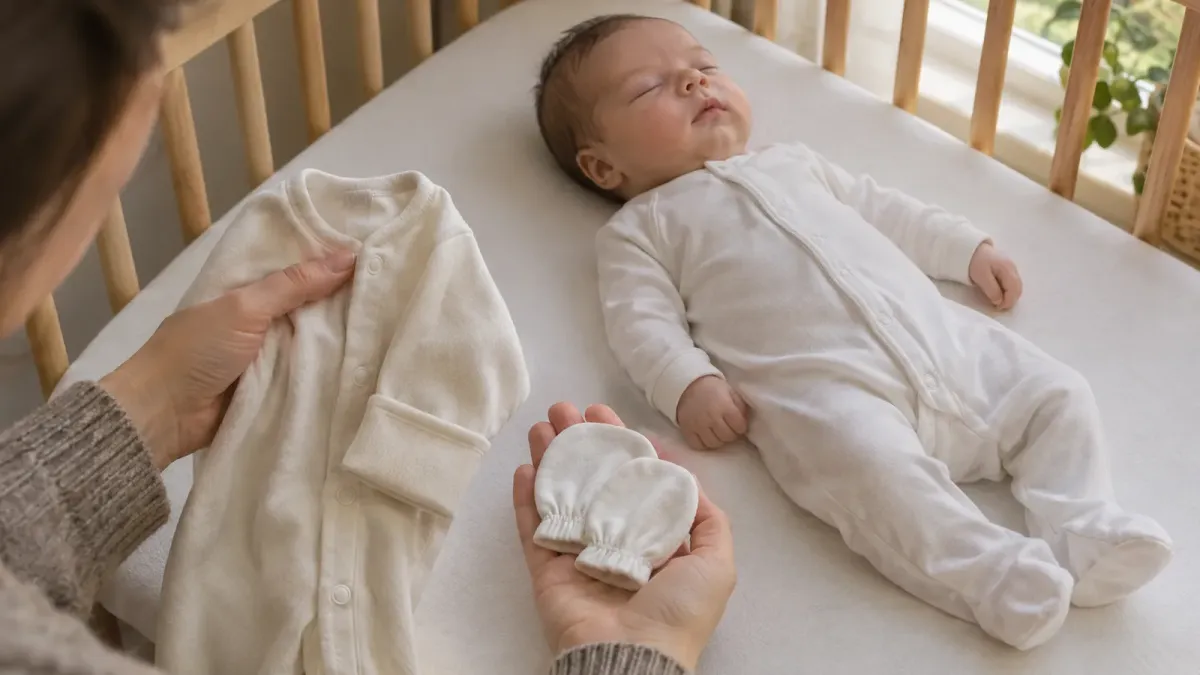
Fold-over scratch mittens are built right into the sleeves of a newborn bodysuit, sleepsuit, or growsuit. The end of the sleeve has an extra flap of soft fabric.
When you want to cover your baby's hands, you simply fold the flap over their fingers like a little pocket. When you want their hands free, you fold the flap back up.
Why parents like fold-over cuffs
- They stay on: because the cuff is part of the sleeve, your baby cannot kick or pull it off.
- No lost mittens: you never have to hunt for a matching mitten in the laundry or at the bottom of the pram.
- No wrist elastic: there is no tight band pressing on your baby's wrist.
- Quick to switch: you can uncover your baby's hands in two seconds for feeding, tummy time, or skin-to-skin cuddles.
What to watch out for with fold-over cuffs
Fold-over cuffs are not perfect. If the bodysuit is too big, the sleeve can still slip down over the wrist, or the fabric can bunch up. If the cuff is too tight when folded over, it can curl your baby's fingers into a tight fist.
Also, most brands only put fold-over cuffs on smaller sizes, like newborn and 0 to 3 months. Once your baby grows into larger sleepsuits, you may not find them as often.
What are standalone scratch mittens?
Standalone scratch mittens are separate little cloth pouches that slip over your baby's hands. They usually stay on with a soft rib-knit cuff or a thin elastic band around the wrist.
They are sold in packs of two or three pairs, often in cotton or bamboo fabric. Many hospital bag checklists still list them, even though fold-over suits have largely replaced them.
The problems with standalone mittens
- They fall off easily: newborns wriggle and suck on their hands. A wet mitten slides right off.
- Cot safety risk: a loose mitten in a cot or bassinet is a loose item. Safe sleep rules say the cot must be completely clear.
- Tight wrist bands: some mittens have elastic that leaves red marks on a baby's wrist or feels too snug.
- Easy to lose: they are tiny and vanish in the washing machine or nappy bag.
Side-by-side comparison: fold-over cuffs vs. standalone mittens
Here is how the two options compare for safety, daily use, and comfort.
| Feature | Fold-over cuffs on bodysuits | Standalone scratch mittens |
|---|---|---|
| Stays on | Yes. Sewn onto the sleeve. | Often slips off when baby sucks or wriggles. |
| Safe for sleep | Safer, as nothing can come loose in the cot. | Risky if it falls off and sits near baby's face. |
| Wrist comfort | No extra band or elastic at the wrist. | Can have elastic that feels tight or leaves marks. |
| Easy to open | Flips back in one second for feeds and play. | Must be pulled off and put somewhere safe. |
| Laundry and loss | Never gets lost. Washes with the suit. | Very easy to lose one of the pair. |
| Size range | Mostly newborn to 3 months. | Sold in newborn and 3 to 6 months sizes. |
| Thread risk | Check inside seams before each wear. | Check inside seams and elastic before each wear. |
The hidden danger: loose threads and hair tourniquets
Whether you use fold-over cuffs or standalone mittens, there is one safety check you must do every single time. Turn the mitten or cuff inside out and look at the seams.
Inside a mitten, there can be loose threads from the sewing machine. A baby's fingers are tiny. If a loose thread wraps around a finger, it can tighten as the baby moves. Doctors call this a hair tourniquet (it can happen with a parent's long hair too, not just sewing threads).
A tight thread or hair can cut off blood flow to the finger. The finger can swell, turn red or purple, and hurt a lot.
How to prevent hair and thread tourniquets
- Turn every mitten and fold-over cuff inside out before putting it on.
- Cut off any loose threads with small scissors.
- Check your baby's fingers and toes when you change their nappy or dress them.
- Wash baby clothes separately or in a mesh bag if someone in the house has long hair.
- If a finger looks swollen or red, check closely for a thin hair or thread wrapped around it.
Safe sleep rules and scratch mittens
Safe sleep guidelines in Australia, the UK, the US and Canada all agree on one big rule: keep the sleep space clear. A baby should sleep on their back, on a firm, flat mattress, with no loose items in the cot or bassinet.
A standalone mitten that falls off in the night becomes a loose item. If it ends up over your baby's nose or mouth, it could block their breathing. That is why Red Nose in Australia, The Lullaby Trust in the UK, the American Academy of Pediatrics in the US, and Health Canada all warn against loose bedding and loose items in the cot.
Fold-over cuffs do not have this problem because they stay attached to the sleepsuit. Still, check that the sleepsuit fits well. The neckline must be snug enough that it cannot ride up over your baby's chin or face.
What about overheating?
Babies lose heat through their head and hands. Covering their hands adds a small layer of warmth, though much less than a hat or beanie. Never put a hat or beanie on your baby for sleep indoors.
If the room is warm, skip the mittens and dress your baby in a light cotton singlet or short-sleeve bodysuit. Feel your baby's tummy or the back of their neck to check if they are too hot. Their hands and feet often feel cool, and that is normal.
Safety standards and official guidance across four countries
There is no single global standard just for baby scratch mittens. Instead, mittens and bodysuits fall under general baby clothing safety rules in each country. Here is what official bodies say in Australia, the UK, the US and Canada.
| Topic | Australia | UK | US | Canada |
|---|---|---|---|---|
| Safe sleep | Red Nose & Pregnancy, Birth and Baby: clear cot, no loose items, baby on back. | NHS & The Lullaby Trust: clear cot, no loose items, baby on back. | AAP & CPSC: bare crib, no loose items, baby on back. | Health Canada & Canadian Paediatric Society: clear crib, no loose items, baby on back. |
| Clothing safety | ACCC / Product Safety Australia: check for choking hazards, loose buttons, and drawstrings. | OPSS / GOV.UK: buy from trusted sellers, check for small parts and loose threads. | CPSC: strict rules on small parts, lead, and phthalates in children's wear. | Health Canada: rules on drawstrings, small parts, and safe sleepwear. |
| Nail care | Pregnancy, Birth and Baby: trim or file gently when baby is calm or asleep. | NHS: use baby nail clippers, emery board, or round-ended scissors. | AAP (HealthyChildren.org): use a soft emery board or baby clippers. | Caring for Kids: keep nails short and smooth. |
Across all four countries, the message is the same. Keep loose items out of the cot. Avoid clothes with buttons, bows, or beads that could come off and be swallowed. Choose simple, soft cotton or bamboo fabrics.
Why bare hands are good for your baby
It is tempting to keep your baby's hands covered all the time so they look neat and scratch-free. But bare hands do important work for a newborn.
- Self-soothing: many babies suck on their fingers or fists to calm down. Covered hands make this harder, and a wet mitten can chafe their skin.
- Brain and touch growth: your baby learns about the world by touching your skin, their clothes, and their own face.
- Feeding cues: one of the first signs a baby is hungry is bringing their hands to their mouth. Mittens can hide this cue or make it frustrating.
- Temperature control: bare hands help your baby cool down if they get a little warm.
If you use fold-over cuffs, try using them only for sleep in the first week or two. Flip them open during awake time, feeds, and tummy time.
Age stages: when to use mittens and when to stop
Every baby grows at their own pace, but most follow a simple timeline for hand covering and nail care.
Birth to 2 weeks
Newborn nails are very soft and bendy. Sometimes they are attached closely to the skin at the fingertip, which makes them hard to clip. A gentle emery board or baby nail file is safest in these first days.
If your baby has a sharp nail edge and is scratching their face, fold-over cuffs on a sleepsuit can help during sleep. Keep hands bare during awake cuddles and feeds.
2 weeks to 6 weeks
By two or three weeks, the nails harden a little and grow faster. You can start trimming them with round-ended baby scissors or baby nail clippers, or keep using a soft file.
Most babies do not need mittens at all once you are keeping their nails short. If your baby has eczema or dry skin and scratches a lot, talk to your doctor or child health nurse about safe ways to soothe the skin.
6 weeks to 3 months
At this age, babies start to discover their hands. They stare at them, open and close their fingers, and bring them to their mouth on purpose. Leave their hands bare all day and night so they can practise these skills.
3 months and older
Once your baby starts showing signs of rolling, they need their arms and hands completely free. They use their hands to push up and move their head if they roll. Stop using mittens by this stage, if not much earlier.
How to care for newborn nails safely
Good nail care is the best way to prevent corneal scratches and face marks. You do not need fancy tools, just good light and a calm moment.
- Pick the right time: trim or file your baby's nails when they are asleep, very sleepy, or just after a warm bath when the nails are soft.
- Get good light: sit near a window or a bright lamp so you can see clearly.
- Use baby tools: choose a fine emery board, round-ended baby nail scissors, or baby nail clippers with a small curved edge.
- Press the fingertip pad down: gently push the soft skin of the fingertip away from the nail so you do not nick it.
- Cut straight across: follow the natural curve of the finger, but do not cut too low at the corners.
- Smooth sharp edges: run a soft emery board lightly over the nail to take away any sharp corners.
If you accidentally nick the skin, do not panic. Press a clean, damp cloth gently on the spot until the bleeding stops. Do not put a sticky plaster (band-aid) on a baby's finger, as it can come off and become a choking hazard.
How to choose the best bodysuits with fold-over cuffs
If you want to buy a few bodysuits or sleepsuits with built-in mittens, look for these simple features:
- Breathable fabric: 100% cotton or soft bamboo viscose lets air flow and keeps your baby from getting sweaty.
- Roomy hand pocket: the fold-over flap should be wide enough that your baby can open and close their fingers inside.
- Clean inside seams: check that the stitching inside the cuff is flat and has no long loose threads.
- Easy nappy access: a two-way zip or snap buttons at the bottom make 2:00 AM nappy changes much faster.
- No loose decorations: skip suits with glued-on gems, bows, or tiny buttons that could fall off.
Common mistakes parents make with scratch mittens
- Using mittens 24/7: keeping hands covered all day slows down touch learning and hides hunger cues.
- Putting standalone mittens on for sleep: if a mitten falls off, it becomes a loose object in the cot.
- Forgetting to check inside: loose threads or stray hairs inside a mitten can wrap around a finger.
- Using mittens that are too small: a tight mitten squishes the fingers together and can rub the skin.
- Waiting too long to file nails: newborn nails grow every few days. A quick file twice a week prevents most scratches.
Frequently asked questions
Are scratch mittens safe for newborns to sleep in?
Fold-over cuffs sewn onto a sleepsuit are safe for sleep, as long as the suit fits well and has no loose threads inside. Standalone mittens are best avoided for sleep because they can slip off and leave a loose piece of fabric in the cot or bassinet.
When should I stop using scratch mittens?
Most babies only need them for the first one to two weeks, if at all. Once you are trimming or filing their nails regularly, you can stop. Always stop before your baby starts trying to roll, or by around 2 to 3 months, so their hands are free.
Can a newborn really scratch their eye?
Yes, it can happen. Newborns have jerky arm movements and sharp little nail corners. Keeping nails short and smooth with a soft file is the best way to protect their eyes. If an eye looks red, watery, or your baby will not open it, see a doctor.
Why do my baby's hands feel cold without mittens?
It is normal for a newborn's hands and feet to feel cool. Their blood flow is still settling down. You do not need mittens to keep their hands warm indoors. Check your baby's tummy or the back of their neck to see if they are warm enough.
What if my baby has eczema and keeps scratching?
If your baby has eczema and scratches their skin raw, talk to your doctor or child health nurse. They can help you treat the itch. For sleep, a bodysuit with fold-over cuffs is safer than standalone mittens, and you should still check inside the cuffs for loose threads.
Should I pack scratch mittens in my hospital bag?
You do not need standalone mittens. Instead, pack three or four newborn bodysuits or sleepsuits that have built-in fold-over cuffs, plus a soft baby nail file.
Sources
- Pregnancy, Birth and Baby – Preparing your home for when your baby arrives
- Red Nose Australia – What is a safe sleeping environment
- NHS – Washing and bathing your baby
- The Lullaby Trust – How to dress your baby for sleep
- HealthyChildren.org (American Academy of Pediatrics) – Bathing your newborn
- Caring for Kids (Canadian Paediatric Society) – Safe sleep for babies
- UK Government – Buy safe, be safe
Related guides
More Clothing & Accessories →
Newborn Baby Mittens: When They Help and How to Use Them Safely

Mesh Laundry Bags for Baby Socks, Mittens and Nursing Pads
Babywearing in Hot and Cold Weather: Mesh Carriers, Babywearing Coats and Keeping Your Baby Safe